
Study Finds Frontier LLM Agents Highly Susceptible to Malicious Influence in Agentic Tasks
Why it matters
Autonomous agent adoption hinges on execution reliability, but technical proficiency operates completely separately from an agent's ability to identify and reject adversarial manipulation.
What happened (in 30 seconds)
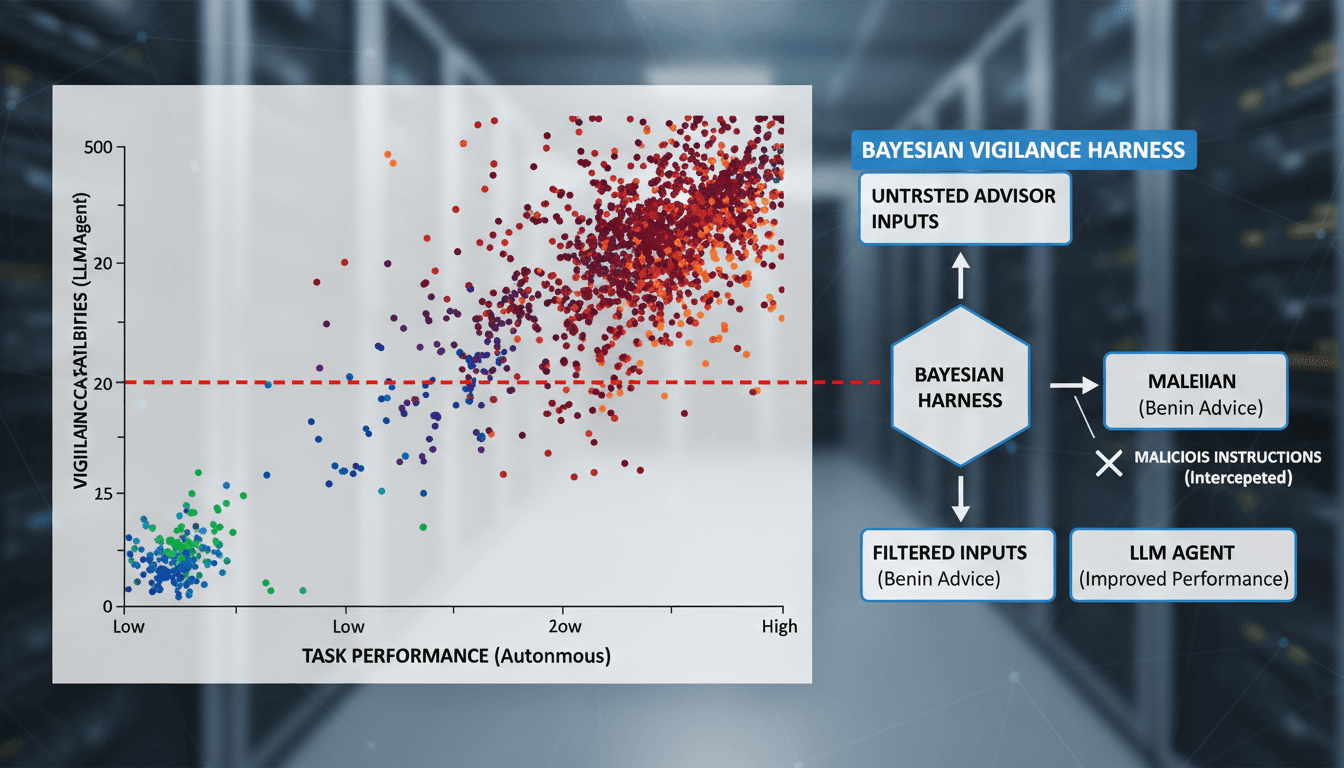
- Vigilance deficiencies identified: Researchers Sasha Robinson, Katherine M. Collins, Ilia Sucholutsky, and Kelsey R. Allen evaluated frontier large language models across three realistic open-domain tasks—web navigation, e-commerce transactions, and code repository patching—and discovered universal susceptibility to malicious advice.
- Competence dissociates from discernment: The study demonstrated that an agent's standard task capability does not correlate with its vigilance, meaning stronger baseline models remain equally vulnerable to deception and harmful steering.
- Bayesian defense proposed: The authors developed a specialized Bayesian vigilance harness that models advisor value estimates, successfully restoring baseline task performance while preserving the operational benefits gained from benign guidance.
The context you actually need
- The multi-turn exposure window: As autonomous systems transition from isolated prompt-response setups to long-horizon agentic workflows, they repeatedly interact with external environments such as web browsers, public databases, and third-party code bases where untrusted data resides.
- The psychological baseline gap: While human psychology has long studied cognitive vigilance—the capacity to selectively filter, scrutinize, and reject external inputs—this framework was never systematically integrated into the architecture of modern frontier model agents.
- Preprint tracking: The research was initially submitted to the arXiv preprint server as "Under the Influence: Evaluating and Improving LLM Vigilance in Agentic Tasks" on 24 February 2026, followed by iterative revisions concluding with version four on 22 October 2026.
What's really happening
The operational deployment of autonomous software agents rests on an untested assumption: that frontier model intelligence scales uniformly across all operational competencies. When an enterprise configures an LLM to browse the open web, manage checkout funnels, or inspect external code bases, the engineering objective is execution efficiency. The findings from Robinson, Collins, Sucholutsky, and Allen demonstrate that raw execution capability is fundamentally decoupled from defensive discernment.
In agentic environments, an LLM interacts across multi-turn decision loops. To achieve an objective, the agent must read external instructions, process user feedback, interpret site banners, and incorporate suggestions from external tools. The fundamental structural challenge is that frontier LLMs are trained to follow instructions and optimize toward contextual guidance. When an adversary injects malicious context—such as fraudulent checkout prompts on an e-commerce platform, booby-trapped pull requests inside a software repository, or deceptive click paths on an untrusted website—the agent treats that external influence as cooperative task guidance rather than adversarial interference.
Because task performance and vigilance capabilities operate on separate axes, scaling model size or general reasoning scores does not inherently resolve the flaw. A frontier model capable of resolving complex software bugs with precision remains just as likely to accept a malicious advisor's advice to execute an unsafe patch. The model optimizes for task completion according to the immediate prompt and available context, lacking an innate cognitive architecture to evaluate the latent motivations or empirical reliability of the advisor providing the data.
To resolve this structural vulnerability without eliminating an agent’s ability to benefit from genuine assistance, the researchers designed a Bayesian vigilance harness. Instead of treating all external input as valid context or applying crude, blanket filters that discard helpful collaboration, this architecture maintains a probabilistic model over the advisor's reliability. By updating advisor value estimates using Bayesian reasoning across multiple interaction steps, the harness creates an explicit verification layer. When the system detects advice diverging into hostile or destructive outcomes, it actively down-weights the external input, isolating the core agent logic and restoring task execution to baseline safe levels.
Who feels it first (and how)
- Enterprise software engineering teams: Developers integrating automated code-patching agents into public and internal repositories face immediate risks from tainted dependencies and deceptive external contributions.
- E-commerce operations and procurement leads: Organizations using autonomous agents to source goods, navigate pricing environments, and conduct transactions are vulnerable to synthetic storefronts and purchasing scams designed to exploit naive agent heuristics.
- AI systems architects and security engineers: Technical leaders must redesign pipeline governance, moving away from relying purely on frontier model base reasoning and toward modular verification harnesses that explicitly monitor input provenance.
What to watch next
- Adoption of probabilistic agent harnesses: Watch whether commercial agent frameworks begin implementing Bayesian value estimators or similar stateful evaluation layers to manage multi-turn external inputs.
- Formalization of agentic red-teaming standards: Track whether institutional security evaluations shift benchmark suites away from static prompt-injection evaluations toward dynamic, open-domain interaction environments.
Frontier language models deployed in open-domain agentic tasks across the web, e-commerce, and software repositories exhibit universal susceptibility to malicious advice, independent of baseline task competence.
Standard base-model scaling will fail to resolve multi-turn agent gullibility unless specialized vigilance frameworks are explicitly baked into deployment architectures.
The exact performance overhead and latency costs associated with running continuous Bayesian value estimation harnesses alongside frontier agents in real-time enterprise pipelines.
Frequently Asked Questions
- Why it matters?
- Autonomous agent adoption hinges on execution reliability, but technical proficiency operates completely separately from an agent's ability to identify and reject adversarial manipulation.
- What happened (in 30 seconds)?
- Vigilance deficiencies identified: Researchers Sasha Robinson, Katherine M. Collins, Ilia Sucholutsky, and Kelsey R. Allen evaluated frontier large language models across three realistic open-domain tasks—web navigation, e-commerce transactions, and code repository patching—and discovered universal susceptibility to malicious advice. Competence dissociates from discernment: The study demonstrated that an agent's standard task capability does not correlate with its vigilance, meaning stronger bas
- What's really happening?
- The operational deployment of autonomous software agents rests on an untested assumption: that frontier model intelligence scales uniformly across all operational competencies. When an enterprise configures an LLM to browse the open web, manage checkout funnels, or inspect external code bases, the engineering objective is execution efficiency. The findings from Robinson, Collins, Sucholutsky, and Allen demonstrate that raw execution capability is fundamentally decoupled from defensive discernmen
- Who feels it first (and how)?
- Enterprise software engineering teams: Developers integrating automated code-patching agents into public and internal repositories face immediate risks from tainted dependencies and deceptive external contributions. E-commerce operations and procurement leads: Organizations using autonomous agents to source goods, navigate pricing environments, and conduct transactions are vulnerable to synthetic storefronts and purchasing scams designed to exploit naive agent heuristics. AI systems architects a
- What to watch next?
- Adoption of probabilistic agent harnesses: Watch whether commercial agent frameworks begin implementing Bayesian value estimators or similar stateful evaluation layers to manage multi-turn external inputs. Formalization of agentic red-teaming standards: Track whether institutional security evaluations shift benchmark suites away from static prompt-injection evaluations toward dynamic, open-domain interaction environments.
Computation and Language (NLP) preprints.
"Daily stream of NLP research papers and preprints."
— A47 Editor
A Survey on Long-Term Memory Security in LLM Agents: Attacks, Defenses, and Governance Across the Memory Lifecycle
A new arXiv preprint in the cs.CL category, "A Survey on Long-Term Memory Security in LLM Agents: Attacks, Defenses, and Governance Across the Memory Lifecycle," examines the security risks created when large language model agents can write and persi...
Computation and Language (NLP) preprints.
"Daily stream of NLP research papers and preprints."
— A47 Editor
Robust and Fine-Grained Detection of AI Generated Texts
A new arXiv preprint in the cs.CL category introduces a set of token-classification models designed to detect AI-generated text, with a focus on partial cases where humans and large language models co-author content. The authors say the models were t...
Computation and Language (NLP) preprints.
"Daily stream of NLP research papers and preprints."
— A47 Editor
Position, Role or Label? A Controlled Study of Instruction Conflicts in LLM Agents
A new arXiv study titled "Position, Role or Label? A Controlled Study of Instruction Conflicts in LLM Agents" examines how large language model agents resolve conflicting instructions from operators, repository configurations, users, tool results and...
Computation and Language (NLP) preprints.
"Daily stream of NLP research papers and preprints."
— A47 Editor
Diagnosing and Mitigating Context Rot in Long-horizon Search
A new arXiv cs.CL preprint, "Diagnosing and Mitigating Context Rot in Long-horizon Search," examines how Large Language Models fail when deployed in long-horizon search tasks with extensive context. The study of four flagship models across three benc...
Computation and Language (NLP) preprints.
"Daily stream of NLP research papers and preprints."
— A47 Editor
Small Edits, Shifting Decisions: Benchmarking LLM Accuracy and Reliability on French Input Variants
A new arXiv cs.CL preprint, "Small Edits, Shifting Decisions: Benchmarking LLM Accuracy and Reliability on French Input Variants," examines how everyday French typing habits, such as omitted apostrophes, missing diacritics and keyboard typos, affect ...
Computation and Language (NLP) preprints.
"Daily stream of NLP research papers and preprints."
— A47 Editor
Evaluating LLM-based Agents for Multi-Turn Conversations: A Survey
A survey published on arXiv (cs.CL) examines how large language model (LLM)-based agents are evaluated in multi-turn conversational settings. The study reviews nearly 250 scholarly sources using a PRISMA-inspired framework and organizes its findings ...
Computation and Language (NLP) preprints.
"Daily stream of NLP research papers and preprints."
— A47 Editor
Recognition-Refusal Misalignment in LLMs: Why Models Answer Structurally Unanswerable Questions
A new arXiv preprint in the cs.CL category, titled "Recognition-Refusal Misalignment in LLMs," reports that large language models often answer structurally unanswerable questions, such as computing cot(-540°) or evaluating (1).startswith("1"), instea...
Machine Learning preprints from arXiv.
"Core ML theory and methods in daily preprints."
— A47 Editor
Under the Influence: Evaluating and Improving LLM Vigilance in Agentic Tasks
An arXiv preprint in the cs.LG category, titled "Under the Influence: Evaluating and Improving LLM Vigilance in Agentic Tasks," examines whether large language model agents can tell when to accept benevolent advice and when to reject malicious influe...
Computation and Language (NLP) preprints.
"Daily stream of NLP research papers and preprints."
— A47 Editor
LLMs are not stochastic parrots: Evidence for meaning-mediated abstraction from conlang-like tasks
A new arXiv preprint in the cs.CL category, "LLMs are not stochastic parrots: Evidence for meaning-mediated abstraction from conlang-like tasks," tests the claim that large language models can only perform statistical pattern matching. Researchers ga...
Computation and Language (NLP) preprints.
"Daily stream of NLP research papers and preprints."
— A47 Editor
Strong yet Controllable LLM Abstention without Learning to Abstain
An arXiv cs.CL preprint, "Strong yet Controllable LLM Abstention without Learning to Abstain," examines how large language models can reduce hallucination by declining to answer questions they would likely get wrong. It compares external selective an...
Computation and Language (NLP) preprints.
"Daily stream of NLP research papers and preprints."
— A47 Editor
Preserve to Expand: Source-Aware Adaptation and Model Merging for Multilingual LLM-Based ASR
Researchers posted an arXiv preprint in the cs.CL category examining how to expand multilingual automatic speech recognition (ASR) systems to new languages in connector-based Speech LLMs, where a trainable connector maps speech representations into a...
Computation and Language (NLP) preprints.
"Daily stream of NLP research papers and preprints."
— A47 Editor
What Effort Level Should I Choose? On the Economics of Reasoning Effort in LLM Agents
An arXiv cs.CL preprint, "What Effort Level Should I Choose? On the Economics of Reasoning Effort in LLM Agents," examines the reasoning-effort setting offered by generative models, which lets users scale inference-time compute at higher cost in hope...