
Study Finds Inconsistent Functional Auto-Consistency in LLM Self-Explanations Across Model Families
Why it matters
Automated self-explanations frequently decouple from underlying model behavior under targeted interventions, creating operational blind spots across automated sentiment and review pipelines.
What happened (in 30 seconds)
- A new research framework tested behavioral alignment. Researchers Alisson Rosa Pereira and Bruno Iochins Grisci evaluated whether token-highlighting explanations provided by models match their internal decision mechanics across IMDB and Steam datasets.
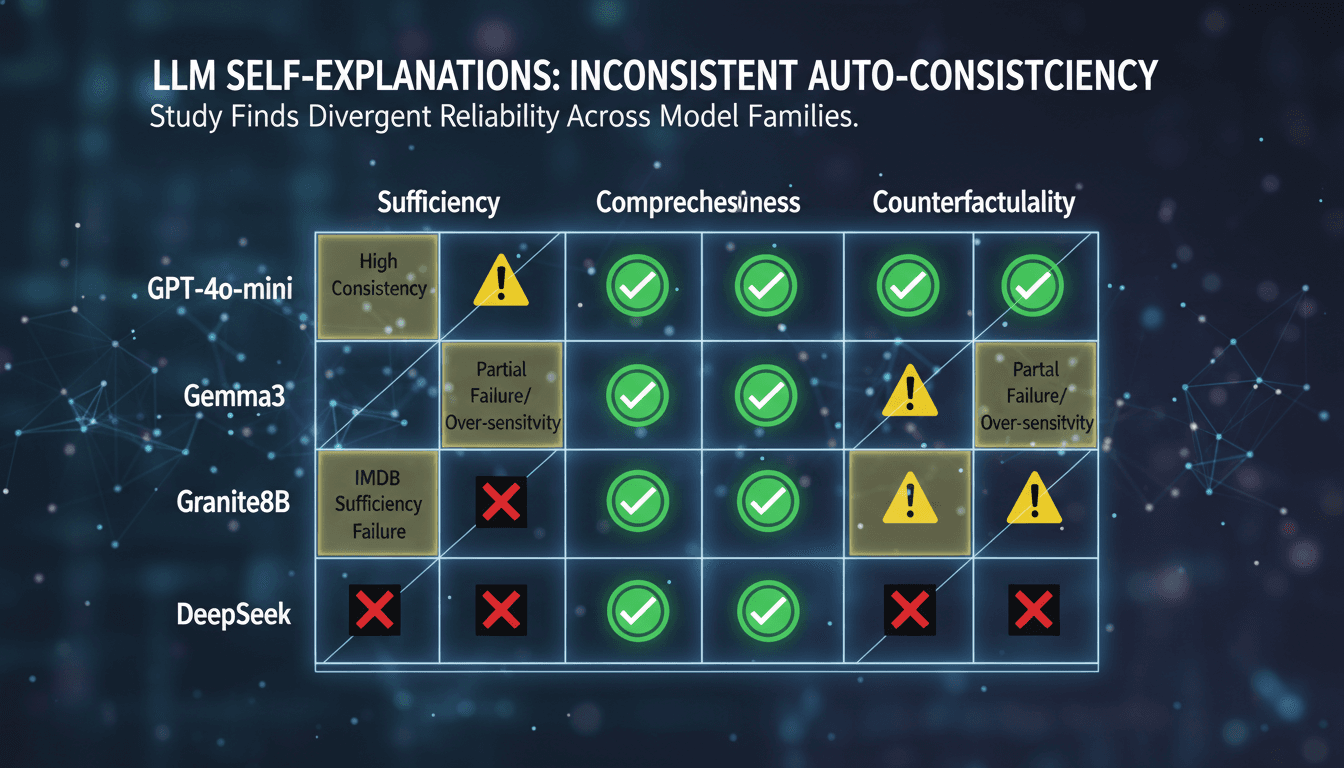
- Model families demonstrated stark variations in stability. Closed-source GPT-4o-mini aligned with expected consistency patterns, while open-source alternatives like Gemma3, Granite8B, and DeepSeek variants showed structural contradictions or over-sensitivity under intervention.
- Academic publication validated the findings. The 6-page study, featuring 2 figures and 1 table, was submitted to arXiv on October 23, 2026, and accepted into the IJCNN 2026 conference proceedings.
The context you actually need
- Plausibility has historically masked functional inconsistency. Traditional evaluation protocols often focused on whether an AI's self-generated justification sounded logical to human readers, ignoring whether modifying those highlighted tokens actually altered the model's prediction.
- Three core metrics determine real explanation fidelity. The study operationalizes auto-consistency through sufficiency (retaining only highlighted tokens), comprehensiveness (removing highlighted tokens), and counterfactuality (inverting token semantics).
- Architecture scale and family dictate behavior. Open models such as Gemma3 and Granite8B held baseline sufficiency coherence but broke down under stricter perturbations, while DeepSeek variants failed baseline sufficiency or overreacted to semantic inversion.
What's really happening
The deployment of Large Language Models in classification pipelines rests on an unverified operational assumption: when a model highlights specific tokens to justify its classification, those tokens represent the actual drivers of the output. The paper submitted by Pereira and Grisci demonstrates that for multiple contemporary model architectures, this premise does not hold.
The experimental setup tests consistency through direct behavioral interventions. When an enterprise configures an LLM to classify customer sentiment or analyze product reviews on datasets like IMDB or Steam, the system produces both a category decision and a self-explanation highlighting influential words. The researchers isolated these highlighted tokens to measure sufficiency, stripped them to test comprehensiveness, and inverted their meaning to track counterfactual sensitivity. If a model genuinely relied on the highlighted tokens, retaining only those tokens should preserve the classification, while removing or reversing them should systematically degrade or shift the output.
The empirical results diverge sharply along architectural lines. GPT-4o-mini behaved according to functional expectations across all three test conditions. When presented with only its highlighted justifications, it maintained its conclusions; when those justifications were inverted, its behavior adjusted proportionately.
By contrast, open-weight deployments exhibited structural failures. Gemma3 and Granite8B preserved baseline coherence when restricted strictly to highlighted tokens, but their stability degraded once exposed to counterfactual and comprehensiveness interventions. DeepSeek model variants displayed more pronounced divergence: certain runs failed basic sufficiency tests entirely—meaning the model could not reproduce its own verdict when limited to the exact tokens it claimed were decisive—while other runs displayed erratic over-sensitivity under counterfactual adjustments.
The incentive structure behind model deployment creates a systemic friction point. Engineering teams deploy token-highlighting features because human operators require interpretability before automating classification decisions. However, because generating an explanation is an act of token generation rather than an introspection of the model's internal weights, the resulting output often mimics human rationalization rather than recording mechanistic causality. For enterprise systems relying on open-weight alternatives to manage classification costs, relying on self-explanations introduces unquantified functional risk into production pipelines.
Who feels it first (and how)
- Machine learning engineers configuring open-weight pipelines: Teams deploying Granite8B or DeepSeek variants face unpredictable shifts if automated fallbacks depend on token-level explainability checks.
- Product operations leads relying on sentiment scoring: Platforms using automated Steam or customer review classification risk processing outputs where the documented explanation does not correspond to the actual classification trigger.
- Enterprise compliance auditors: Risk teams verifying automated classification accuracy cannot accept self-generated token attribution as formal proof of algorithmic fairness or operational safety.
What to watch next
- Independent replication across non-review benchmarks: Watch whether the functional consistency gap between GPT-4o-mini and open architectures persists across structured tabular, legal, or financial text datasets.
- Adoption of intervention-based evaluation metrics: Track whether production observability platforms replace static token attribution with sufficiency and counterfactuality stress tests.
- Fine-tuning frameworks targeting auto-consistency: Look for developer updates to Granite8B, Gemma3, and DeepSeek that explicitly optimize explanation faithfulness rather than superficial text coherence.
Pereira and Grisci documented that model self-explanations vary by model family, with GPT-4o-mini demonstrating expected consistency while Gemma3, Granite8B, and DeepSeek exhibit distinct intervention failures across 6 pages of IJCNN 2026 research.
Organizations deploying smaller or open-weight models for autonomous text classification will need secondary verification layers rather than relying on native token attribution.
The degree to which these functional inconsistencies degrade broader automated workflows outside sentiment and review classification domains remains unmeasured.
Frequently Asked Questions
- Why it matters?
- Automated self-explanations frequently decouple from underlying model behavior under targeted interventions, creating operational blind spots across automated sentiment and review pipelines.
- What happened (in 30 seconds)?
- A new research framework tested behavioral alignment. Researchers Alisson Rosa Pereira and Bruno Iochins Grisci evaluated whether token-highlighting explanations provided by models match their internal decision mechanics across IMDB and Steam datasets. Model families demonstrated stark variations in stability. Closed-source GPT-4o-mini aligned with expected consistency patterns, while open-source alternatives like Gemma3, Granite8B, and DeepSeek variants showed structural contradictions or over-
- What's really happening?
- The deployment of Large Language Models in classification pipelines rests on an unverified operational assumption: when a model highlights specific tokens to justify its classification, those tokens represent the actual drivers of the output. The paper submitted by Pereira and Grisci demonstrates that for multiple contemporary model architectures, this premise does not hold. The experimental setup tests consistency through direct behavioral interventions. When an enterprise configures an LLM to
- Who feels it first (and how)?
- Machine learning engineers configuring open-weight pipelines: Teams deploying Granite8B or DeepSeek variants face unpredictable shifts if automated fallbacks depend on token-level explainability checks. Product operations leads relying on sentiment scoring: Platforms using automated Steam or customer review classification risk processing outputs where the documented explanation does not correspond to the actual classification trigger. Enterprise compliance auditors: Risk teams verifying automate
- What to watch next?
- Independent replication across non-review benchmarks: Watch whether the functional consistency gap between GPT-4o-mini and open architectures persists across structured tabular, legal, or financial text datasets. Adoption of intervention-based evaluation metrics: Track whether production observability platforms replace static token attribution with sufficiency and counterfactuality stress tests. Fine-tuning frameworks targeting auto-consistency: Look for developer updates to Granite8B, Gemma3, a
Computation and Language (NLP) preprints.
"Daily stream of NLP research papers and preprints."
— A47 Editor
Can LLMs Trust Appropriately? Evaluating Calibrated Reliance on Imperfect Partners
A new arXiv preprint in the cs.CL category, "Can LLMs Trust Appropriately? Evaluating Calibrated Reliance on Imperfect Partners," examines whether large language models adjust their reliance on partner agents rationally as evidence accumulates. The s...
Computation and Language (NLP) preprints.
"Daily stream of NLP research papers and preprints."
— A47 Editor
Style over Substance? Linguistic Bias in LLM-based Peer Review Copy title
A new arXiv cs.CL preprint, "Style over Substance? Linguistic Bias in LLM-based Peer Review," describes a controlled experiment in which research papers were rewritten to exhibit linguistic features associated with native or non-native English writin...
Computation and Language (NLP) preprints.
"Daily stream of NLP research papers and preprints."
— A47 Editor
Semantic Needles in Document Haystacks: Sensitivity Testing of LLM-as-a-Judge Similarity Scoring
A new arXiv cs.CL preprint, "Semantic Needles in Document Haystacks: Sensitivity Testing of LLM-as-a-Judge Similarity Scoring," proposes a multifactorial framework to test how large language models respond to subtle semantic changes when comparing do...
Machine Learning preprints from arXiv.
"Core ML theory and methods in daily preprints."
— A47 Editor
Do Language Models Trust Their Own Justifications? A Study on Functional Consistency
A new arXiv preprint in the cs.LG category, titled "Do Language Models Trust Their Own Justifications? A Study on Functional Consistency," examines whether the tokens that large language models highlight as decisive in text classification actually dr...
Computation and Language (NLP) preprints.
"Daily stream of NLP research papers and preprints."
— A47 Editor
Old Ideas, Novel Problems: The Instability of LLM-Based Novelty Evaluation
A preprint posted to arXiv's cs.CL category, titled "Old Ideas, Novel Problems: The Instability of LLM-Based Novelty Evaluation," reports that large language models used to judge the novelty of AI-generated research ideas perform poorly. The study bu...
Computation and Language (NLP) preprints.
"Daily stream of NLP research papers and preprints."
— A47 Editor
Detecting Differences Is Not Understanding Structure: Large Language Models Fail at Graph Isomorphism
A new arXiv cs.CL preprint, "Detecting Differences Is Not Understanding Structure: Large Language Models Fail at Graph Isomorphism," reports that large language models achieve near-perfect accuracy at detecting whether two graphs are isomorphic, but ...
Computation and Language (NLP) preprints.
"Daily stream of NLP research papers and preprints."
— A47 Editor
Beyond Belief: Evaluating and Mitigating LLM Susceptibility to Misinformation
An arXiv cs.CL preprint titled "Beyond Belief: Evaluating and Mitigating LLM Susceptibility to Misinformation" examines whether tool-using large language models that rate information as untrustworthy actually refrain from acting on it. Testing five L...
Computation and Language (NLP) preprints.
"Daily stream of NLP research papers and preprints."
— A47 Editor
The Straight and Narrow: Do LLMs Possess an Internal Moral Path?
A new arXiv preprint in the cs.CL category, "The Straight and Narrow: Do LLMs Possess an Internal Moral Path?", examines whether large language models hold intrinsic moral representations rather than only surface-level safety guardrails. Using Moral ...
Computation and Language (NLP) preprints.
"Daily stream of NLP research papers and preprints."
— A47 Editor
Constrained Decoding: Harmful or Beneficial? Revisiting Its Impact on LLM Performance
An arXiv preprint in the cs.CL category, "Constrained Decoding: Harmful or Beneficial? Revisiting Its Impact on LLM Performance," challenges the common assumption that constrained decoding, which forces Large Language Models to output predefined form...
Computation and Language (NLP) preprints.
"Daily stream of NLP research papers and preprints."
— A47 Editor
Prompt PerturbAItions: Mechanisms of LLM Response Inconsistencies
A new arXiv preprint in the cs.CL category, "Prompt PerturbAItions: Mechanisms of LLM Response Inconsistencies," reports that lexical and tone-based changes to otherwise semantically equivalent prompts can degrade the factual reliability of large lan...