
UK CMA Opens Antitrust Probe into Meta Commercial Terms for Publisher and Advertiser Content Use
Why it matters
The investigation establishes whether dominant social distribution channels can legally compel commercial partners to surrender training inputs as an unnegotiated condition of audience access.
What happened (in 30 seconds)
- Regulators opened an investigation: On October 30, 2026, the UK Competition and Markets Authority launched a formal Chapter II probe under the Competition Act 1998 to evaluate whether Meta imposes unfair trading conditions on commercial users across Facebook and Instagram.
- The underlying dispute involves AI ingestion: News publishers and trade groups challenged Meta's contractual terms, which allow the company to collect and utilize business and publisher content to develop and power its products, including artificial intelligence features, without providing genuine opt-out choices.
- Implementation is paused for consultation: Meta paused its scheduled rollout on October 28, 2026, after initial target dates of October 30 and November 20, maintaining that its terms introduce no new data collection mechanisms and adhere to standard robots.txt protocols.
The context you actually need
- Publisher reliance creates bargaining asymmetry: Thousands of businesses and professional news organizations depend on Meta’s audience infrastructure to drive traffic, making complete platform abandonment economically non-viable.
- AI developers face high data acquisition hurdles: Frontier model developers require continuous, authoritative text streams to train and refine AI features, driving platforms to leverage existing commercial terms rather than negotiating bespoke licensing deals.
- Regulatory pressure mirrors search platform precedents: The probe follows formal pushback from the News Media Association and Movement for an Open Web, matching similar global scrutiny faced by Google regarding publisher opt-out controls for generative tools.
What's really happening
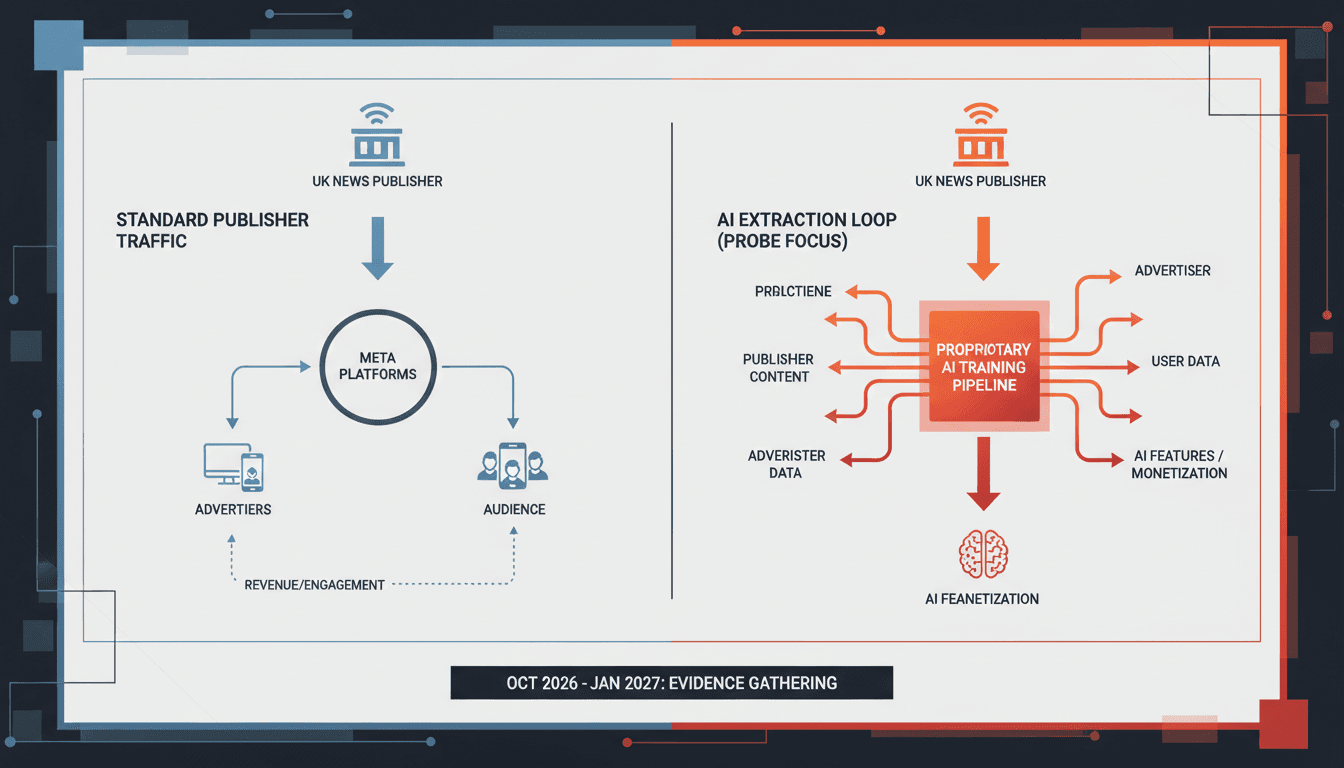
The conflict between platform operators and content producers centers on contractual leverage. Over two decades, commercial publishers, brands, and media organizations built audience strategies around Meta's surface properties. In return for organic reach and targeted ad delivery, businesses integrated Meta pixels, business integrations, and catalog tools.
Under the disputed commercial terms, Meta sought to formalize the collection and application of commercial and editorial content hosted on or funneled through its network to feed internal products, explicitly including artificial intelligence capabilities. For Meta, using platform interactions as a training base provides an efficient pipeline of human-generated language, product descriptions, and analytical reporting. Competing at the technological frontier requires continuous, low-friction access to fresh corpus data. Sourcing this data through unilateral terms-of-service updates removes the expense and friction of negotiated per-publisher licensing agreements.
Publishers face an asymmetrical economic calculation. The News Media Association and the Movement for an Open Web argue that publishers cannot simply refuse the terms. Exiting Facebook and Instagram would sever traffic and audience engagement channels that sustain digital subscriptions and programmatic ad models. Because commercial users cannot selectively decline AI data harvesting while maintaining operational distribution, publishers argue the terms operate as an unfair trading condition under Section 18 of the Competition Act 1998.
Meta counters that the updated terms do not expand its scraping rights beyond established industry practices and technical directives, including standard web-crawling protocols such as robots.txt. The company asserts that the updates merely consolidate and clarify existing platform rules.
By opening a formal probe, the Competition and Markets Authority tests whether market power allows a multi-sided intermediary to tie core distribution services to mandatory AI training inputs. If the watchdog determines that businesses lack meaningful choice, the case will challenge the unilateral terms framework that consumer-facing tech giants have used to secure AI training rights across global supply chains.
Who feels it first (and how)
- Digital publishers and media groups: Operating margins and proprietary value are tied directly to whether content can be ingested without explicit licensing fees.
- Brand marketing and growth leads: Enterprise advertisers monitoring brand safety and competitive intelligence face questions over whether catalog and campaign data feed platform-level AI models.
- Platform legal and compliance officers: Corporate counsels must assess standard business-to-business platform agreements against escalating European and UK antitrust standards.
- Frontier AI engineering teams: Product developers relying on platform-native web scraping face potential data pipeline constraints or mandatory technical opt-out carve-outs.
What to watch next
- The conclusion of the CMA evidence phase in January 2027: The closure of the initial information-gathering round will determine whether the regulator seeks interim enforcement orders or formal commitments from Meta.
- Meta's revised commercial terms redraft: The outcome of platform consultations will reveal whether Meta offers a technical decoupling between standard distribution services and AI model training ingestion.
- Parallel European and international regulatory probes: Antitrust interventions in the UK frequently serve as a blueprint for competition authorities reviewing algorithmic data rights across digital economies.
The CMA opened a Chapter II Competition Act 1998 investigation on October 30, 2026; Meta paused its terms rollout; maximum statutory penalties under the Act reach up to 10% of global turnover.
Meta will propose revised commercial wording or automated controls allowing publishers to toggle off AI data collection while keeping standard distribution and advertising tooling active.
Whether the CMA will formally define digital platforms' business terms as an abuse of dominance, creating a binding legal boundary between business distribution contracts and AI model training.
Frequently Asked Questions
- Why it matters?
- The investigation establishes whether dominant social distribution channels can legally compel commercial partners to surrender training inputs as an unnegotiated condition of audience access.
- What happened (in 30 seconds)?
- Regulators opened an investigation: On October 30, 2026, the UK Competition and Markets Authority launched a formal Chapter II probe under the Competition Act 1998 to evaluate whether Meta imposes unfair trading conditions on commercial users across Facebook and Instagram. The underlying dispute involves AI ingestion: News publishers and trade groups challenged Meta's contractual terms, which allow the company to collect and utilize business and publisher content to develop and power its product
- What's really happening?
- The conflict between platform operators and content producers centers on contractual leverage. Over two decades, commercial publishers, brands, and media organizations built audience strategies around Meta's surface properties. In return for organic reach and targeted ad delivery, businesses integrated Meta pixels, business integrations, and catalog tools. Under the disputed commercial terms, Meta sought to formalize the collection and application of commercial and editorial content hosted on o
- Who feels it first (and how)?
- Digital publishers and media groups: Operating margins and proprietary value are tied directly to whether content can be ingested without explicit licensing fees. Brand marketing and growth leads: Enterprise advertisers monitoring brand safety and competitive intelligence face questions over whether catalog and campaign data feed platform-level AI models. Platform legal and compliance officers: Corporate counsels must assess standard business-to-business platform agreements against escalating Eu
- What to watch next?
- The conclusion of the CMA evidence phase in January 2027: The closure of the initial information-gathering round will determine whether the regulator seeks interim enforcement orders or formal commitments from Meta. Meta's revised commercial terms redraft: The outcome of platform consultations will reveal whether Meta offers a technical decoupling between standard distribution services and AI model training ingestion. Parallel European and international regulatory probes: Antitrust interventions
U.S. business news, corporate developments, and economy.
"The Wall Street Journal is respected for deep financial and economic reporting with a center-right editorial perspective."
— A47 Editor
Meta Faces U.K. Antitrust Probe Over Publisher Content Terms
The U.K. Competition and Markets Authority has opened an antitrust probe into Meta over planned changes to its publisher content terms, which were meant to take effect on Friday and would have allowed the company to collect content from publishers to...
English-language digital publication covering business, politics, technology, and current affairs.
"The Arabian Post mixes original and syndicated-style coverage with a broad regional and global business-news orientation."
— A47 Editor
UK competition watchdog examines Meta publisher contract terms
Britain's Competition and Markets Authority has opened an investigation into Meta Platforms over proposed commercial terms that could let the company use publishers' website content for its own products, including AI services. The regulator will exam...
Technology business news, market impacts, and innovation trends.
"Bloomberg is a premier financial and tech news provider, respected for its in-depth reporting and analytical rigor."
— A47 Editor
Meta Investigated by UK Over Alleged Harm Caused in Commercial Small Print
Meta Platforms Inc. is under investigation in the UK over concerns that its commercial terms could impose "exploitative" conditions on publishers and advertisers, with the probe centred on alleged harm embedded in the company's small print.
Curated tech headlines including AI stories.
"Influential aggregator surfacing the day’s top tech/AI links."
— A47 Editor
The UK CMA opens a probe into whether Meta imposed exploitative terms on publishers and advertisers to use their content to develop its AI and other services (Reuters)
The UK Competition and Markets Authority (CMA) has opened an investigation into whether Meta imposed exploitative terms on publishers and advertisers that would allow the company to use their content to develop its AI and other services, according to...