
Major AI Firms Commit to Unified Robots.txt Policy Token for Publisher Opt-Out of Training Scraping
Why it matters
The pact establishes the first unified technical opt-out for artificial intelligence training across major tech infrastructure, moving the sector from fragmented blocking scripts to a coordinated self-regulatory protocol.
What happened (in 30 seconds)
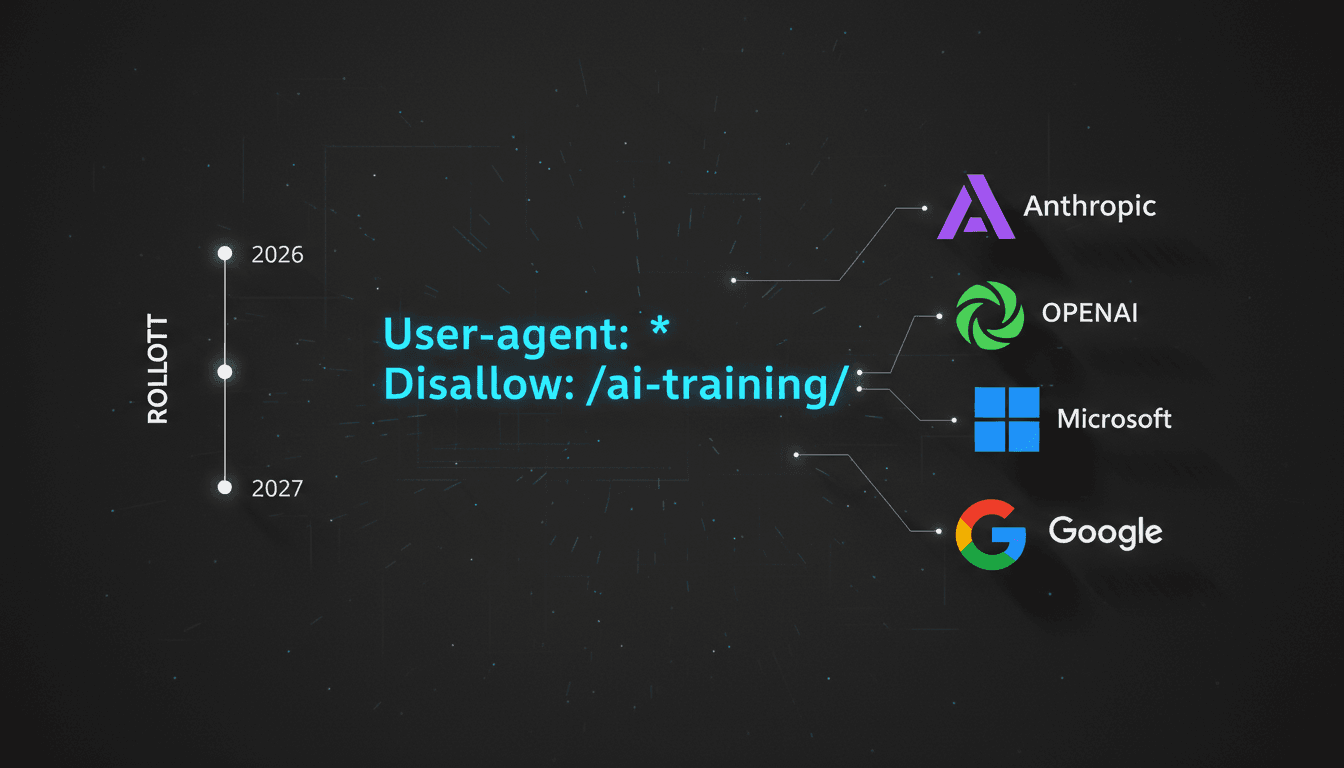
- Four major AI firms aligned on a shared standard: On October 31, 2026, OpenAI, Google, Microsoft, and Anthropic agreed to honor a unified policy token within robots.txt files to let site operators prohibit crawler data harvesting for model training.
- The proposal originates from IETF submissions: Developed through an Internet Engineering Task Force (IETF) submission by Anthropic’s Kevin Kelley, the mechanism replaces distinct, vendor-specific robots.txt rules with a universal machine-readable declaration.
- Rollout schedules diverge significantly: Anthropic launched immediate support on October 31, 2026, while OpenAI committed to upcoming months, Microsoft set February 1, 2027, and Google scheduled adoption for 2027.
The context you actually need
- Publisher litigation escalated the pressure: The agreement follows high-stakes legal challenges, highlighted by The New York Times filing a copyright infringement lawsuit against OpenAI and Microsoft in December 2023 over millions of articles used without consent.
- Infrastructure providers moved first: Prior to this consensus, site administrators relied on individual rules or network-level barriers, such as Cloudflare enforcing automated blocking of artificial intelligence scrapers by default since July 2025.
- Legacy web discovery remains untouched: The new directive isolates training data ingestion from conventional web indexing; activating the opt-out token will not remove pages from standard search engine results.
What's really happening
The unified robots.txt token is an incentive-driven concession designed to de-escalate friction between model builders and web asset owners without altering the underlying economics of data harvesting.
Until now, enterprise administrators faced an operational challenge: preventing proprietary copy from feeding large-scale training pipelines required configuring distinct user-agent directives for individual scrapers, such as GPTBot, ClaudeBot, and Google-Extended. If a company deployed an unlisted crawler or updated its scraping infrastructure, sites surrendered their text by omission. By establishing an IETF-backed token, model creators offer a centralized technical control point that reduces publisher friction and establishes a formal baseline for consent.
However, the architecture protects key developer advantages. First, the standard is opt-out by design. The web defaults to full ingestion permissions; your content continues to populate training sets unless engineering teams deliberately add the code snippet to site root directories. Second, the technical standard operates strictly prospectively. It applies solely to future training runs, leaving model weights already trained on billions of public pages intact. For publishers who claim years of historical extraction occurred without authorization, the protocol provides zero retroactive remedy.
The structural tension shifts from copyright litigation to platform discoverability. Both Google and Microsoft explicitly noted that applying the training opt-out may result in reduced distribution inside native generative interfaces and chat assistants. This creates a strategic bind for web operators. If you protect your text from training ingestion, you risk omission from conversational query interfaces that increasingly intermediate customer navigation. Conversely, if you prioritize referral reach through generative summaries, you must concede your proprietary content as training material.
For the participating technology firms—including Meta, which endorsed the framework without fixing an implementation roadmap—the move establishes a viable self-policing argument. By creating an open standard that lets copyright holders withdraw, foundation model creators construct a technical defense against claims of non-consensual harvesting while preserving the core mechanism that feeds their development pipelines.
Who feels it first (and how)
- Digital publishers and media groups: Operations departments gain a direct mechanism to restrict major models from using new articles, research reports, and commentary for post-2026 training runs.
- Chief technology officers and webmasters: Engineering organizations can replace fragile, bespoke blocklists with a single standard, though they must monitor different adoption timelines across providers until Google and Microsoft go live in 2027.
- Corporate brands reliant on search discovery: Marketing directors must evaluate whether safeguarding brand-owned collateral from model training harms their presence in automated search experiences managed by Google and Microsoft.
- AI startups and independent scraper operators: Smaller model companies outside the tier-one coalition risk higher crawler blocking at the CDN level if network providers prioritize compliance checks around the new standard.
What to watch next
- Microsoft’s February 1, 2027 milestone: Track whether engineering changes in Redmond deploy on schedule, confirming whether legacy search engines successfully separate training bots from retrieval crawlers.
- Platform visibility penalties: Watch for measurable dips in referral volume or conversational citations for major websites that implement the policy token compared to competitors who remain scraped.
- Meta's formal rollout timeline: Observe if Meta moves from verbal support to production engineering, signaling whether social network ecosystems will enforce the same web-scraping boundary.
Anthropic, OpenAI, Microsoft, and Google agreed to adopt a shared IETF robots.txt policy token for future training opt-outs, with Anthropic deploying immediately and others rolling out through 2027.
Tier-one web publishers will deploy the standard at scale, leading to diverging tiers of web content: public properties accessible to generative engines and guarded repositories sealed behind opt-out directives.
It remains unverified whether non-participating overseas AI developers will honor the voluntary IETF token, or if legal systems will view the standard as adequate compliance under evolving data privacy and copyright frameworks.
Frequently Asked Questions
- Why it matters?
- The pact establishes the first unified technical opt-out for artificial intelligence training across major tech infrastructure, moving the sector from fragmented blocking scripts to a coordinated self-regulatory protocol.
- What happened (in 30 seconds)?
- Four major AI firms aligned on a shared standard: On October 31, 2026, OpenAI, Google, Microsoft, and Anthropic agreed to honor a unified policy token within robots.txt files to let site operators prohibit crawler data harvesting for model training. The proposal originates from IETF submissions: Developed through an Internet Engineering Task Force (IETF) submission by Anthropic’s Kevin Kelley, the mechanism replaces distinct, vendor-specific robots.txt rules with a universal machine-readable dec
- What's really happening?
- The unified robots.txt token is an incentive-driven concession designed to de-escalate friction between model builders and web asset owners without altering the underlying economics of data harvesting. Until now, enterprise administrators faced an operational challenge: preventing proprietary copy from feeding large-scale training pipelines required configuring distinct user-agent directives for individual scrapers, such as GPTBot, ClaudeBot, and Google-Extended. If a company deployed an unlis
- Who feels it first (and how)?
- Digital publishers and media groups: Operations departments gain a direct mechanism to restrict major models from using new articles, research reports, and commentary for post-2026 training runs. Chief technology officers and webmasters: Engineering organizations can replace fragile, bespoke blocklists with a single standard, though they must monitor different adoption timelines across providers until Google and Microsoft go live in 2027. Corporate brands reliant on search discovery: Marketing d
- What to watch next?
- Microsoft’s February 1, 2027 milestone: Track whether engineering changes in Redmond deploy on schedule, confirming whether legacy search engines successfully separate training bots from retrieval crawlers. Platform visibility penalties: Watch for measurable dips in referral volume or conversational citations for major websites that implement the policy token compared to competitors who remain scraped. Meta's formal rollout timeline: Observe if Meta moves from verbal support to production engine
Latest AI/ML research news and breakthroughs.
"Aggregated research highlights across institutions."
— A47 Editor
AI giants promise publishers new way to block some scraping
OpenAI, Google, Microsoft and Anthropic have pledged to give media outlets and other websites a single standard for blocking their content from being scraped to train AI models, amid mounting criticism and legal battles from news publishers. The shar...
Consumer technology news with AI coverage.
"Gadget and tech site reporting on AI in products."
— A47 Editor
Google joins OpenAI and Anthropic in promising new scraping controls
Google, OpenAI, Anthropic and Microsoft have pledged to support a new common signal for robots.txt that blocks scraping of their content for AI training, according to Engadget. The commitment addresses growing publisher concerns about how web content...
Covers consumer technology, electronics, gadgets, and product reviews.
"Engadget is a trusted source for gadget reviews and consumer tech news, known for its hands-on analysis and industry coverage."
— A47 Editor
Google joins OpenAI and Anthropic in promising new scraping controls
Google, OpenAI, Anthropic and Microsoft have pledged to support a new common signal for robots.txt that blocks scraping of their content for AI training, according to Engadget. The commitment addresses growing publisher concerns about how web content...
AI news with an enterprise and cloud focus.
"Covers AI in the context of data infrastructure, cloud, and enterprise stacks."
— A47 Editor
Google, Anthropic and others to support new AI crawling opt-out standard
Google LLC, Microsoft Corp., Anthropic PBC and OpenAI Group PBC have announced plans to support an upcoming website crawling standard that would let website operators block AI developers from using their content to train models, building on the long-...
Curated tech headlines including AI stories.
"Influential aggregator surfacing the day’s top tech/AI links."
— A47 Editor
OpenAI, Google, Microsoft, and Anthropic say they will adopt a new standard that publishers can use to opt out of being scraped by AI across multiple crawlers (Emma Roth/The Verge)
OpenAI, Google, Microsoft, and Anthropic say they will adopt a new standard that lets publishers opt out of being scraped by AI crawlers across multiple providers, with a single control that applies their AI training preferences across several crawle...
Consumer tech and culture with frequent AI coverage.
"Influential tech outlet covering AI products and policy."
— A47 Editor
The biggest names in AI are backing a new way to opt out of scraping
OpenAI, Google, Microsoft, and Anthropic have said they will adopt a new industry standard that lets publishers opt out of being scraped for AI training. The shared "policy token" signal allows publishers to set their AI training preferences once and...
Tech news, reviews, and analysis of consumer electronics, science, art, and culture.
"The Verge is a technology-focused media outlet known for in-depth reporting, product reviews, and coverage of the intersection between technology and culture."
— A47 Editor
The biggest names in AI are backing a new way to opt out of scraping
OpenAI, Google, Microsoft, and Anthropic have said they will adopt a new industry standard that lets publishers opt out of being scraped for AI training. The shared "policy token" signal allows publishers to set their AI training preferences once and...