
Nvidia Faces Renewed Scrutiny Over Alleged China Chip Diversion Through Southeast Asian Intermediaries
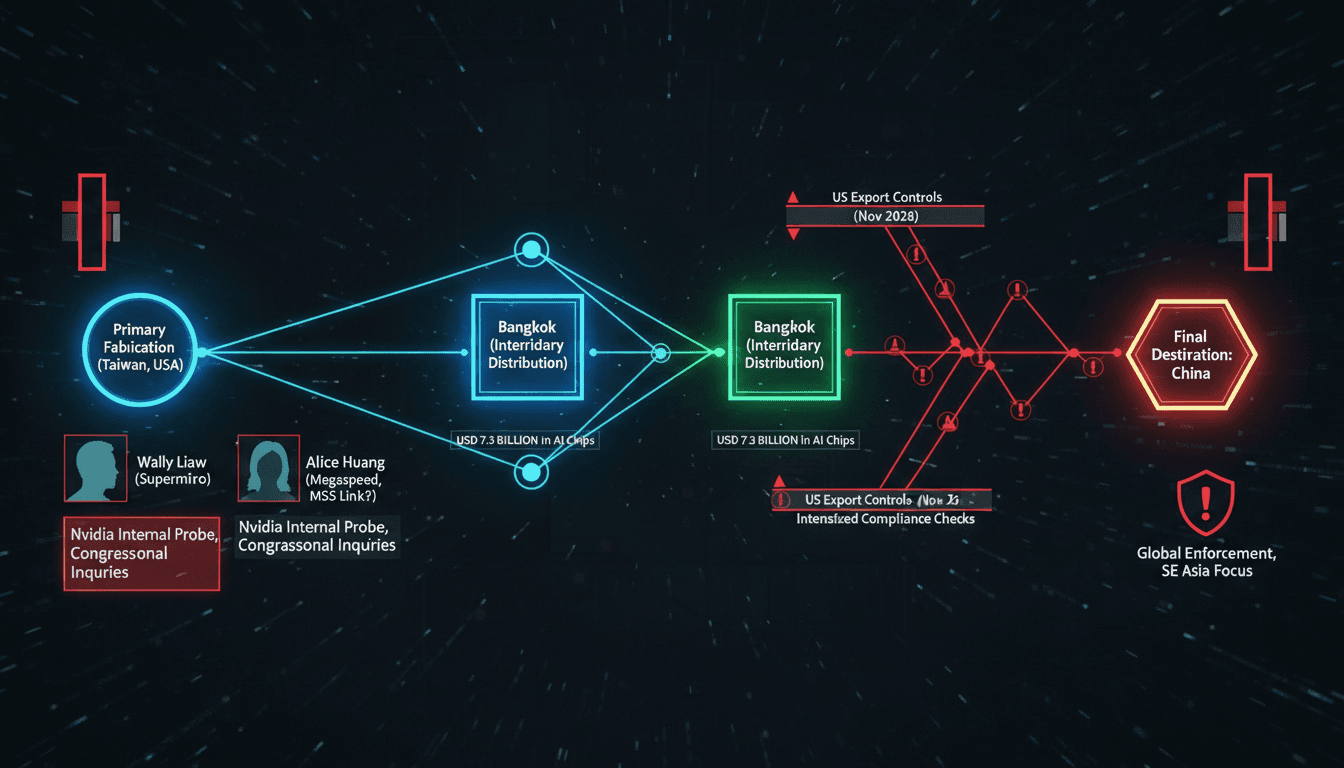
Why it matters
The convergence of a $7.3 billion aggregate hardware leakage channel with boardroom exposure threatens to transform voluntary tech compliance into rigorous, sovereign-enforced hardware tracking worldwide.
What happened (in 30 seconds)
- Federal authorities targeted major supply chain intermediaries, documenting the diversion of $2.5 billion in high-performance server hardware through a Bangkok entity named OBON, leading to the March 2026 indictment of Supermicro co-founder Yih-Shyan “Wally” Liaw.
- Nvidia’s primary regional buyer faced parallel federal investigations, with Megaspeed International under review for allegedly routing more than $4.8 billion in restricted computing silicon toward Chinese organizations.
- Corporate governance faced direct pressure, prompting Nvidia's board of directors to retain former acting U.S. Attorney Joon Kim for an independent probe following Jensen Huang’s acknowledged relationship with former Megaspeed executive Alice Huang, who faces intelligence scrutiny regarding ties to China’s Ministry of State Security.
The context you actually need
- Advanced compute restrictions drive dual-use enforcement, as trade frameworks strictly limit transfers of high-density graphics processing units—such as the H100, H200, and B200 architectures—to prevent military application enhancements in restricted jurisdictions.
- Intermediary re-export schemes mirror historical patterns, reminiscent of Supermicro’s 2006 guilty plea concerning prohibited system deliveries routed through intermediary entities in Dubai to reach restricted markets in Iran.
- Southeast Asia has emerged as a high-volume routing corridor, with trading centers across Singapore, Thailand, Malaysia, and Indonesia acting as key transit jurisdictions under active regulatory and short-seller examination.
What's really happening
The current regulatory escalation is not an isolated breach; it represents a structural clash between corporate volume incentives and strict state containment. High-performance processors, engineered primarily for hyper-scale civilian deployment, command substantial capital premiums within restricted destinations. This price differential creates massive economic incentives for intermediary entities to systematically bypass cross-border trade controls.
The physical mechanics of this diversion rely on multi-tier obfuscation. In the March 2026 federal indictment concerning Supermicro co-founder Wally Liaw, prosecutors detailed a blueprint relying on label alteration, dummy hardware units, and layered transshipment hubs. Hardware valued at $2.5 billion moved through Bangkok-based front operations to obscure ultimate end-users. Concurrently, Megaspeed International acquired over $4.8 billion in silicon allocations as Nvidia’s top Southeast Asian client, utilizing legitimate distribution quotas that investigators allege were diverted into prohibited jurisdictions.
This environment changes dramatically once executive leadership becomes linked to channel counterparties. The acknowledgment of an extramarital relationship between Jensen Huang and former Megaspeed executive Alice Huang—combined with intelligence scrutiny regarding her alleged links to China’s Ministry of State Security—shifts the issue from standard commercial compliance into counterintelligence risk. While Nvidia maintains that it enforces comprehensive compliance protocols, retains no evidence of systematic partner diversion, and faces no corporate charges, the operational firewall between enterprise leadership and distributor networks is now under federal review.
For enterprise buyers, the structural impact is immediate friction. Global technology firms have historically managed trade compliance as a procedural step during deal settlement. Regulators and congressional oversight bodies are now signaling that distributor vetting must transition into continuous physical auditing, end-to-end telemetry verification, and persistent location tracking.
Consequently, the operational premium of procuring high-end computational infrastructure will rise. Technology companies will incur higher legal and compliance expenditures to authenticate global buyers, extending deployment timelines across all enterprise sectors. The open distribution model for advanced hardware is giving way to a closed, state-monitored supply architecture.
Who feels it first (and how)
- Enterprise Chief Technology and Procurement Officers: Will experience extended lead times, mandatory hardware attestation requirements, and heightened audit clauses on tier-one GPU server acquisitions.
- Hardware Distributors across Southeast Asia and the Middle East: Will face intrusive end-user validation protocols, sudden allocation halts, and direct regulatory scrutiny over cross-border cargo routing.
- AI Infrastructure Investors: Will absorb valuation discounts and margin compression across hardware-adjacent equities as secondary compliance costs and delivery delays escalate.
- Global Compliance and Trade Counsel: Will see immediate demand for comprehensive forensic supply chain reviews, distributor verification workflows, and executive conflict-of-interest assessments.
What to watch next
- Congressional Oversight Briefings: Watch for formal hearing dates and subpoena issuances from Senate and House committee leaders, which will establish whether legislative pressure forces statutory changes to distributor liability standards.
- Findings of the Independent Board Probe: Monitor public disclosures from independent counsel Joon Kim regarding Nvidia’s internal controls, communication records, and enterprise governance adjustments.
- Secondary Transshipment Interventions: Track potential enforcement penalties or commerce list additions targeting regional logistics entities across Singapore, Malaysia, and Thailand.
Federal prosecutors indicted Wally Liaw over a $2.5 billion transshipment route; Megaspeed is under formal review for $4.8 billion in chip shipments; Jensen Huang admitted an affair with former Megaspeed executive Alice Huang; Nvidia's board retained independent counsel; no charges have been filed against Nvidia or Huang.
U.S. regulatory agencies will enforce strict, mandatory telemetric and physical verification benchmarks for all high-performance silicon shipments entering non-restricted regional distribution hubs.
Whether federal investigations will reveal documented knowledge of hardware diversion within primary vendor executive suites, or if regulatory action will focus entirely on channel intermediaries.
Frequently Asked Questions
- Why it matters?
- The convergence of a $7.3 billion aggregate hardware leakage channel with boardroom exposure threatens to transform voluntary tech compliance into rigorous, sovereign-enforced hardware tracking worldwide.
- What happened (in 30 seconds)?
- Federal authorities targeted major supply chain intermediaries, documenting the diversion of $2.5 billion in high-performance server hardware through a Bangkok entity named OBON, leading to the March 2026 indictment of Supermicro co-founder Yih-Shyan “Wally” Liaw. Nvidia’s primary regional buyer faced parallel federal investigations, with Megaspeed International under review for allegedly routing more than $4.8 billion in restricted computing silicon toward Chinese organizations. Corporate gover
- What's really happening?
- The current regulatory escalation is not an isolated breach; it represents a structural clash between corporate volume incentives and strict state containment. High-performance processors, engineered primarily for hyper-scale civilian deployment, command substantial capital premiums within restricted destinations. This price differential creates massive economic incentives for intermediary entities to systematically bypass cross-border trade controls. The physical mechanics of this diversion re
- Who feels it first (and how)?
- Enterprise Chief Technology and Procurement Officers: Will experience extended lead times, mandatory hardware attestation requirements, and heightened audit clauses on tier-one GPU server acquisitions. Hardware Distributors across Southeast Asia and the Middle East: Will face intrusive end-user validation protocols, sudden allocation halts, and direct regulatory scrutiny over cross-border cargo routing. AI Infrastructure Investors: Will absorb valuation discounts and margin compression across ha
- What to watch next?
- Congressional Oversight Briefings: Watch for formal hearing dates and subpoena issuances from Senate and House committee leaders, which will establish whether legislative pressure forces statutory changes to distributor liability standards. Findings of the Independent Board Probe: Monitor public disclosures from independent counsel Joon Kim regarding Nvidia’s internal controls, communication records, and enterprise governance adjustments. Secondary Transshipment Interventions: Track potential en
Corporate leadership, finance, technology, and market trends.
"Fortune covers financial trends, leadership, and innovation with a pragmatic editorial approach."
— A47 Editor
2 scandals, 1 destination—Why Nvidia can’t shake China smuggling allegations
The base report from Fortune says a co-founder of Supermicro has been charged with routing banned Nvidia-linked servers to China through Southeast Asia, while Megaspeed, a Singapore firm where a suspected spy tied to Nvidia CEO Jensen Huang once serv...
Technology business and AI-related headlines.
"Data-driven tech newsroom with global scope."
— A47 Editor
Nvidia Faces Fresh US Scrutiny on Megaspeed Probe
Nvidia's general counsel intervened in a U.S. government probe into suspected smuggling of AI chips by Singapore-based Megaspeed International, according to Bloomberg reporting by Tyler Kendall, raising questions about the company's ability to influe...
Technology business news, market impacts, and innovation trends.
"Bloomberg is a premier financial and tech news provider, respected for its in-depth reporting and analytical rigor."
— A47 Editor
Nvidia Faces Fresh US Scrutiny on Megaspeed Probe
Nvidia's general counsel intervened in a U.S. government probe into suspected smuggling of AI chips by Singapore-based Megaspeed International, according to Bloomberg reporting by Tyler Kendall, raising questions about the company's ability to influe...
Market-moving headlines impacting equities, bonds, and related risk assets.
"Real-time catalysts and volatility drivers across indices and sectors."
— A47 Editor
What we know about Megaspeed, Singapore-based customer of Nvidia
Megaspeed, a Singapore-based company that buys advanced Nvidia A.I. chips, has drawn attention after a U.S. Commerce Department inquiry into the firm was reportedly transferred to the Justice Department following contact from a senior Nvidia executiv...
Curated tech headlines including AI stories.
"Influential aggregator surfacing the day’s top tech/AI links."
— A47 Editor
Analysis: Nvidia's 2025 figures to the US government undercounted chips sold to Megaspeed via partners by 50K; Nvidia did not give Bloomberg an exact figure (Mackenzie Hawkins/Bloomberg)
Nvidia's 2025 figures reported to the US government reportedly undercounted AI chips sold to Megaspeed International via partners by about 50,000 units, according to a Bloomberg analysis by Mackenzie Hawkins; Nvidia did not provide Bloomberg an exact...
Technology business and AI-related headlines.
"Data-driven tech newsroom with global scope."
— A47 Editor
Nvidia Intervened in US Megaspeed Chip Smuggling Probe
Bloomberg reports that Nvidia's general counsel intervened in a U.S. government probe into suspected smuggling of AI chips by Megaspeed International, a case in which the company's involvement has drawn attention amid a broader investigation into its...
Technology business news, market impacts, and innovation trends.
"Bloomberg is a premier financial and tech news provider, respected for its in-depth reporting and analytical rigor."
— A47 Editor
Nvidia Intervened in US Megaspeed Chip Smuggling Probe
Bloomberg reports that Nvidia's general counsel intervened in a U.S. government probe into suspected smuggling of AI chips by Megaspeed International, a case in which the company's involvement has drawn attention amid a broader investigation into its...