
Microsoft 365 Outage Blocks Chlorine Safety Alerts Leading to Gas Exposure of 15 Guests at German Hotel
Why it matters
When consumer-grade communication software underpins industrial hazard controls, cloud server latency directly converts digital downtime into physical injury.
What happened (in 30 seconds)
- A cloud disruption silenced warnings: Between November 12 and November 14, 2026, a worldwide Microsoft 365 disruption disabled Exchange Online and Outlook, halting automated alert traffic.
- A mechanical failure generated toxic gas: On November 13, 2026, an automated pool dosing mechanism malfunctioned at Hotel Ling Bao in Phantasialand, Germany, dumping excess chlorine into the water.
- Fifteen hotel guests sustained chemical injuries: Because the monitoring system's automated email warning never arrived, staff did not intervene before gas accumulated, resulting in 15 people injured and four hospitalized.
The context you actually need
- A latent software defect triggered the collapse: The Microsoft outage originated from code introduced in a July 2026 update, which remained dormant until combined with heavy traffic from an earlier Teams incident and a separate 14% server capacity loss.
- Zero communication redundancy was installed: The facility’s water safety architecture relied solely on standard Microsoft Outlook emails to alert team members to toxic chemical spikes, lacking local auditory sirens or secondary channels.
- Cascading server failures drove the impact: Microsoft's post-incident report confirmed that the service interruption stemmed from internal cascading infrastructure failures rather than an external cyberattack.
What's really happening
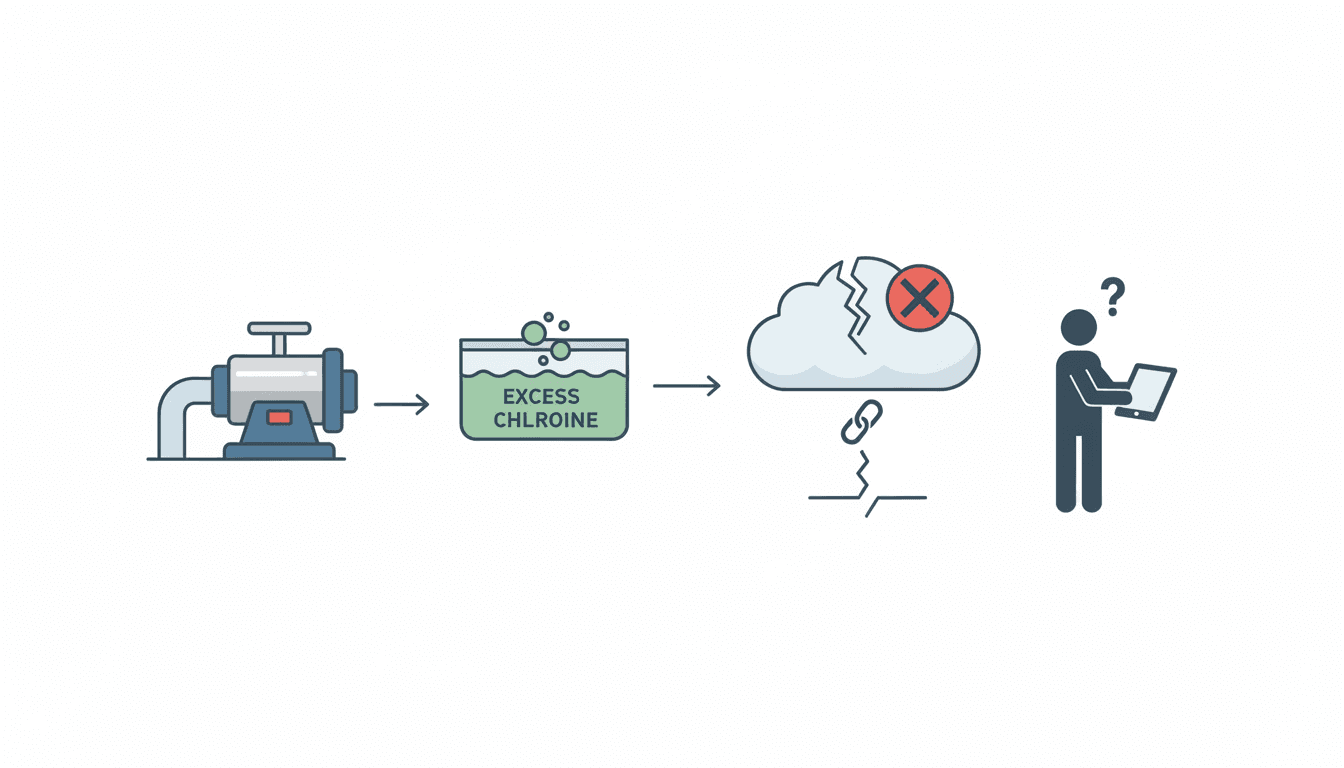
The chemical exposure at Hotel Ling Bao reveals the systemic hazard of treating commercial business tools as mission-critical safety instrumentation. The operational pathway was straightforward: an automated dosing controller malfunctioned and fed surplus chlorine into the hotel pool. The physical sensor detected the anomaly and triggered an outbound alert. Yet, the warning mechanism stopped entirely within a stalled software queue because facility managers tied life-safety signaling directly to standard enterprise email.
Modern facilities face strong financial and operational incentives to unify operational technology (OT) with everyday information technology (IT). Connecting building sensors directly to tools employees already open daily—like Microsoft Outlook—appears cost-effective. It avoids the procurement costs of specialized telemetry hardware, proprietary alert consoles, on-site alarm panels, or cellular failover lines. However, enterprise office suites operate under best-effort delivery architectures designed for correspondence, not real-time deterministic reliability. When physical systems depend on standard email protocols, hazard notification times become tied to global software stability.
The failure chain underscores the fragility of hyper-consolidated cloud ecosystems. Microsoft's analysis indicated the November 12–14 incident was not caused by malicious external activity, but by a latent software defect introduced four months earlier in July 2026. This defect lay hidden until unexpected load spikes from an earlier Microsoft Teams event collided with an unexpected 14% loss of server capacity. That sequence set off a cascading collapse across Exchange Online clusters worldwide.
Because the hotel maintained no redundant, out-of-band communication paths—such as local strobe lights, hardwired sirens, or analog interlocks that kill chemical feed pumps upon threshold breaches—the cloud failure effectively blinded the maintenance team. By the time 40 responding firefighters arrived to secure the scene and triage the guests, 15 individuals had sustained respiratory exposure, sending four to local hospitals.
The structural lesson for operators is fundamental: cloud outages are inevitable events. When digital downtime occurs in an office setting, it delays paperwork. When it occurs in an environment where industrial chemicals, high-voltage equipment, or pressure systems interact, the absence of local failsafes turns code defects into immediate physical liabilities.
Who feels it first (and how)
- Hospitality and leisure facility operators: Engineering leads must immediately audit their remote sensor configurations and remove commercial email dependencies from hazard mitigation workflows.
- Enterprise IT and OT system architects: Technology officers are forced to explain why physical plant infrastructure relies on SaaS applications with intermittent service-level agreements rather than isolated, on-premises networks.
- Commercial liability insurers: Underwriters must recalibrate risk pricing and underwriting exclusions for commercial venues that fail to separate life-safety triggers from standard office software suites.
What to watch next
- Hardware-level interlock adoption: Watch whether commercial facilities shift away from cloud-routed notifications toward hardwired automatic-shutoff valves that operate independently of any internet connection.
- Insurance compliance revisions: Monitor whether industrial and commercial property insurers begin requiring strict separation between IT business software and OT hazard systems as a condition of coverage.
- Post-incident infrastructure audits: Track whether municipal building safety inspectors update physical plant codes to mandate redundant, multi-channel notification methods for hazardous materials.
The pool dosing system malfunctioned at Hotel Ling Bao on November 13, 2026, the Microsoft 365 outage prevented delivery of the safety system's email, and 15 people were injured with four admitted to the hospital.
The incident will prompt commercial operators to review single-point dependencies where enterprise software manages automated alarms for hazardous physical systems.
It remains unknown whether European safety regulators will introduce punitive compliance mandates or specific operational standards governing digital alert redundancies for public swimming facilities.
Frequently Asked Questions
- Why it matters?
- When consumer-grade communication software underpins industrial hazard controls, cloud server latency directly converts digital downtime into physical injury.
- What happened (in 30 seconds)?
- A cloud disruption silenced warnings: Between November 12 and November 14, 2026, a worldwide Microsoft 365 disruption disabled Exchange Online and Outlook, halting automated alert traffic. A mechanical failure generated toxic gas: On November 13, 2026, an automated pool dosing mechanism malfunctioned at Hotel Ling Bao in Phantasialand, Germany, dumping excess chlorine into the water. Fifteen hotel guests sustained chemical injuries: Because the monitoring system's automated email warning never a
- What's really happening?
- The chemical exposure at Hotel Ling Bao reveals the systemic hazard of treating commercial business tools as mission-critical safety instrumentation. The operational pathway was straightforward: an automated dosing controller malfunctioned and fed surplus chlorine into the hotel pool. The physical sensor detected the anomaly and triggered an outbound alert. Yet, the warning mechanism stopped entirely within a stalled software queue because facility managers tied life-safety signaling directly to
- Who feels it first (and how)?
- Hospitality and leisure facility operators: Engineering leads must immediately audit their remote sensor configurations and remove commercial email dependencies from hazard mitigation workflows. Enterprise IT and OT system architects: Technology officers are forced to explain why physical plant infrastructure relies on SaaS applications with intermittent service-level agreements rather than isolated, on-premises networks. Commercial liability insurers: Underwriters must recalibrate risk pricing
- What to watch next?
- Hardware-level interlock adoption: Watch whether commercial facilities shift away from cloud-routed notifications toward hardwired automatic-shutoff valves that operate independently of any internet connection. Insurance compliance revisions: Monitor whether industrial and commercial property insurers begin requiring strict separation between IT business software and OT hazard systems as a condition of coverage. Post-incident infrastructure audits: Track whether municipal building safety inspect
Consumer tech and culture with frequent AI coverage.
"Influential tech outlet covering AI products and policy."
— A47 Editor
15 hotel guests were injured by chlorine poisoning due to Microsoft’s global email outage
A widespread Microsoft 365 and Outlook outage cut off email alerts to a safety system at a Phantasialand hotel in Germany, where a warning about elevated chlorine levels in the pool was not delivered, and 15 guests were injured by chlorine poisoning,...
Tech news, reviews, and analysis of consumer electronics, science, art, and culture.
"The Verge is a technology-focused media outlet known for in-depth reporting, product reviews, and coverage of the intersection between technology and culture."
— A47 Editor
15 hotel guests were injured by chlorine poisoning due to Microsoft’s global email outage
A widespread Microsoft 365 and Outlook outage cut off email alerts to a safety system at a Phantasialand hotel in Germany, where a warning about elevated chlorine levels in the pool was not delivered, and 15 guests were injured by chlorine poisoning,...
Tech news, hardware, and AI tools coverage.
"PC/tech site increasingly covering AI hardware and apps."
— A47 Editor
Microsoft 365 outage led to chlorine gas leak at German hotel, poisoning of 15 guests and sending four to hospital
A malfunction in the dosing system at the Hotel Ling Bao, part of Phantasialand theme park in Germany, pumped too much chlorine into the hotel pool, reportedly leading to a chlorine gas leak that poisoned 15 guests and sent four to hospital, accordin...
Consumer tech news, reviews, and buying guides for gadgets and electronics.
"TechRadar is known for comprehensive buying advice, hardware reviews, and consumer tech news targeted at mainstream audiences."
— A47 Editor
Microsoft 365 outage led to chlorine gas poisoning of 15 people in Germany
TechRadar reports that a Microsoft 365 outage left 15 hotel guests in Germany suffering chlorine gas poisoning, with Microsoft revealing the cause of the outage that preceded the incident. The base report centers on the health consequences tied to th...
Arabic-language coverage of international news and geopolitics.
"RT Arabic is a Russian state-funded outlet often criticized for promoting Kremlin-aligned narratives."
— A47 Editor
ألمانيا.. عطل "مايكروسوفت" يتسبب بحالات تسمم بالكلور لحوالي 15 شخصا
Germany's WDR network reported that an outage in Microsoft's Outlook service prevented warnings about elevated chlorine levels at a swimming pool in the German city of Brühl from reaching people, resulting in chlorine poisoning for about 15 people.