
OpenAI Launches Free CSAM Image Classifier to Curb AI-Generated Abuse Report Overload
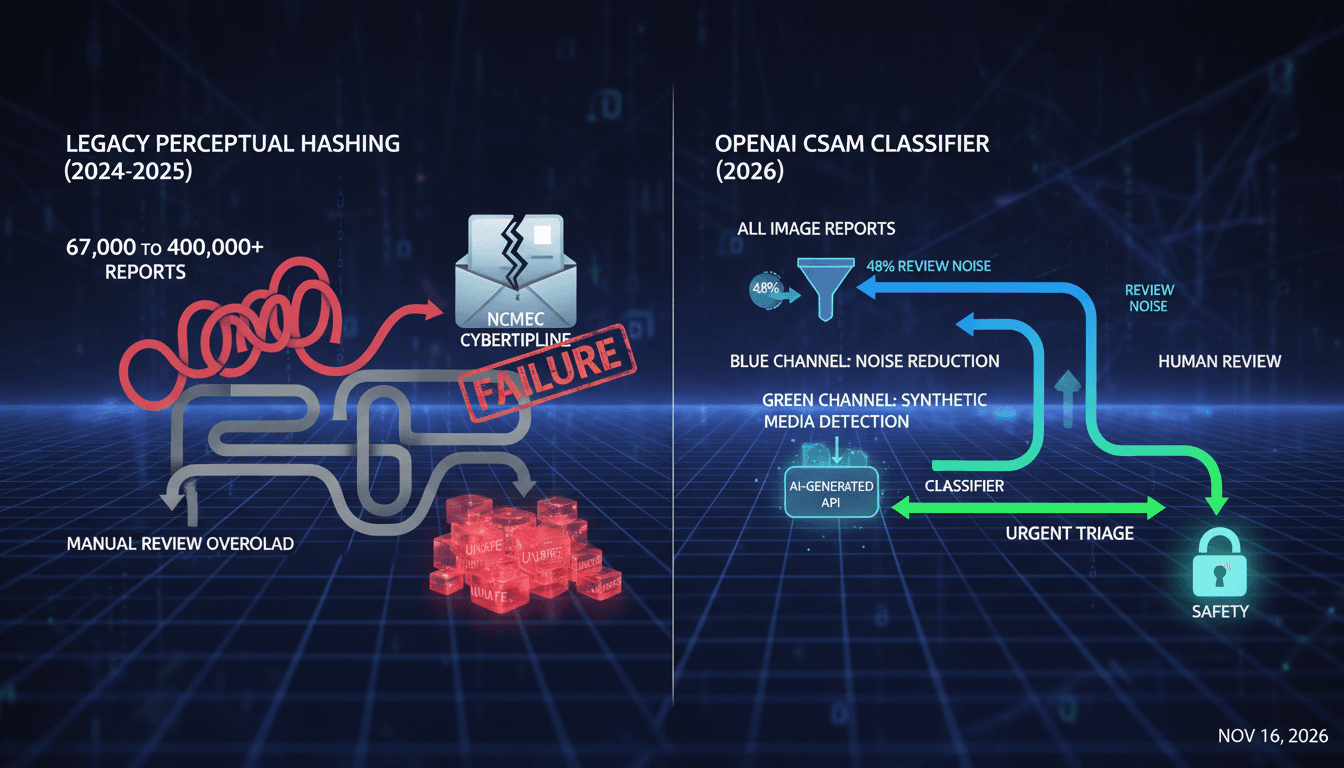
Platform operators, safety engineers, and compliance leaders must now prepare for automated triage infrastructure that explicitly distinguishes synthetic materials from camera-captured files to keep legal reporting pipelines functional.
Why it matters
The operational bottleneck in digital compliance has shifted from raw intake volume to signal-to-noise triage as synthetic files threaten to break the triage capacity of institutional clearinghouses.
What happened (in 30 seconds)
- OpenAI deployed a free specialized classifier built alongside the National Center for Missing and Exploited Children (NCMEC) to identify child sexual abuse material (CSAM) with a dedicated indicator for AI-generated media.
- The verification model cuts triage overhead by decreasing overall flagged images by 48% while doubling the likelihood that retained flags contain actionable abuse.
- Account enforcement mechanisms expanded to issue active ChatGPT warnings and trigger mandatory 24-hour account suspensions for users attempting to prompt illicit imagery.
The context you actually need
- Intake volume escalated exponentially, with NCMEC’s CyberTipline recording 400,000 reports tied to generative AI in 2025, climbing sharply from 67,000 instances logged in 2024.
- Statutory frameworks treat pixels identically, as federal and state legislation penalizes synthetic and authentic abuse media under the same baseline standards, with 48 states maintaining specific deepfake measures.
- Operational triage stalled under false-positive burdens, prompting safety researchers to caution that existing staff cannot manually evaluate uncalibrated automated flags at current growth trajectories.
What's really happening
The launch of an algorithmic triage filter marks an architectural pivot in how digital infrastructure manages liability, moving past basic perimeter bans to triage infrastructure built to preserve reporting clearinghouses. Historically, automated safety scanning relied on perceptual hashing tools like PhotoDNA. These databases cross-referenced known media files across cross-platform repositories. That architecture functions exclusively when tracking previously cataloged, distributed files. Generative engines inverted this paradigm by outputting infinite variations of novel, unindexed pixel grids, stripping digital infrastructure of its primary defense.
The resulting administrative friction surfaced directly within institutional processing hubs. In 2024, NCMEC handled 67,000 generative AI reports. By 2025, that metric reached 400,000—a nearly six-fold surge inside twelve months. Because legal mandates across jurisdictions require platforms to forward suspected CSAM directly to centralized systems, moderation systems defaulted to over-flagging to hedge statutory liability. The consequence was structural paralysis: high-volume intake pipelines filled with low-confidence flags, diluting the investigative attention required for immediate, high-severity cases involving actual victims.
By providing a model that cuts flagged image volume by 48% while doubling the density of confirmed violations within the remaining sample, OpenAI is addressing a pipeline problem rather than a public relations challenge. For an AI developer, reducing platform-level friction serves an incentive-based calculation. Tech firms face sustained exposure to legislative mandates and cross-jurisdictional scrutiny. Proactively shipping a functional classification layer—offered at zero cost via an application programming interface (API) to vetted platforms—establishes a technical standard before regulators mandate one.
Simultaneously, the inclusion of a synthetic-specific flag creates a structural taxonomy shift. Law enforcement investigators operate with limited field resources. An alert signaling an ongoing physical emergency requires an entirely different operational response than synthetic material produced by a bad actor using local models. Differentiating real-world victims from algorithmically generated material at the metadata layer prevents systemic resource misallocation.
This integration of algorithmic filtering, developer documentation, and direct account friction—manifested as 24-hour account access freezes for violation attempts—outlines the standard blueprint for commercial AI safety operations. Platforms hosting generative compute can no longer treat moderation as an asynchronous after-action review. Detection must operate directly at the generation interface, functioning as a real-time checkpoint to manage systemic volume before it enters institutional reporting pipelines.
Who feels it first (and how)
- Trust and Safety Operations Teams: Systems administrators inside digital platforms gain access to API tooling that cuts total review backlogs by roughly half without degrading capture accuracy.
- Law Enforcement and Triage Analysts: Investigators at entities like NCMEC receive higher-confidence documentation that explicitly separates synthetic generation from live-victim photography.
- Third-Party API Developers: Engineering teams integrating commercial vision and image models must incorporate new standardized content parameters and reporting workflows or risk operational cutoffs.
- Enterprise Risk Officers: Corporate risk executives must re-evaluate legal compliance protocols to track both synthetic content signals and baseline illicit media.
What to watch next
- API Adoption Footprint: The operational uptake rate of the classifier across independent hosting providers, social platforms, and cloud infrastructure companies will indicate whether this methodology becomes the standard industry baseline.
- CyberTipline Backlog Metrics: Year-end reporting data from NCMEC will show whether targeted false-positive filtering meaningfully reduces raw intake volume below the 400,000-report baseline set in 2025.
- State-Level Regulatory Convergence: Legal mandates across the 48 states with existing deepfake statutes will signal whether synthetic-specific detection metadata becomes a statutory requirement for commercial frontier models.
OpenAI released an image classifier specifically flagged for generative child abuse imagery, offered free to qualified entities, backed by data showing a 48% drop in low-value flags and a doubling of detection accuracy.
Peer foundation model developers will deploy parallel classification layers to protect their own compute networks from direct statutory exposure and platform abuse.
It remains unverified whether downstream state agencies possess the localized forensic infrastructure required to process and leverage synthetic-detection flags at scale.
Frequently Asked Questions
- Why it matters?
- The operational bottleneck in digital compliance has shifted from raw intake volume to signal-to-noise triage as synthetic files threaten to break the triage capacity of institutional clearinghouses.
- What happened (in 30 seconds)?
- OpenAI deployed a free specialized classifier built alongside the National Center for Missing and Exploited Children (NCMEC) to identify child sexual abuse material (CSAM) with a dedicated indicator for AI-generated media. The verification model cuts triage overhead by decreasing overall flagged images by 48% while doubling the likelihood that retained flags contain actionable abuse. Account enforcement mechanisms expanded to issue active ChatGPT warnings and trigger mandatory 24-hour account su
- What's really happening?
- The launch of an algorithmic triage filter marks an architectural pivot in how digital infrastructure manages liability, moving past basic perimeter bans to triage infrastructure built to preserve reporting clearinghouses. Historically, automated safety scanning relied on perceptual hashing tools like PhotoDNA. These databases cross-referenced known media files across cross-platform repositories. That architecture functions exclusively when tracking previously cataloged, distributed files. Gener
- Who feels it first (and how)?
- Trust and Safety Operations Teams: Systems administrators inside digital platforms gain access to API tooling that cuts total review backlogs by roughly half without degrading capture accuracy. Law Enforcement and Triage Analysts: Investigators at entities like NCMEC receive higher-confidence documentation that explicitly separates synthetic generation from live-victim photography. Third-Party API Developers: Engineering teams integrating commercial vision and image models must incorporate new s
- What to watch next?
- API Adoption Footprint: The operational uptake rate of the classifier across independent hosting providers, social platforms, and cloud infrastructure companies will indicate whether this methodology becomes the standard industry baseline. CyberTipline Backlog Metrics: Year-end reporting data from NCMEC will show whether targeted false-positive filtering meaningfully reduces raw intake volume below the 400,000-report baseline set in 2025. State-Level Regulatory Convergence: Legal mandates across
Consumer tech and culture with frequent AI coverage.
"Influential tech outlet covering AI products and policy."
— A47 Editor
OpenAI wants to stop deepfakes from overwhelming child abuse tiplines
OpenAI has announced a classifier it says can better detect child sexual abuse imagery, including whether it is AI-generated, aiming to help investigators cut through the volume of deepfakes that overwhelm child abuse tiplines and quickly identify ma...
Tech news, reviews, and analysis of consumer electronics, science, art, and culture.
"The Verge is a technology-focused media outlet known for in-depth reporting, product reviews, and coverage of the intersection between technology and culture."
— A47 Editor
OpenAI wants to stop deepfakes from overwhelming child abuse tiplines
OpenAI has announced a classifier it says can better detect child sexual abuse imagery, including whether it is AI-generated, aiming to help investigators cut through the volume of deepfakes that overwhelm child abuse tiplines and quickly identify ma...
Capitol Hill news, legislation, and policy insight.
"The Hill specializes in U.S. politics and policy, with a focus on Capitol Hill developments and a reputation for insider reporting."
— A47 Editor
OpenAI unveils tool to better detect child sexual abuse material
OpenAI released a new tool on Monday designed to detect possible child sexual abuse material (CSAM), including content created with artificial intelligence. The image classifier, which will be available to vetted organizations and law enforcement inv...
Curated tech headlines including AI stories.
"Influential aggregator surfacing the day’s top tech/AI links."
— A47 Editor
OpenAI announces new tools to combat CSAM, including an image classifier and warning screens to prevent users from accessing material that sexualizes children (Ivan Mehta/TechCrunch)
OpenAI has announced new tools to combat child sexual abuse material (CSAM), including an image classifier and warning screens intended to keep users from accessing material that sexualizes children, amid growing safety concerns around the use of AI ...
Technology industry news and policy coverage.
"Fox News is a highly influential conservative news outlet known for right-leaning political commentary and coverage."
— A47 Editor
OpenAI child safety tools target AI-generated abuse
OpenAI has introduced new child safety tools aimed at AI-generated abuse, including a classifier that reportedly flags 48% fewer images for human review while detecting similar levels of child sexual abuse material, and ChatGPT now suspends users for...
Startup news with frequent AI coverage.
"Covers launches, funding, and product updates in AI."
— A47 Editor
OpenAI releases a new image classifier and ChatGPT warnings to combat CSAM
OpenAI has released a new image classifier designed to detect child sexual abuse material (CSAM), and ChatGPT will now issue a 24-hour account ban to users who attempt to access such content, according to TechCrunch.