
Optimizely Supply Chain Compromise Injects Malware into Websites of 178 Organizations Including Zoom, CNN and BBC
Why it matters
Third-party client-side dependencies remain an architectural vulnerability for global digital brands, turning a single software vendor's onboarding flaw into arbitrary script execution across 178 enterprise platforms.
What happened (in 30 seconds)
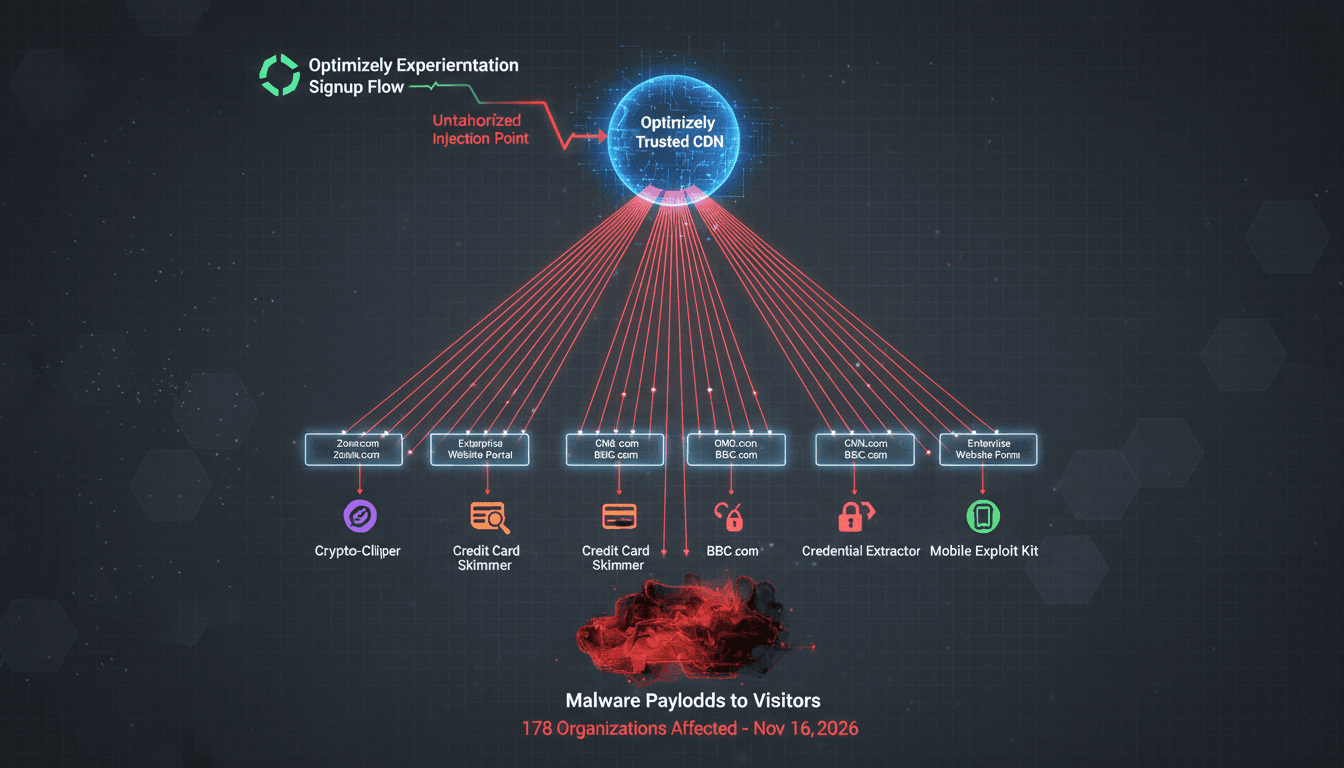
- Account creation vector exploited: Between November 15 and 16, 2026, unauthorized actors accessed a vulnerability in Optimizely's Experimentation signup workflow to alter customer configurations directly.
- Malicious script deployment via CDN: Attackers placed harmful JavaScript into the "Project JavaScript" field of enterprise setups, prompting Optimizely’s content delivery network to serve payloads across 188 infected scripts identified out of 1,611 analyzed by security researcher Scott Helme of Report URI.
- High-profile platforms affected: Global sites—including Zoom, CNN, BBC, Salesforce, GitLab, IKEA, HSBC, and Equifax—inadvertently delivered multi-vector payloads that stole payment cards, intercepted cryptocurrency transfers, extracted session cookies, captured screenshots, and targeted older iOS software.
The context you actually need
- A recurring software supply chain pattern: This intrusion mirrors the July 2026 Adform script compromise that manipulated crypto wallet destinations and the 2024 Polyfill.io domain incident that modified libraries across more than 100,000 domains.
- The structural risk of A/B testing architecture: Optimization and experimentation suites require client websites to load scripts hosted externally with full Document Object Model (DOM) access, granting those scripts execution rights within the visitor’s browser context.
- Swift remediation but active exposure: Optimizely identified and closed the exploited signup pathway on November 17, 2026, deleted the unauthorized scripts, and notified users, while confirmed attacker wallets collected approximately $7,040 in diverted digital assets over the exposure window.
What's really happening
- It monitored system clipboards to identify cryptocurrency wallet addresses across eight separate blockchains, dynamically replacing destination strings with attacker-controlled addresses during transactions.
- It functioned as a digital card skimmer, logging payment credentials typed into checkout and billing fields across commercial sites.
- It captured document cookies and screenshots of active user sessions.
- It evaluated the visitor's user-agent string, serving Coruna and DarkSword exploit kits to devices operating on vulnerable, older versions of iOS.
Who feels it first (and how)
- Web visitors and consumers: Individuals who entered payment information on affected domains on November 16, 2026, or who operated devices running iOS versions prior to 18.7.3, face potential card cloning or browser-level compromise.
- Cryptocurrency traders: Users copying and pasting blockchain wallet strings during the attack window risk funds diversion across eight supported networks.
- Enterprise security teams: Chief Information Security Officers at digital-first enterprises must trace internal log data to determine whether customer input was skimmed before script removal occurred.
- Product and growth executives: Marketing and experimentation leads encounter heightened scrutiny over third-party tag managers and dynamic testing tools from internal risk and compliance departments.
What to watch next
- Payment card fraud signals: Financial institutions will monitor charge disputes and authorization anomalies originating from users who engaged with affected enterprise checkout pages on November 16.
- Script management audits: Whether engineering teams move to restrict third-party DOM access via strict Content Security Policies (CSP) and Subresource Integrity (SRI) mechanisms to limit dynamic runtime modifications.
- Vendor access controls: How software providers restructure signup workflows and customer project segmentation to prevent administrative injection vectors from propagating into production delivery networks.
Attackers leveraged an Optimizely Experimentation signup vulnerability on November 15–16, 2026, injecting scripts across 178 customer organizations, while attacker wallets documented approximately $7,040 in transferred digital currency before Optimizely patched the system on November 17.
Exposed payment card information entered into forms on affected websites during the compromise window will appear in downstream unauthorized transaction attempts.
The total count of individual end-user sessions exposed to the skimmed scripts, the volume of credentials exfiltrated, and the complete geographic distribution of impacted visitors.
Frequently Asked Questions
- Why it matters?
- Third-party client-side dependencies remain an architectural vulnerability for global digital brands, turning a single software vendor's onboarding flaw into arbitrary script execution across 178 enterprise platforms.
- What happened (in 30 seconds)?
- Account creation vector exploited: Between November 15 and 16, 2026, unauthorized actors accessed a vulnerability in Optimizely's Experimentation signup workflow to alter customer configurations directly. Malicious script deployment via CDN: Attackers placed harmful JavaScript into the "Project JavaScript" field of enterprise setups, prompting Optimizely’s content delivery network to serve payloads across 188 infected scripts identified out of 1,611 analyzed by security researcher Scott Helme of
- What's really happening?
- The incident at Optimizely demonstrates the structural tension between marketing agility and web application security. Modern digital enterprises rely on experimentation platforms to continuously test user interfaces, alter page layouts, and optimize conversion funnels without requiring complete code deployments by core engineering teams. To achieve this flexibility, engineering organizations embed third-party script tags into their websites. These scripts dynamically fetch JavaScript from a sof
- Who feels it first (and how)?
- Web visitors and consumers: Individuals who entered payment information on affected domains on November 16, 2026, or who operated devices running iOS versions prior to 18.7.3, face potential card cloning or browser-level compromise. Cryptocurrency traders: Users copying and pasting blockchain wallet strings during the attack window risk funds diversion across eight supported networks. Enterprise security teams: Chief Information Security Officers at digital-first enterprises must trace internal
- What to watch next?
- Payment card fraud signals: Financial institutions will monitor charge disputes and authorization anomalies originating from users who engaged with affected enterprise checkout pages on November 16. Script management audits: Whether engineering teams move to restrict third-party DOM access via strict Content Security Policies (CSP) and Subresource Integrity (SRI) mechanisms to limit dynamic runtime modifications. Vendor access controls: How software providers restructure signup workflows and cus
Tech news, hardware, and AI tools coverage.
"PC/tech site increasingly covering AI hardware and apps."
— A47 Editor
Optimizely hack made Zoom, CNN, BBC, and 175 other sites serve crypto-stealing malware
Optimizely, a web experimentation platform used for A/B testing, was reportedly compromised so that malicious JavaScript was served to visitors of 178 organisations, including Zoom, CNN and BBC. Because customer sites load their project code directly...
English-language digital publication covering business, politics, technology, and current affairs.
"The Arabian Post mixes original and syndicated-style coverage with a broad regional and global business-news orientation."
— A47 Editor
Optimizely breach exposes visitors across 178 organisations
An unauthorised party inserted malicious JavaScript into customer projects on Optimizely's Web Experimentation platform, exposing visitors across websites operated by at least 178 organisations. Optimizely said it removed the code, secured affected a...
Consumer tech news, reviews, and buying guides for gadgets and electronics.
"TechRadar is known for comprehensive buying advice, hardware reviews, and consumer tech news targeted at mainstream audiences."
— A47 Editor
Some of the world's largest brands hit following Optimizely flaw — Salesforce, CNN, Fox News, BBC sites hit with malware
A bug in the Optimizely experimentation platform reportedly allowed an attacker to deploy malicious JavaScript across websites that use the service, affecting high-profile sites including Salesforce, CNN, Fox News and BBC properties. TechRadar, the r...
Global business headlines with AI angles.
"General business outlet that frequently covers AI."
— A47 Editor
Zoom, CNN And HSBC Websites Targeted In Crypto Theft Attack. iPhone Users Also At Risk.
Attackers exploited a vulnerability in Optimizely, a web experimentation platform, to inject malicious JavaScript into websites linked to major companies, including Zoom, CNN and HSBC. The reported risks include theft targeting cryptocurrency payment...
Real-time updates, analysis, and reports on the blockchain and cryptocurrency sectors.
"Crypto News delivers real-time updates, analysis, and reports on the blockchain and cryptocurrency sectors."
— A47 Editor
Optimizely supply chain attack targets crypto wallets across 186 websites
Crypto News reported that hackers compromised Optimizely website scripts to spread cryptocurrency-stealing malware across 186 websites, including sites associated with hardware wallet maker Ledger and crypto platform Coinpass, with researchers tracin...
Technology and innovation coverage, including consumer tech and digital transformation stories.
"Emirates 24|7 technology coverage often highlights practical tech developments with relevance to Gulf readers and businesses."
— A47 Editor
Major websites Including Zoom, HSBC, and CNN compromised in supply chain attack
Malicious JavaScript compromised websites of 178 organizations, including Zoom, HSBC, Equifax, CNN, Salesforce and IKEA, through Optimizely, a website optimization platform, according to security researcher Scott Helme. The scripts reportedly attempt...
Curated tech headlines including AI stories.
"Influential aggregator surfacing the day’s top tech/AI links."
— A47 Editor
Researchers find Optimizely serving malicious JavaScript to sites of 178 orgs including Zoom, CNN, HSBC, Salesforce, GitLab, Ledger, BBC, Equifax, IKEA, more (Scott Helme/Report URI Blog)
Researchers reported that malicious JavaScript was served to visitors of 178 organisations through the Optimizely Web experimentation platform on 16 November 2026, with the affected sites reportedly including Zoom, CNN, HSBC, Salesforce, GitLab, Ledg...