
US Imposes AI Chip Licensing Requirements on Southeast Asian Data Centers to Curb China Access
Why it matters
The tightening of advanced AI semiconductor licensing establishes extraterritorial operational oversight on overseas infrastructure, altering the capital economics and access models of the global data center expansion.
What happened (in 30 seconds)
- New licensing mandates took effect: On November 16, 2026, the U.S. Department of Commerce issued an interim final rule mandating export licenses for advanced AI semiconductors (ECCN 3A090 and related) destined for data centers in Singapore, Malaysia, Thailand, Indonesia, and Brazil.
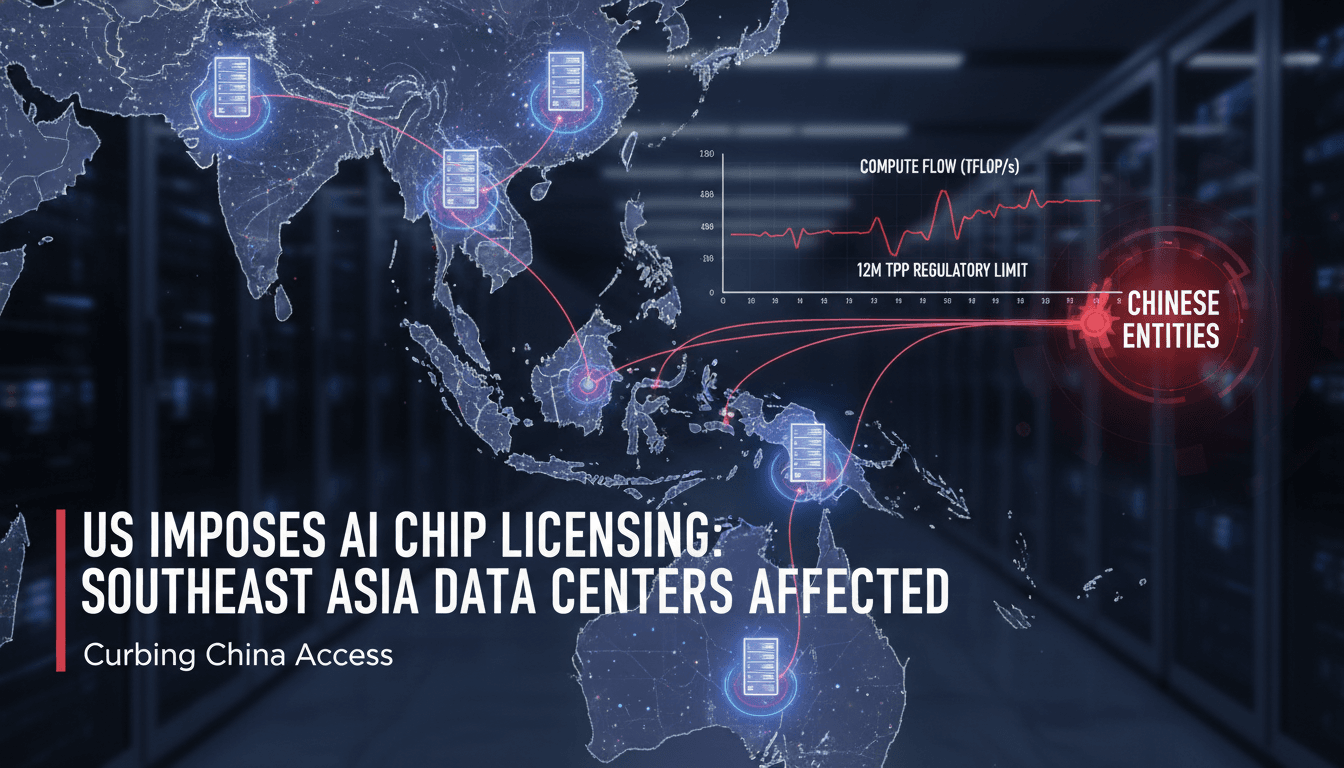
- Remote computing thresholds were locked: The regulation established requirements for global facilities offering aggregate processing performance exceeding 12 million Total Processing Performance (TPP) to Chinese-headquartered entities or entities from D:5 countries.
- Regional markets suffered immediate drops: Following the announcement, Malaysian infrastructure firms registered sharp market declines on November 17, with MN Holdings and Critical Holdings falling nearly 20% and YTL Power dropping almost 10%.
The context you actually need
- Prior export curbs created a compute detour: Previous U.S. controls on direct semiconductor shipments to China drove companies to access computing resources remotely via third-country facilities, accelerating investment across hubs like Malaysia's Johor and Singapore.
- Capacity concentrated rapidly in Southeast Asia: The region accounts for an estimated 75%—or roughly 505.8 megawatts out of 794.2 megawatts—of China's overseas AI computing capacity by the end of 2026.
- Enforcement shifted from physical chips to cloud access: Heightened regulatory attention on potential diversion and smuggling through third parties prompted Washington to close remote-access avenues rather than focusing solely on physical border shipments.
What's really happening
The November 16, 2026 interim final rule issued by the U.S. Department of Commerce Bureau of Industry and Security marks a shift from controlling the destination of physical hardware to governing how computing power is distributed globally.
By designating Singapore, Malaysia, Thailand, Indonesia, and Brazil as higher-risk destinations for chip diversion, the framework targets the operational models of facilities hosting high-performance accelerators. The regulation targets the circumvention of prior export bans by restricting remote computing capacity. Specifically, it subjects any global data center to direct U.S. licensing rules if it provides computing capacity exceeding an aggregate threshold of 12 million TPP to entities headquartered in China or designated D:5 nations.
This mechanism alters the risk-reward calculus for regional infrastructure operators. Over the past several years, capital poured into Southeast Asia to build physical data centers, leveraging abundant land, lower power costs, and proximity to regional commercial centers. Much of that capacity absorbed compute workloads from firms seeking alternatives to domestic Chinese hardware limitations. Under the new rule, operating as a neutral colocation provider becomes legally challenging. Data center operators must either monitor tenant workloads to document that their hardware does not aggregate beyond the 12 million TPP cap for restricted clients, or forgo access to the latest U.S.-designed AI silicon.
The rule introduces an asymmetric advantage for U.S.-headquartered infrastructure providers. U.S. operators operating within these five countries are granted carve-outs coupled with recurring reporting obligations, whereas local, independent, or third-country operators must navigate case-by-case licensing approvals. For regional facilities, this increases administrative overhead, extends procurement cycles, and raises customer verification costs.
Because non-U.S. developers in Singapore and Malaysia rely heavily on international capital and imported accelerators, the requirement to verify end-users creates friction. With a 90-day compliance window in place, project financiers must reassess counterparty risks, leading to deferred development schedules, redesigned customer service contracts, and increased pricing for high-performance enterprise workloads.
Who feels it first (and how)
- Southeast Asian data center developers: Operators in Malaysia and Singapore face immediate compliance audits, project deferrals, and higher customer verification expenditures.
- Enterprise cloud customers in ASEAN: Regional startups and multinationals purchasing local GPU capacity will experience tighter tenant screening and upward price adjustments as operators pass on compliance overhead.
- U.S. hardware exporters and chipmakers: Companies like Nvidia must adjust their regional distribution pipelines, adding licensing checks before fulfilling hardware orders to facilities in covered jurisdictions.
- Chinese technology companies: Firms renting remote computing power across Southeast Asian facilities face service terminations or capacity reductions below the 12 million aggregate TPP threshold.
What to watch next
- The expiration of the 90-day compliance window: This will clarify which regional facilities secure U.S. Commerce Department operating licenses and which choose to offload restricted tenants.
- Singapore and Malaysia bilateral trade engagements: Ongoing consultations between regional trade ministries and U.S. officials will signal whether standard compliance exemptions can be negotiated for local operators.
- Capital expenditure adjustments by regional builders: Quarterly financial disclosures from regional power and infrastructure developers will reveal the extent of project postponements across hubs like Johor.
The interim final rule mandates export licenses for advanced AI chips shipped to data centers in five specified countries and caps aggregate remote compute services for Chinese-headquartered firms at 12 million TPP.
Construction and hardware installation schedules for independent data centers across Southeast Asia will slow down as procurement teams navigate the licensing pipeline.
Whether regional data center operators will pivot toward alternative, non-U.S. accelerator architectures to bypass Commerce Department oversight entirely.
Frequently Asked Questions
- Why it matters?
- The tightening of advanced AI semiconductor licensing establishes extraterritorial operational oversight on overseas infrastructure, altering the capital economics and access models of the global data center expansion.
- What happened (in 30 seconds)?
- New licensing mandates took effect: On November 16, 2026, the U.S. Department of Commerce issued an interim final rule mandating export licenses for advanced AI semiconductors (ECCN 3A090 and related) destined for data centers in Singapore, Malaysia, Thailand, Indonesia, and Brazil. Remote computing thresholds were locked: The regulation established requirements for global facilities offering aggregate processing performance exceeding 12 million Total Processing Performance (TPP) to Chinese-head
- What's really happening?
- The November 16, 2026 interim final rule issued by the U.S. Department of Commerce Bureau of Industry and Security marks a shift from controlling the destination of physical hardware to governing how computing power is distributed globally. By designating Singapore, Malaysia, Thailand, Indonesia, and Brazil as higher-risk destinations for chip diversion, the framework targets the operational models of facilities hosting high-performance accelerators. The regulation targets the circumvention of
- Who feels it first (and how)?
- Southeast Asian data center developers: Operators in Malaysia and Singapore face immediate compliance audits, project deferrals, and higher customer verification expenditures. Enterprise cloud customers in ASEAN: Regional startups and multinationals purchasing local GPU capacity will experience tighter tenant screening and upward price adjustments as operators pass on compliance overhead. U.S. hardware exporters and chipmakers: Companies like Nvidia must adjust their regional distribution pipeli
- What to watch next?
- The expiration of the 90-day compliance window: This will clarify which regional facilities secure U.S. Commerce Department operating licenses and which choose to offload restricted tenants. Singapore and Malaysia bilateral trade engagements: Ongoing consultations between regional trade ministries and U.S. officials will signal whether standard compliance exemptions can be negotiated for local operators. Capital expenditure adjustments by regional builders: Quarterly financial disclosures from r
Technology business and AI-related headlines.
"Data-driven tech newsroom with global scope."
— A47 Editor
How Trump’s AI Chip Crackdown May Hit Southeast Asia
The Trump administration has tightened U.S. export controls on advanced AI chips, closing loopholes that allowed Chinese entities to use American chips and servers remotely through indirect channels. The new rules apply to data centers in Southeast A...
Technology business news, market impacts, and innovation trends.
"Bloomberg is a premier financial and tech news provider, respected for its in-depth reporting and analytical rigor."
— A47 Editor
How Trump’s AI Chip Crackdown May Hit Southeast Asia
The Trump administration has tightened U.S. export controls on advanced AI chips, closing loopholes that allowed Chinese entities to use American chips and servers remotely through indirect channels. The new rules apply to data centers in Southeast A...
Technology business and AI-related headlines.
"Data-driven tech newsroom with global scope."
— A47 Editor
US AI Chip Curbs Test Southeast Asia Data Center Boom
The Trump administration has tightened US export controls on advanced AI chips, closing loopholes that let Chinese entities use American chips and servers remotely through indirect channels, a move that threatens a multibillion-dollar cloud business ...
Technology business news, market impacts, and innovation trends.
"Bloomberg is a premier financial and tech news provider, respected for its in-depth reporting and analytical rigor."
— A47 Editor
US AI Chip Curbs Test Southeast Asia Data Center Boom
The Trump administration has tightened US export controls on advanced AI chips, closing loopholes that let Chinese entities use American chips and servers remotely through indirect channels, a move that threatens a multibillion-dollar cloud business ...
Research, news, and analysis on blockchain startups, DeFi, and regulations.
"Crypto Briefing provides research, news, and analysis on blockchain startups, DeFi, and crypto regulations with investor-focused coverage."
— A47 Editor
New US AI chip rules against China threaten Southeast Asia’s data centers
The United States has introduced new AI chip rules aimed at restricting advanced semiconductor exports to China, a move that could disrupt data center growth across Southeast Asia by raising operational costs and reshaping competitive dynamics, accor...