
Netanyahu Presses Trump for Post-Midterm Iran Strikes as US Weighs Ongoing Qatar-Mediated Diplomacy
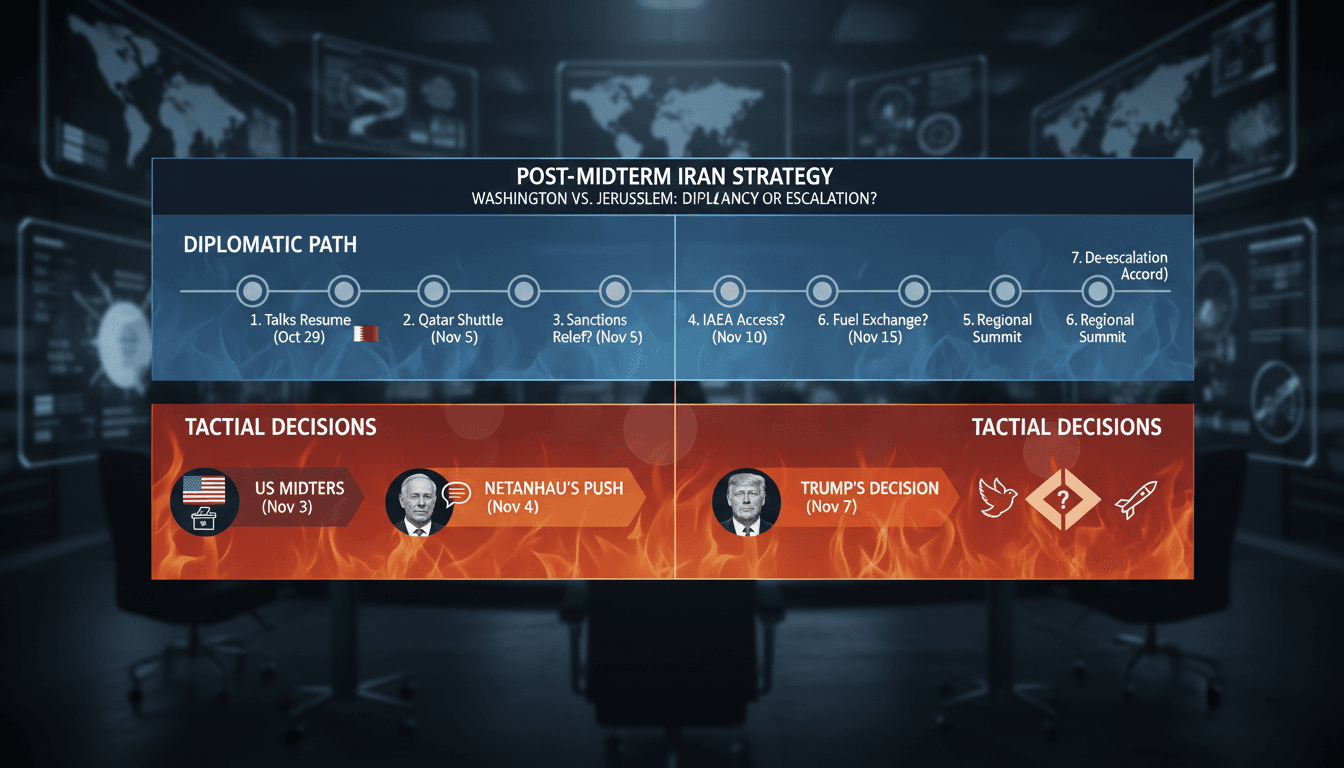
Why it matters
The tactical divergence between unilateral deterrence and mediated talks directly governs maritime security across the Strait of Hormuz and stability pricing in global crude markets.
What happened (in 30 seconds)
- The direct appeal: Israeli Prime Minister Benjamin Netanyahu urged US President Donald Trump during a November 1, 2026 telephone discussion to authorize renewed military strikes on Iran immediately following the November 3 US midterm elections.
- The diplomatic preference: President Trump signaled a preference to allow ongoing Qatari-mediated negotiations in Doha between Washington and Tehran to proceed before committing to kinetic action.
- The unresolved posture: While US leadership maintained operational readiness and consulted regional commanders, no commitment to renewed strikes was authorized, leaving policy positioned between diplomatic testing and military escalation.
The context you actually need
- Domestic political pressures: The call occurred days after Israel's October 27 legislative elections, which left Prime Minister Netanyahu navigating acute coalition strain after losing a parliamentary majority.
- The Doha framework: Ongoing talks facilitated by Qatari mediators involve a seven-step Iranian proposal that addresses both nuclear enrichment concerns and security dynamics within the Strait of Hormuz.
- The fiscal baseline: The strategic calculation follows prior rounds of confrontation that generated an estimated $15 billion in damage to US regional military facilities from Iranian missile and drone barrages.
What's really happening
The friction exposed in the November 1 phone call is not a disagreement over end states, but a strategic split over timing and leverage.
For the Israeli leadership, the operating clock is driven by technical estimates of nuclear reconstitution and acute domestic political fragmentation. Having lost a formal majority in the October 27 parliamentary contest, the executive faces compressed decision cycles. In that incentive structure, an immediate post-midterm strike window offers two benefits: it exploits an existing window of US electoral transition, and it preempts potential interim concessions in Doha before Iranian enrichment infrastructure re-secures hardened positions.
For the White House, the calculation is anchored in cost absorption and leverage sequencing. Prior kinetic exchanges demonstrated clear limits to low-friction operations, highlighted by the $15 billion in facility damage sustained across regional military sites during earlier Iranian missile and drone responses. Authorizing an immediate military escalation alongside an unresolved diplomatic channel removes optionality. By maintaining consultations with operational commanders while publicly declaring that talks are progressing, the US executive preserves secondary options: using the credible threat of force to extract concessions from Tehran via Qatari channels, without prematurely triggering a secondary regional confrontation.
Tehran’s posture relies on symmetric counter-pressure. By presenting a seven-step framework while warning of an extended, multi-phase response to any new strikes, Iranian negotiators aim to price out direct action. Their leverage rests heavily on maritime chokepoints—principally the threat of disruption across the Strait of Hormuz—and the knowledge that regional energy transit absorbs risk premiums rapidly.
This dynamic sets up a distinct trade-off. Delaying strikes preserves mediation pathways, keeps commercial navigation stable, and avoids immediate spikes in regional risk pricing. However, extending negotiations grants Iranian facilities additional operational time to reconstitute defenses, increasing the operational threshold required for any future intervention. Consequently, the regional posture remains volatile: diplomatic engagement serves as the operating mechanism, while military posture functions as the underlying enforcement tool.
Who feels it first (and how)
- Maritime shipping operators and commodity traders: Fleet directors routing bulk and container assets through the Strait of Hormuz must factor war-risk insurance premiums against fluctuating diplomatic progress in Doha.
- Defense procurement and infrastructure contractors: Teams managing asset hardening, air defense replenishment, and facility repair in the region face shifting operational priorities linked directly to the $15 billion damage baseline.
- Corporate risk and treasury officers: Strategic planners across regional trade hubs evaluate contingency hedging based on whether energy supply lines remain stable under mediated terms or encounter sudden transit friction.
What to watch next
- Doha negotiation progress reports: Track whether Qatari mediators secure consensus on the initial phases of the seven-step Iranian proposal, which serves as the primary benchmark for diplomatic viability.
- US military movement post-midterms: Monitor regional asset deployments following November 3 for tactical adjustments indicating preparation for operational contingency rather than standard deterrence.
- Official announcements from Tehran: Watch for statements regarding uranium enrichment volumes or Strait of Hormuz transit protocols that indicate whether defensive posturing is shifting toward asymmetric enforcement.
Prime Minister Netanyahu advocated for immediate post-midterm strikes on Iran; President Trump favored allowing Qatari-mediated negotiations to continue; prior strikes resulted in an estimated $15 billion in infrastructure damage to regional US military bases.
Washington will use the immediate post-election window to assess Tehran's seriousness regarding the seven-step proposal before committing to a definitive shift in military posture.
Whether Israeli operational planning will remain synchronized with US timelines if talks extend without concrete verification protocols or stabilization guarantees.
Frequently Asked Questions
- Why it matters?
- The tactical divergence between unilateral deterrence and mediated talks directly governs maritime security across the Strait of Hormuz and stability pricing in global crude markets.
- What happened (in 30 seconds)?
- The direct appeal: Israeli Prime Minister Benjamin Netanyahu urged US President Donald Trump during a November 1, 2026 telephone discussion to authorize renewed military strikes on Iran immediately following the November 3 US midterm elections. The diplomatic preference: President Trump signaled a preference to allow ongoing Qatari-mediated negotiations in Doha between Washington and Tehran to proceed before committing to kinetic action. The unresolved posture: While US leadership maintained ope
- What's really happening?
- The friction exposed in the November 1 phone call is not a disagreement over end states, but a strategic split over timing and leverage. For the Israeli leadership, the operating clock is driven by technical estimates of nuclear reconstitution and acute domestic political fragmentation. Having lost a formal majority in the October 27 parliamentary contest, the executive faces compressed decision cycles. In that incentive structure, an immediate post-midterm strike window offers two benefits: i
- Who feels it first (and how)?
- Maritime shipping operators and commodity traders: Fleet directors routing bulk and container assets through the Strait of Hormuz must factor war-risk insurance premiums against fluctuating diplomatic progress in Doha. Defense procurement and infrastructure contractors: Teams managing asset hardening, air defense replenishment, and facility repair in the region face shifting operational priorities linked directly to the $15 billion damage baseline. Corporate risk and treasury officers: Strategic
- What to watch next?
- Doha negotiation progress reports: Track whether Qatari mediators secure consensus on the initial phases of the seven-step Iranian proposal, which serves as the primary benchmark for diplomatic viability. US military movement post-midterms: Monitor regional asset deployments following November 3 for tactical adjustments indicating preparation for operational contingency rather than standard deterrence. Official announcements from Tehran: Watch for statements regarding uranium enrichment volumes
RT is a Russian state-funded network covering global events from a Russian perspective.
"RT is widely criticized for promoting pro-Kremlin narratives and is considered by many to be a state propaganda outlet."
— A47 Editor
Netanyahu pressing Trump to bomb Iran immediately after midterms – Axios
Israeli Prime Minister Benjamin Netanyahu is reportedly pressing US President Donald Trump to launch strikes on Iran immediately after the November midterm elections, according to Axios, as reported by RT (Russia Today). The base story frames the pus...
Global business headlines with AI angles.
"General business outlet that frequently covers AI."
— A47 Editor
Netanyahu Reportedly Wants to Strike Iran Right After U.S. Midterms, But Trump Wants to Give Negotiations a Chance
Israeli Prime Minister Benjamin Netanyahu reportedly wants to carry out a joint strike on Iran with the United States immediately after the U.S. midterm elections, while President Donald Trump prefers to give diplomatic negotiations more time to play...
Arabic-language coverage of international news and geopolitics.
"RT Arabic is a Russian state-funded outlet often criticized for promoting Kremlin-aligned narratives."
— A47 Editor
أكسيوس: نتنياهو يضغط على ترامب لضرب إيران بعد الانتخابات الأمريكية والأخير يميل للتفاوض
Axios reported that Israeli Prime Minister Benjamin Netanyahu is pressing U.S. President Donald Trump to resume strikes on Iran immediately after the November 3 congressional elections, while Trump reportedly leans toward negotiations with Tehran.