
Houthi Forces Assume Full Control of Bab el-Mandeb Strait as Saudi-Backed Yemeni Units Withdraw
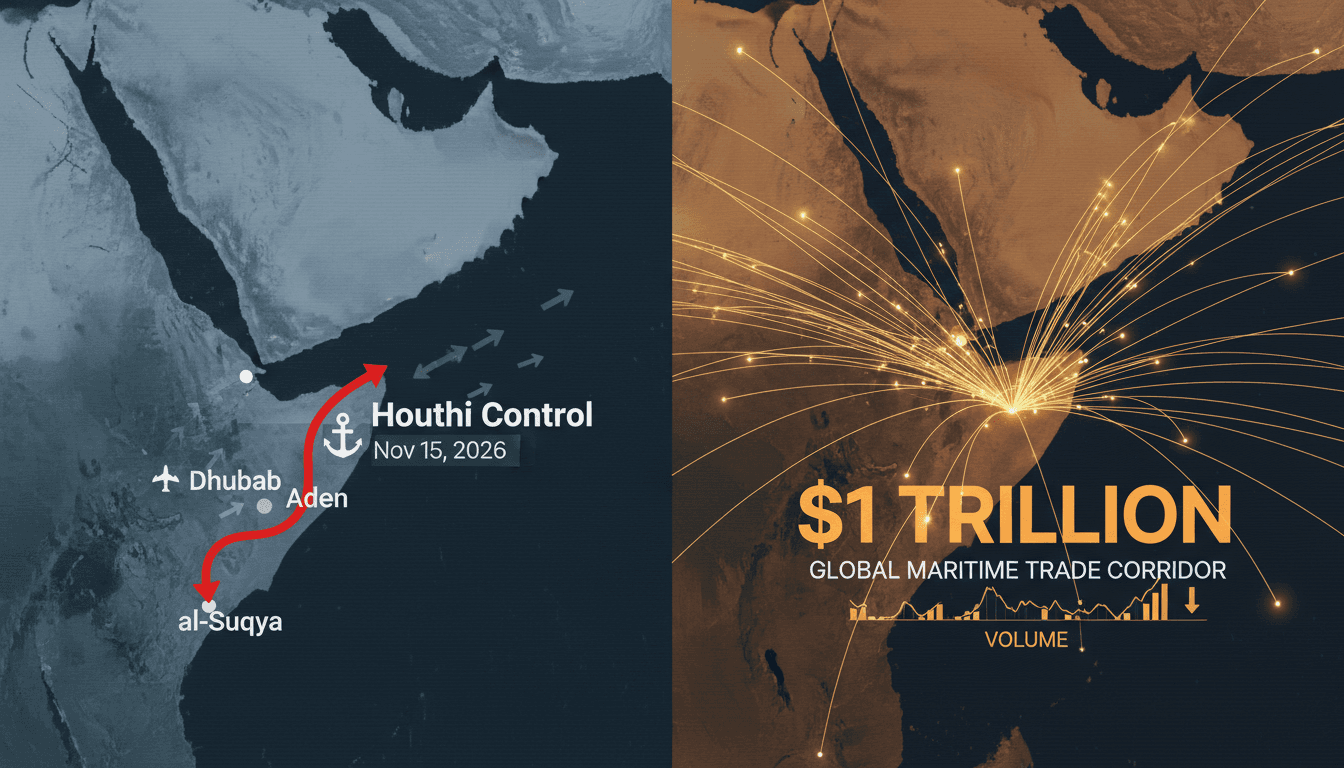
Why it matters
A single chokepoint carrying $1 trillion in annual global commerce has fallen under the singular operational leverage of Houthi forces, complicating risk premiums across global logistics corridors.
What happened (in 30 seconds)
- A planned retreat altered control: On November 15, 2026, Saudi-backed Southern Armed Forces withdrew from positions near Dhubab Airport and the Bab el-Mandeb Strait, redeploying to al-Suqyah roughly 150 kilometers west of Aden.
- A multi-week offensive concluded: The redeployment marked the end of a six-week counteroffensive launched in October that attempted to reclaim Red Sea coastal zones seized by Houthi forces in September.
- Physical consolidation occurred: Iran-backed Houthi forces secured full territorial control over the strait area, occupying elevated positions directly overlooking the narrow international shipping channel.
The context you actually need
- A dormant civil war restarted: The conflict in Yemen, largely paused under a truce arrangement since 2022, reignited in the summer of 2026 as wider regional friction expanded.
- Alternative corridors were already strained: Saudi Arabia had previously shifted crude export flows through the Bab el-Mandeb corridor after security disruptions constrained transit via the Strait of Hormuz.
- Territorial priorities forced the concession: Facing pressure on Taiz and a need to defend administrative infrastructure in Aden, coalition leadership chose to consolidate lines rather than maintain extended coastal positions.
What's really happening
The mechanics of global shipping depend entirely on predictable bottlenecks. The Bab el-Mandeb Strait serves as the southern gate to the Red Sea and the Suez Canal, processing approximately $1 trillion in annual goods. When physical control of the headlands flanking a waterway that narrows to under 30 kilometers shifts to a non-state actor equipped with coastal radar, drones, and anti-ship munitions, the pricing architecture of international trade adjusts instantly.
The Southern Armed Forces' decision to abandon positions near Dhubab Airport was driven by defensive arithmetic. In military logistics, holding an extended littoral strip without air dominance or defensible depth creates a liability. With Houthi forces exerting pressure on Taiz and threatening rear positions toward Aden, coalition commanders faced an asymmetric resource drain. By pulling forces 150 kilometers eastward to al-Suqyah, their command preserved core administrative territory at the expense of maritime oversight.
For Houthi leadership, holding the coastal high ground west of Taiz Governorate delivers outsized leverage with minimal resource expenditure. Stationary coastal artillery, anti-ship cruise missiles, and loitering munitions deployed on coastal bluffs overlook the international transit lane. This tactical posture eliminates the need for a conventional naval fleet to exercise sea denial.
This dynamic creates secondary economic impacts. Prior to this shift, energy exporters had rerouted oil tankers through the Red Sea to circumvent disruptions around the Strait of Hormuz. With the Bab el-Mandeb waterway now subject to coastal missile coverage and simultaneous cross-border strikes targeting Aramco and Riyadh assets, that alternative route loses its operational utility.
When insurance underwriters calculate maritime transit risk through contested waters, premiums climb or coverage is withdrawn. Ship operators then evaluate the trade-off: absorb heightened insurance costs and potential physical loss, or absorb a ten- to fourteen-day transit extension around the Cape of Good Hope. Both choices remove vessel capacity from circulation, contract spot container availability, and lift bunker fuel consumption, translating into higher landed costs across import-dependent markets.
Who feels it first (and how)
- Supply Chain Executives in Dubai & the GCC: Importers and freight forwarders face higher war-risk insurance premiums, delayed ocean shipments, and renegotiated spot container rates on Europe-Asia lanes.
- Maritime Underwriters & Fleet Operators: Commercial vessel owners must decide whether to route ships past newly fortified Houthi coastal positions or absorb the structural costs of circumnavigating Africa.
- Energy Traders & Refiners: Energy flows re-routed from Hormuz into the Red Sea face operational bottlenecks, driving crude volatility and altering physical delivery schedules.
- Civilian Populations in Southwest Yemen: Residents in besieged urban hubs like Taiz face compounding humanitarian distress as local trade arteries and aid flows encounter expanded checkpoint control.
What to watch next
- Commercial rerouting announcements: Monitor whether major container lines suspend Red Sea bookings in favor of Cape of Good Hope diversions, which would signal a prolonged cost adjustment.
- Attacks on Saudi energy nodes: Watch for escalation in drone and missile deployment against Aramco processing facilities, which would indicate a broader campaign beyond coastal deterrence.
- Coalition perimeter stabilization at al-Suqyah: Track whether government forces establish sustainable defensive lines 150 kilometers outside Aden, or if inland pressure on Taiz triggers further withdrawals.
Southern Armed Forces redeployed to al-Suqyah on November 15, 2026, leaving the Bab el-Mandeb coastal corridor under complete Houthi operational control.
Maritime insurance syndicates will elevate war-risk surcharges for vessels entering the southern Red Sea, shifting marginal transit volumes toward southern Africa.
Whether coalition partners will launch air campaigns to contest Houthi surveillance platforms along the strait, or accept the maritime chokepoint as a consolidated security boundary.
Frequently Asked Questions
- Why it matters?
- A single chokepoint carrying $1 trillion in annual global commerce has fallen under the singular operational leverage of Houthi forces, complicating risk premiums across global logistics corridors.
- What happened (in 30 seconds)?
- A planned retreat altered control: On November 15, 2026, Saudi-backed Southern Armed Forces withdrew from positions near Dhubab Airport and the Bab el-Mandeb Strait, redeploying to al-Suqyah roughly 150 kilometers west of Aden. A multi-week offensive concluded: The redeployment marked the end of a six-week counteroffensive launched in October that attempted to reclaim Red Sea coastal zones seized by Houthi forces in September. Physical consolidation occurred: Iran-backed Houthi forces secured fu
- What's really happening?
- The mechanics of global shipping depend entirely on predictable bottlenecks. The Bab el-Mandeb Strait serves as the southern gate to the Red Sea and the Suez Canal, processing approximately $1 trillion in annual goods. When physical control of the headlands flanking a waterway that narrows to under 30 kilometers shifts to a non-state actor equipped with coastal radar, drones, and anti-ship munitions, the pricing architecture of international trade adjusts instantly. The Southern Armed Forces' d
- Who feels it first (and how)?
- Supply Chain Executives in Dubai & the GCC: Importers and freight forwarders face higher war-risk insurance premiums, delayed ocean shipments, and renegotiated spot container rates on Europe-Asia lanes. Maritime Underwriters & Fleet Operators: Commercial vessel owners must decide whether to route ships past newly fortified Houthi coastal positions or absorb the structural costs of circumnavigating Africa. Energy Traders & Refiners: Energy flows re-routed from Hormuz into the Red Sea face operati
- What to watch next?
- Commercial rerouting announcements: Monitor whether major container lines suspend Red Sea bookings in favor of Cape of Good Hope diversions, which would signal a prolonged cost adjustment. Attacks on Saudi energy nodes: Watch for escalation in drone and missile deployment against Aramco processing facilities, which would indicate a broader campaign beyond coastal deterrence. Coalition perimeter stabilization at al-Suqyah: Track whether government forces establish sustainable defensive lines 150
Breaking news, politics, business, and entertainment from the U.S. and around the world.
"The New York Post is a tabloid-format newspaper known for its sensationalist headlines and conservative-leaning editorial tone."
— A47 Editor
Major Red Sea strait falls under full Houthi control as Yemeni forces retreat
The Saudi-backed Yemeni government withdrew from the Bab el-Mandeb Strait on Sunday, relinquishing full control of the waterway to the Iran-backed Houthi group, according to the New York Post report on the Red Sea strait.
24/7 international news from a French perspective in multiple languages.
"France 24 is viewed as a globally focused outlet with balanced coverage and a European perspective."
— A47 Editor
Yemen's Houthis advance on Aden as government forces retreat to defend their capital
Houthi forces in Yemen have advanced to within 60 kilometres of Aden, the seat of the country's internationally recognised government, according to military and government sources. The embattled government earlier announced it was pulling back its la...
European coverage of Middle East politics and security issues.
"France 24 offers international reporting with a European editorial perspective."
— A47 Editor
Yemen's Houthis advance on Aden as government forces retreat to defend their capital
Houthi forces in Yemen have advanced to within 60 kilometres of Aden, the seat of the country's internationally recognised government, according to military and government sources. The embattled government earlier announced it was pulling back its la...
Regional coverage and analysis focused on politics, diplomacy, and business across the Middle East.
"Al-Monitor is known for analytical reporting on Middle East politics and policy developments."
— A47 Editor
Anti-Houthi forces retreat in Yemen as Iran strikes Bahrain
On Sunday, November 15, Saudi-backed Yemeni government forces withdrew from an area overlooking the strategic Bab el-Mandeb Strait, leaving the Iran-aligned Houthis in control of the position and pulling back to defend the temporary capital Aden, acc...
UAE-based English-language newspaper covering regional politics, economics, and global affairs.
"The National reflects Emirati policy perspectives while maintaining international editorial standards."
— A47 Editor
Yemen government forces' pullback hands Houthis greater leverage over Bab Al Mandeb
Yemen's Saudi-backed, internationally recognised government forces have withdrawn from an area overlooking the strategic Bab el-Mandeb Strait, leaving the Iran-aligned Houthis in control of the position, according to Reuters reporting. The pullback c...
Regional coverage and analysis focused on politics, diplomacy, and business across the Middle East.
"Al-Monitor is known for analytical reporting on Middle East politics and policy developments."
— A47 Editor
Yemeni government force retreats from strait in major setback in war against Houthis
Yemeni government forces announced on Sunday, November 15, that they were withdrawing from the area near the Bab el-Mandeb Strait to focus on defending their main base in Aden, leaving the Iran-aligned Houthis in control of the position and marking t...
Regional coverage and analysis focused on politics, diplomacy, and business across the Middle East.
"Al-Monitor is known for analytical reporting on Middle East politics and policy developments."
— A47 Editor
Yemen government forces withdraw from area near Bab el-Mandeb Strait, Houthis in control
Yemeni forces fighting for the internationally recognised, Saudi-backed government said on Sunday that they were withdrawing from an area overlooking the strategic Bab el-Mandeb Strait, leaving the Iran-aligned Houthis in control, according to Reuter...