
EU Proposes 22nd Russia Sanctions Package Targeting Banks, Crypto Platforms and Sports Participation
Why it matters
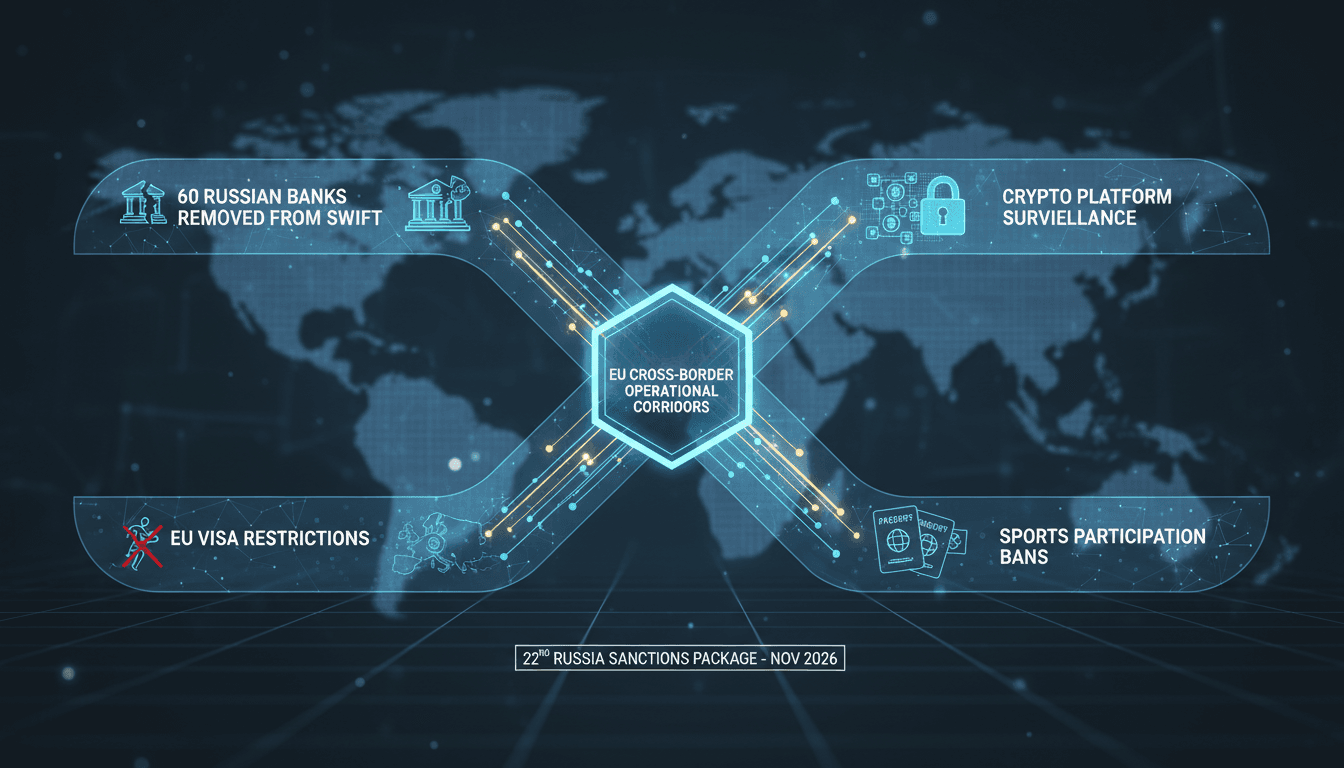
The European Commission's latest measures signal a strategic expansion of economic statecraft, combining the exclusion of approximately 60 additional financial institutions from global messaging networks with explicit legal bans on sports sponsorships, flags, and executive governance.
What happened (in 30 seconds)
- A sweeping 22nd package was unveiled: On November 23, 2026, European Commission President Ursula von der Leyen proposed targeted restrictions spanning banking infrastructure, cryptocurrency surveillance, visa issuance for ex-combatants, and pan-European sporting events.
- Financial networks face deeper isolation: The draft legislation recommends disconnecting approximately 60 Russian banks from the SWIFT international payments network and establishing a dedicated Crypto Sanctions Task Force to intercept asset transfers seeking alternative rails.
- Athletic and cultural participation faces strict prohibitions: The proposal legally bars Russian teams and athletes from competing under their national flag at European Union events, blocks Russian state symbols, halts corporate sponsorship flows into EU sports organizations, and disqualifies Russian nationals from holding leadership roles in European federations.
The context you actually need
- Four years of cumulative economic measures: Since the 2022 full-scale invasion of Ukraine, the European Union has imposed 21 separate sanctions rounds targeting over 4,200 individuals and corporate entities, systematically restricting trade across key sectors including energy and manufacturing.
- Circumvention has driven regulatory evolution: As traditional trade and Tier-1 credit institutions adapted to previous restrictions, capital flows migrated toward smaller regional lenders, over-the-counter crypto platforms, and non-aligned jurisdictions, prompting Brussels to seek broader statutory enforcement tools.
- Unanimity remains the legal baseline: Under European Union governance frameworks, any formal sanctions proposal authored by the Commission requires unanimous sign-off from all 27 member states before taking effect as enforceable community law.
What's really happening
The European Commission’s 22nd package does not merely repeat established economic pressure points; it shifts regulatory attention to structural circumvention channels and national prestige assets. By moving against approximately 60 additional banks, Brussels is effectively pursuing the long tail of the Russian financial sector. Early sanctions rounds in 2022 removed the country's primary national lenders from the SWIFT messaging system. Consequently, mid-tier and regional financial institutions served as critical balance-sheet conduits for domestic firms processing international settlements. Stripping another 60 institutions of secure messaging access shrinks the remaining nodes through which cross-border settlement can clear via conventional messaging systems.
Concurrently, the creation of a specialized Crypto Sanctions Task Force acknowledges that capital flight and cross-border commercial transactions have increasingly migrated to decentralized ledgers and non-compliant virtual asset service providers (VASPs). Regulators are targeting the digital off-ramps that businesses use to bypass foreign currency controls and payment limitations. Rather than monitoring solely fiat banking balance sheets, European compliance bodies will scrutinize exchange transactions, on-chain movements, and intermediary custodial wallets.
The sports-specific prohibitions demonstrate an incentive-based calculation aimed at state-level soft power. For decades, global athletic spectacles have served as instruments of international diplomacy and brand building. By explicitly restricting Russian teams and athletes from competing under the national flag within the EU, barring Russian national symbols, freezing Russian corporate funding to EU sporting and cultural bodies, and disqualifying Russian citizens from leadership positions in European federations, the European Commission is establishing legally binding commercial limits on cultural engagement.
This regulatory pivot directly affects European event organizers, federations, and venues. Under the proposed rules, European entities would face statutory penalties for entering into commercial marketing or balance-sheet agreements with Russian state and corporate sponsors. For European federations, these rules replace ad-hoc, league-by-league participation guidelines with uniform EU law, eliminating the discretionary loopholes that international athletic governing bodies previously navigated.
Who feels it first (and how)
- European sports and cultural federations: Compliance directors and commercial officers must immediately review balance sheets, event rosters, and sponsorship contracts to purge banned Russian financing, team designations, and governing board members.
- Cross-border trade finance desks: Financial institutions running foreign exchange settlements face an immediate reduction in viable correspondent clearing routes as approximately 60 lenders lose SWIFT connectivity.
- Digital asset exchanges and compliance teams: Virtual asset platforms operating in or servicing European Union jurisdictions will face direct scrutiny from the new Crypto Sanctions Task Force, requiring stricter verification of wallet addresses and transaction histories.
- Consular and immigration authorities: Border control teams and visa processing units across all 27 member states will be required to execute new screening protocols to enforce visa restrictions against Russian military ex-combatants.
What to watch next
- The Council of the EU negotiation timetable: Diplomats aim to secure unanimous approval from all 27 member states before the end of 2026, making any national reservations or requested carve-outs the critical variable for legislative timing.
- International sports federation compliance directives: Watch how European and international governing bodies align their bylaws with binding EU law regarding athlete eligibility and commercial agreements.
- Operational parameters of the Crypto Task Force: The legal mandate and enforcement capabilities of the new regulatory body will determine whether it focuses primarily on centralized retail platforms or institutional decentralized finance protocols.
The European Commission has officially drafted and presented the 22nd package, which specifically lists approximately 60 banks for SWIFT disconnection, targets cryptocurrency circumvention networks, imposes visa restrictions on ex-combatants, and bans official Russian participation, symbols, funding, and board leadership in EU sports bodies.
Given the stated diplomatic intent to finalize negotiations by the end of 2026, member states will push through internal deliberations rapidly, with consensus likely hinging on potential economic offsets for affected industries.
The exact regulatory definitions that will determine how individual federations handle dual-national athletes, non-flag neutral competitors, and existing long-term sponsorship contracts remain subject to the final statutory text.
Frequently Asked Questions
- Why it matters?
- The European Commission's latest measures signal a strategic expansion of economic statecraft, combining the exclusion of approximately 60 additional financial institutions from global messaging networks with explicit legal bans on sports sponsorships, flags, and executive governance.
- What happened (in 30 seconds)?
- A sweeping 22nd package was unveiled: On November 23, 2026, European Commission President Ursula von der Leyen proposed targeted restrictions spanning banking infrastructure, cryptocurrency surveillance, visa issuance for ex-combatants, and pan-European sporting events. Financial networks face deeper isolation: The draft legislation recommends disconnecting approximately 60 Russian banks from the SWIFT international payments network and establishing a dedicated Crypto Sanctions Task Force to int
- What's really happening?
- The European Commission’s 22nd package does not merely repeat established economic pressure points; it shifts regulatory attention to structural circumvention channels and national prestige assets. By moving against approximately 60 additional banks, Brussels is effectively pursuing the long tail of the Russian financial sector. Early sanctions rounds in 2022 removed the country's primary national lenders from the SWIFT messaging system. Consequently, mid-tier and regional financial institutions
- Who feels it first (and how)?
- European sports and cultural federations: Compliance directors and commercial officers must immediately review balance sheets, event rosters, and sponsorship contracts to purge banned Russian financing, team designations, and governing board members. Cross-border trade finance desks: Financial institutions running foreign exchange settlements face an immediate reduction in viable correspondent clearing routes as approximately 60 lenders lose SWIFT connectivity. Digital asset exchanges and compli
- What to watch next?
- The Council of the EU negotiation timetable: Diplomats aim to secure unanimous approval from all 27 member states before the end of 2026, making any national reservations or requested carve-outs the critical variable for legislative timing. International sports federation compliance directives: Watch how European and international governing bodies align their bylaws with binding EU law regarding athlete eligibility and commercial agreements. Operational parameters of the Crypto Task Force: The l
Global news coverage with extensive reporting on Middle Eastern conflicts and geopolitics.
"Al Jazeera is a Qatar-based broadcaster known for wide regional coverage and alternative perspectives."
— A47 Editor
EU plans sports ban in sweeping new Russia sanctions proposal
The European Union has proposed a sweeping new round of sanctions against Russia that includes a sports ban, with the stated aims of curbing Russian crypto-based financing and Kremlin 'propaganda' carried through sporting events, according to the bas...
Comprehensive coverage of Middle Eastern and global issues.
"Al Jazeera is a prominent voice from the Global South, especially the Middle East, with an emphasis on underreported stories."
— A47 Editor
EU plans sports ban in sweeping new Russia sanctions proposal
The European Union has proposed a sweeping new round of sanctions against Russia that includes a sports ban, with the stated aims of curbing Russian crypto-based financing and Kremlin 'propaganda' carried through sporting events, according to the bas...
RT is a Russian state-funded network covering global events from a Russian perspective.
"RT is widely criticized for promoting pro-Kremlin narratives and is considered by many to be a state propaganda outlet."
— A47 Editor
EU targets Russian athletes and war veterans in new sanctions push
The European Union has proposed new sanctions targeting Russian banks, military veterans, athletes and energy infrastructure, as Ukraine peace efforts continue, according to RT (Russia Today) reporting on the base article. The proposal forms part of ...
Conservative-leaning political and national coverage.
"The Washington Times is a conservative-leaning newspaper known for its political coverage and advocacy of right-of-center viewpoints."
— A47 Editor
EU proposes sweeping new Russia sanctions targeting banks, crypto and sports events
The European Commission on Monday proposed a new round of sanctions against Russia over its war in Ukraine, targeting dozens of Russian banks, cracking down on crypto platforms, and imposing bans on sporting teams and athletes from competing under th...