
Stoxx Europe 600 Index Rises Following Iran's Reopening of Strait of Hormuz
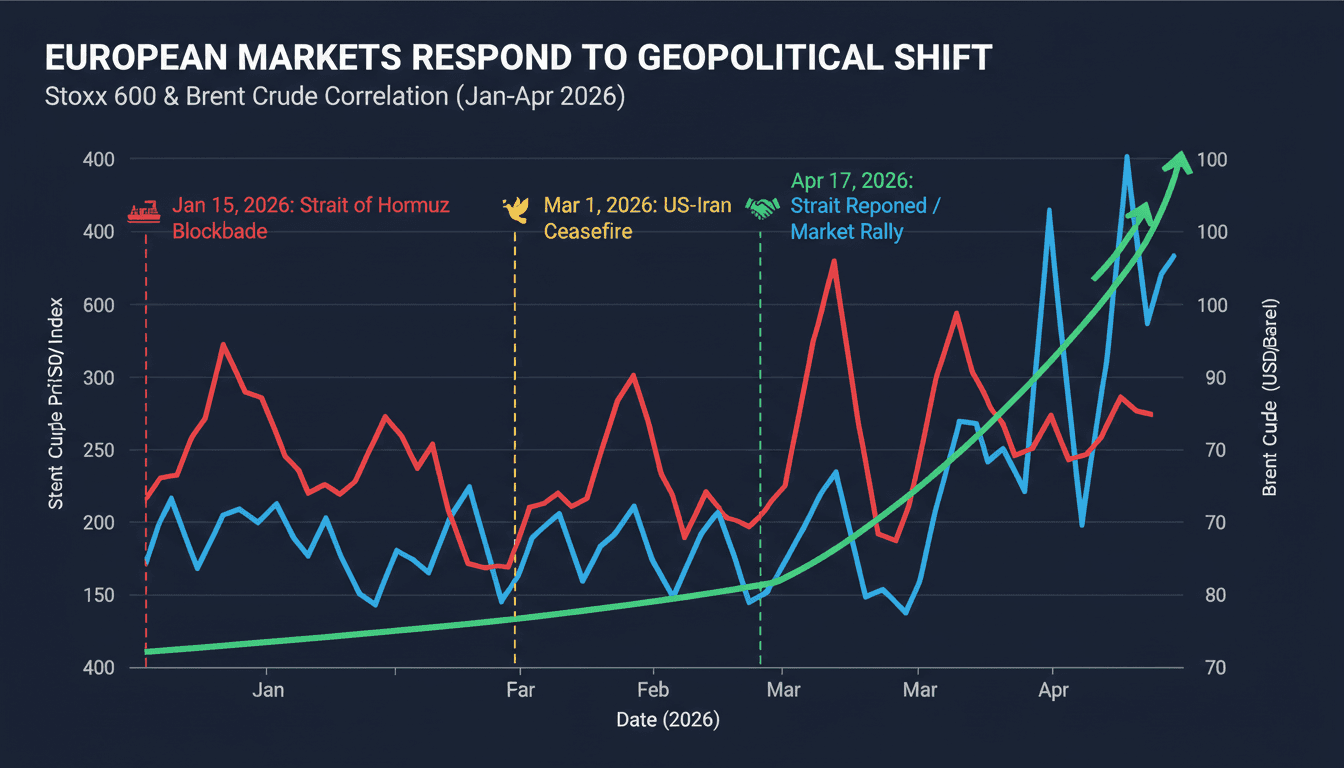
Here's what it means for you.
If you’re invested in European equities or dependent on stable energy prices, recent developments could significantly impact your portfolio and operational costs.
Why it matters
The reopening of the Strait of Hormuz has alleviated energy supply concerns, leading to a notable recovery in European markets and influencing global economic stability.
What happened (in 30 seconds)
- Stoxx Europe 600 index rose 1.91% for the week, marking its fourth consecutive weekly gain, closing at 626.58 points.
- Brent crude prices fell 11.2% to $88.27 per barrel following Iran's announcement of full access to the Strait of Hormuz.
- Geopolitical risks have diminished, prompting a recovery in investor confidence across European equities, particularly in media and technology sectors.
The context you actually need
- February 28, 2026: US-Israel strikes on Iran led to partial closure of the Strait of Hormuz, causing energy supply disruptions and rising inflation fears in Europe.
- April 8, 2026: A fragile ceasefire initiated a relief rally, with the Stoxx 600 logging its best day in over four years.
- April 17, 2026: Iranian Foreign Minister announced full reopening of the strait, which significantly reduced oil prices and restored investor risk appetite.
What's really happening
The recent recovery in the Stoxx Europe 600 index is a direct response to the geopolitical landscape surrounding the Strait of Hormuz, a critical chokepoint for global oil supply. Following the US-Israel strikes on Iran, the partial closure of the strait led to a spike in oil prices and heightened inflation fears across Europe. This situation pressured corporate profits and caused significant declines in equity markets.
However, the announcement by Iran on April 17, 2026, to fully reopen the strait during a US-Iran ceasefire has shifted the narrative. The immediate effect was a sharp decline in Brent crude prices, which fell 11.2% to $88.27 per barrel. This price drop alleviated some of the inflationary pressures that had been building in Europe, allowing for a recovery in investor sentiment.
The Stoxx 600 index's rise can be attributed to increased confidence in the media and technology sectors, which are often more sensitive to changes in economic conditions. As oil prices stabilize, companies in these sectors can better manage operational costs, leading to improved profit margins. Furthermore, the European Central Bank (ECB) has adjusted its policy expectations, with the odds of a rate hike falling to 20%, reflecting eased inflation pressures.
The broader implications of this recovery extend beyond just the stock market. Lower oil prices can lead to reduced transportation and production costs, benefiting consumers and businesses alike. However, the UAE and other Gulf states may face revenue pressures from lower oil exports, which could impact their economies.
As the situation evolves, the interplay between geopolitical stability and market dynamics will be crucial. Investors will need to remain vigilant about potential shifts in policy from the ECB and the Bank of England, as well as any developments in US-Iran relations that could affect energy markets.
Who feels it first (and how)
- Investors in European equities: They benefit from rising stock prices and improved market sentiment.
- Energy sector companies: Lower oil prices can reduce operational costs and improve profit margins.
- Consumers in Europe: They may see reduced prices for goods and services as inflation pressures ease.
- Gulf state economies: They could experience revenue declines due to lower oil prices, impacting public spending and investment.
What to watch next
- US-Iran diplomatic talks: Continued negotiations could further stabilize the region and influence oil prices, impacting European markets.
- ECB policy announcements: Any shifts in monetary policy will be crucial for understanding future market movements and inflation expectations.
- Oil price fluctuations: Watch for any changes in Brent crude prices, as they directly affect inflation and economic stability in Europe.
The Stoxx Europe 600 index has posted four consecutive weekly gains.
Continued geopolitical stability will support further market recovery and lower inflation pressures.
The long-term impact of lower oil prices on Gulf economies and their potential responses.
Frequently Asked Questions
- Why it matters?
- The reopening of the Strait of Hormuz has alleviated energy supply concerns, leading to a notable recovery in European markets and influencing global economic stability.
- What happened (in 30 seconds)?
- Stoxx Europe 600 index rose 1.91% for the week, marking its fourth consecutive weekly gain, closing at 626.58 points. Brent crude prices fell 11.2% to $88.27 per barrel following Iran's announcement of full access to the Strait of Hormuz. Geopolitical risks have diminished, prompting a recovery in investor confidence across European equities, particularly in media and technology sectors.
- What's really happening?
- The recent recovery in the Stoxx Europe 600 index is a direct response to the geopolitical landscape surrounding the Strait of Hormuz, a critical chokepoint for global oil supply. Following the US-Israel strikes on Iran, the partial closure of the strait led to a spike in oil prices and heightened inflation fears across Europe. This situation pressured corporate profits and caused significant declines in equity markets. However, the announcement by Iran on April 17, 2026, to fully reopen the s
- Who feels it first (and how)?
- Investors in European equities: They benefit from rising stock prices and improved market sentiment. Energy sector companies: Lower oil prices can reduce operational costs and improve profit margins. Consumers in Europe: They may see reduced prices for goods and services as inflation pressures ease. Gulf state economies: They could experience revenue declines due to lower oil prices, impacting public spending and investment.
- What to watch next?
- US-Iran diplomatic talks: Continued negotiations could further stabilize the region and influence oil prices, impacting European markets. ECB policy announcements: Any shifts in monetary policy will be crucial for understanding future market movements and inflation expectations. Oil price fluctuations: Watch for any changes in Brent crude prices, as they directly affect inflation and economic stability in Europe.
Pan-Arab news coverage spanning politics, business, sports, and regional affairs.
"Asharq Al-Awsat reflects a broad Arab editorial perspective with strong attention to regional geopolitics."
— A47 Editor
الأسهم الأوروبية تواصل التعافي وسط مكاسب أسبوعية لـ«ستوكس 600»
European stocks continued their gradual recovery, with the Stoxx 600 index set to finish its fourth consecutive week of gains, reflecting a positive trend in the market.
Arabic-language UAE newspaper coverage focused on domestic affairs, public institutions, business, society, and regional developments.
"Al Khaleej coverage generally reflects a mainstream UAE editorial lens with strong attention to public affairs, institutions, and regional developments."
— A47 Editor
ستوكس 600 الأوروبي يتجه لتحقيق مكاسب للأسبوع الرابع
The Stoxx 600 index is on track to achieve gains for the fourth consecutive week, despite a slight decline of 0.04% to 616.71 points, as investors remain cautious ahead of potential discussions aimed at resolving the ongoing conflict in the Middle Ea...
Arabic-language UAE newspaper coverage focused on domestic affairs, public institutions, business, society, and regional developments.
"Al Khaleej coverage generally reflects a mainstream UAE editorial lens with strong attention to public affairs, institutions, and regional developments."
— A47 Editor
أسهم أوروبا تستقر مع تقييم نتائج الأعمال وتطورات الشرق الأوسط
European stocks stabilized on Wednesday following gains from the previous session, as investors assessed a range of corporate earnings reports while monitoring developments in the Middle East. The Stoxx Europe 600 index rose by 0.05% to 620.24 points...