
China's Exports Slow to 2.5% Growth Amid Iranian War Impact
Here's what it means for you.
If you're in a trade-dependent sector, prepare for potential disruptions and increased costs.
Why it matters
The slowdown in China's exports signals a broader decline in global demand, impacting economies and industries worldwide.
What happened (in 30 seconds)
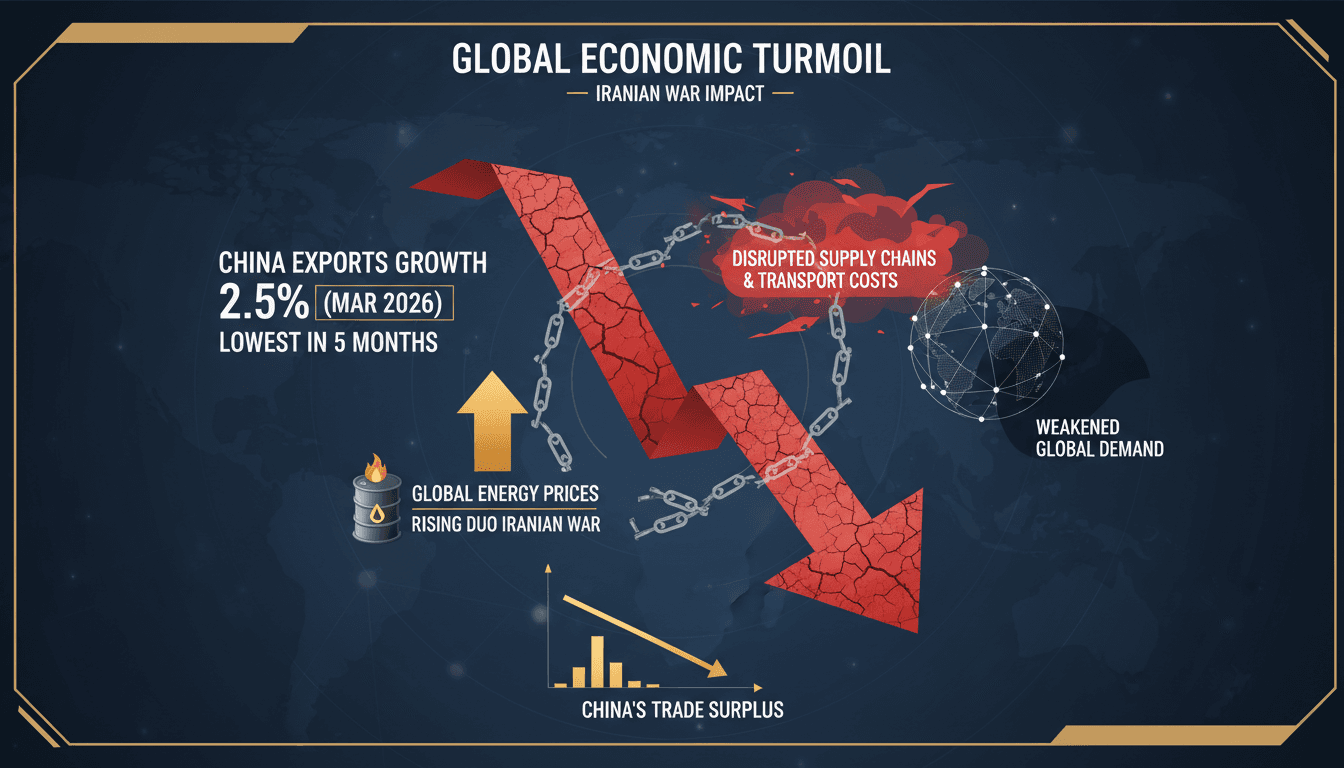
- China's exports grew by only 2.5% in March 2026, the lowest rate in five months, down from 21.8% in January-February.
- The trade surplus fell to $51.13 billion, significantly below expectations of $108 billion, indicating weakened demand.
- Global energy price shocks and transportation disruptions from the Iranian war have exacerbated vulnerabilities in China's export-reliant economy.
The context you actually need
- China's economy is heavily export-driven, with a $19 trillion valuation relying on international trade to offset weak domestic consumption.
- The Iranian war has disrupted energy supplies, leading to increased global commodity prices and uncertainty, which has curtailed demand for Chinese goods.
- Preceding months saw strong growth driven by AI-related demand and pre-tariff shipments, making the March slowdown particularly notable.
What's really happening
In early 2026, China's export growth was buoyed by a surge in demand for technology products, particularly semiconductors and electric vehicles, as businesses rushed to meet deadlines before U.S. tariffs took effect. However, the escalation of the Iranian war in March has dramatically shifted the landscape. The conflict has not only disrupted energy supplies from the Middle East but has also led to significant increases in transportation costs and heightened uncertainty among global importers.
As a result, China's export growth plummeted to just 2.5% in March, a stark contrast to the robust 21.8% growth seen in the preceding months. This deceleration has been attributed to several factors: the immediate impact of the Iranian war on global demand, rising energy prices that have compressed profit margins, and seasonal effects related to the Lunar New Year, which typically sees a slowdown in trade activity.
The implications of this slowdown are profound. With a trade surplus that halved to $51.13 billion, analysts are warning of a shrinking Chinese trade surplus as energy costs continue to rise. This could lead to a ripple effect across global markets, particularly in sectors that rely heavily on Chinese exports. The decline in demand for Chinese goods could also exacerbate existing vulnerabilities in economies that are already struggling with inflation and supply chain disruptions.
Moreover, the situation is compounded by the fact that China's economy is heavily reliant on exports to stimulate growth. Economists project a GDP growth of 4.6% for 2026, which is within the government's target range of 4.5-5%. However, if the global demand continues to weaken, these projections may need to be revised downward, leading to further economic challenges both domestically and internationally.
Who feels it first (and how)
- Exporters in China: Companies relying on international markets will face reduced orders and increased competition.
- Global importers: Businesses that depend on Chinese goods, especially in technology and consumer products, will experience supply shortages and rising costs.
- Consumers: Higher prices for goods that rely on Chinese manufacturing may lead to increased living costs.
- Investors: Those with stakes in export-driven sectors may see volatility in stock prices and reduced returns.
What to watch next
- Q1 2026 GDP data release: Scheduled for April 17, 2026, this will provide insights into the broader economic impact of the export slowdown.
- Energy price trends: Monitoring fluctuations in global energy prices will be crucial, as they directly affect China's export margins and overall economic health.
- Global trade agreements: Any new trade policies or agreements emerging from the Iranian conflict could reshape the landscape for Chinese exports and global supply chains.
China's export growth has sharply declined to 2.5% in March 2026.
Continued global demand weakness will further impact China's trade surplus and economic growth.
The long-term effects of the Iranian war on global supply chains and energy prices remain uncertain.
Frequently Asked Questions
- Why it matters?
- The slowdown in China's exports signals a broader decline in global demand, impacting economies and industries worldwide.
- What happened (in 30 seconds)?
- China's exports grew by only 2.5% in March 2026, the lowest rate in five months, down from 21.8% in January-February. The trade surplus fell to $51.13 billion, significantly below expectations of $108 billion, indicating weakened demand. Global energy price shocks and transportation disruptions from the Iranian war have exacerbated vulnerabilities in China's export-reliant economy.
- What's really happening?
- In early 2026, China's export growth was buoyed by a surge in demand for technology products, particularly semiconductors and electric vehicles, as businesses rushed to meet deadlines before U.S. tariffs took effect. However, the escalation of the Iranian war in March has dramatically shifted the landscape. The conflict has not only disrupted energy supplies from the Middle East but has also led to significant increases in transportation costs and heightened uncertainty among global importers.
- Who feels it first (and how)?
- Exporters in China: Companies relying on international markets will face reduced orders and increased competition. Global importers: Businesses that depend on Chinese goods, especially in technology and consumer products, will experience supply shortages and rising costs. Consumers: Higher prices for goods that rely on Chinese manufacturing may lead to increased living costs. Investors: Those with stakes in export-driven sectors may see volatility in stock prices and reduced returns.
- What to watch next?
- Q1 2026 GDP data release: Scheduled for April 17, 2026, this will provide insights into the broader economic impact of the export slowdown. Energy price trends: Monitoring fluctuations in global energy prices will be crucial, as they directly affect China's export margins and overall economic health. Global trade agreements: Any new trade policies or agreements emerging from the Iranian conflict could reshape the landscape for Chinese exports and global supply chains.
Pan-Arab news coverage spanning politics, business, sports, and regional affairs.
"Asharq Al-Awsat reflects a broad Arab editorial perspective with strong attention to regional geopolitics."
— A47 Editor
تباطؤ حاد لمحرك الصادرات الصينية مع تراجع الطلب العالمي بسبب الحرب الإيرانية
China's export engine experienced a sharp slowdown in March, attributed to the impacts of the Iranian war, which has led to shocks in energy and transportation costs. This decline reflects a significant decrease in global demand for Chinese goods ami...
24/7 international news from a French perspective in multiple languages.
"France 24 is viewed as a globally focused outlet with balanced coverage and a European perspective."
— A47 Editor
China's exports slow amid surging costs brought on by Iran war
China's exports grew by only 2.5% in March, a significant slowdown attributed to the ongoing war in Iran, which has disrupted supply chains and increased material costs, particularly following the closure of the Strait of Hormuz.
Global business, markets, and technology policy/industry coverage.
"France 24 provides balanced international coverage with a European perspective."
— A47 Editor
China's exports slow amid surging costs brought on by Iran war
China's exports grew by only 2.5% in March, a significant slowdown attributed to the ongoing war in Iran, which has disrupted supply chains and increased material costs, particularly following the closure of the Strait of Hormuz.
Global political, business, and cultural coverage from WSJ international desks.
"The Wall Street Journal offers extensive international reporting with a reputation for financial insight and a center-right editorial stance."
— A47 Editor
China’s Export Momentum Slows Amid Iran War
China's export momentum is experiencing a slowdown due to the ongoing conflict in the Middle East, particularly the war involving Iran. This situation is impacting global demand, which is a crucial growth driver for Beijing's economy.
Social/economic commentary and analysis relevant to business and markets.
"WSJ blends data-driven economic insight with commentary on policy and society."
— A47 Editor
China’s export momentum slowed sharply in March, signaling the Middle East war is weighing on global demand and threatening a driver of growth
China's export momentum is experiencing a slowdown due to the ongoing conflict in the Middle East, particularly the war involving Iran. This situation is impacting global demand, which is a crucial growth driver for Beijing's economy.
Macro commentary, policy analysis, growth/inflation themes, and global outlooks.
"Contextual macro coverage that complements day-to-day market headlines."
— A47 Editor
China’s March exports slow as Iran war wipes out AI-driven gains
China's exports have slowed significantly in March 2026, primarily due to the ongoing conflict in Iran, which has disrupted global supply chains and diminished the AI-driven economic gains previously experienced.
Global markets, investing, and macroeconomics from a premier financial newsroom.
"Bloomberg is respected for in-depth financial reporting and data-driven analysis."
— A47 Editor
China’s Export Growth Faltered in First Month of War in Iran
China's export growth experienced a significant slowdown in March 2026, attributed to the ongoing conflict in Iran, which has disrupted global energy supply chains and economic stability. This decline reflects the broader challenges facing the world'...
Macro commentary, policy analysis, growth/inflation themes, and global outlooks.
"Contextual macro coverage that complements day-to-day market headlines."
— A47 Editor
China’s exports set to lose momentum as Iran war undercuts AI-driven boom
China's exports are expected to lose momentum as the ongoing conflict in Iran disrupts global supply chains and undercuts the AI-driven economic boom that had previously bolstered trade. The war has led to significant challenges in energy and chemica...