
Gold Prices Surge to Near Three-Week High After U.S.-Iran Ceasefire Agreement
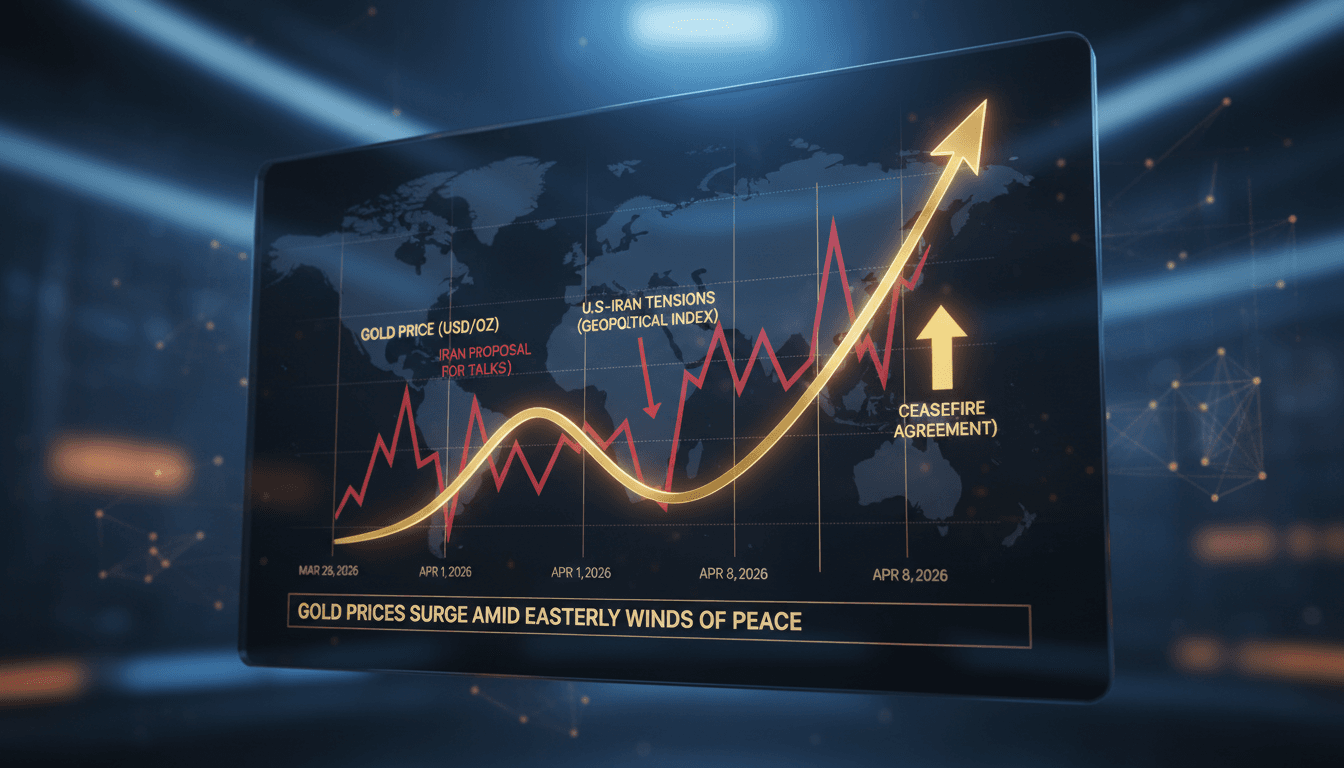
Here's what it means for you.
If you’re invested in commodities or energy markets, the recent gold price surge could significantly impact your portfolio.
Why it matters
The ceasefire between the U.S. and Iran has immediate implications for global commodity prices, particularly gold and oil.
What happened (in 30 seconds)
- Gold prices surged to a nearly three-week high on April 8, 2026, reaching $4,819.52 per ounce after a U.S.-Iran ceasefire was announced.
- U.S. President Donald Trump agreed to a two-week pause in attacks on Iran, which led to a reassessment of risks in the Strait of Hormuz.
- Negotiations are scheduled for April 10, 2026, in Islamabad, aiming to stabilize the region further.
The context you actually need
- The U.S.-Iran conflict escalated significantly after the war began on February 28, 2026, leading to fears of energy disruptions.
- Gold prices fell over 8% during the conflict due to inflation fears and a stronger U.S. dollar, making the recent surge noteworthy.
- The Strait of Hormuz is crucial for global oil and LNG shipments, with one-fifth of the world's supply passing through this chokepoint.
What's really happening
The recent surge in gold prices can be traced back to a complex interplay of geopolitical tensions and market reactions. Following the outbreak of the U.S.-Iran war in late February 2026, gold prices had been under significant pressure, dropping over 8% as investors reacted to fears of energy-driven inflation and a strengthening U.S. dollar. The conflict's escalation led to Iran's closure of the Strait of Hormuz, a critical passage for global oil and liquefied natural gas shipments, raising concerns about prolonged disruptions in energy supply.
On April 7, 2026, President Trump accepted Iran's proposal for a two-week pause in military actions, which marked a pivotal moment in the conflict. This truce was not merely a ceasefire; it was a strategic maneuver that allowed both parties to reassess their positions and negotiate terms. Iran's commitment to halt counter-attacks and secure the Strait passage if U.S. assaults ceased was crucial in easing market fears. The announcement led to a swift market reaction, with spot gold prices climbing over 3% intraday, ultimately settling at $4,819.52 per ounce, a 2.5% gain.
The implications of this ceasefire extend beyond gold prices. Global equities advanced, with the MSCI Asia-Pacific index reaching a three-week high, while crude oil prices experienced sharp declines. Gulf exchanges rallied as investors reacted positively to the de-escalation, indicating a broader market relief. Analysts characterized the gold price movement as a relief rally contingent on Iranian compliance with the ceasefire terms, highlighting the fragile nature of this newfound stability.
Furthermore, the Federal Reserve's upcoming minutes are anticipated amid ongoing inflation concerns, which could further influence market dynamics. The Iranian officials have emphasized that while talks are underway, they do not signify an end to the war, suggesting that the geopolitical landscape remains volatile.
Who feels it first (and how)
- Investors in commodities: Those holding gold or energy stocks will see immediate impacts on their portfolios.
- Energy sector companies: Firms reliant on stable oil prices may experience fluctuations based on ongoing negotiations.
- Global markets: Traders and investors in stock markets, particularly in Asia and the Gulf, will feel the effects of changing commodity prices.
What to watch next
- Negotiation outcomes: The April 10 talks in Islamabad will be critical in determining the future of U.S.-Iran relations and market stability.
- Federal Reserve announcements: Any signals regarding interest rates or inflation management could further influence gold and commodity prices.
- Iranian compliance: Monitoring Iran's adherence to the ceasefire will be essential for predicting future market movements.
Gold prices have surged to $4,819.52 per ounce following the ceasefire announcement.
Continued volatility in energy markets as negotiations unfold and geopolitical tensions persist.
The long-term implications of the ceasefire on U.S.-Iran relations and global commodity prices.
Frequently Asked Questions
- Why it matters?
- The ceasefire between the U.S. and Iran has immediate implications for global commodity prices, particularly gold and oil.
- What happened (in 30 seconds)?
- Gold prices surged to a nearly three-week high on April 8, 2026, reaching $4,819.52 per ounce after a U.S.-Iran ceasefire was announced. U.S. President Donald Trump agreed to a two-week pause in attacks on Iran, which led to a reassessment of risks in the Strait of Hormuz. Negotiations are scheduled for April 10, 2026, in Islamabad, aiming to stabilize the region further.
- What's really happening?
- The recent surge in gold prices can be traced back to a complex interplay of geopolitical tensions and market reactions. Following the outbreak of the U.S.-Iran war in late February 2026, gold prices had been under significant pressure, dropping over 8% as investors reacted to fears of energy-driven inflation and a strengthening U.S. dollar. The conflict's escalation led to Iran's closure of the Strait of Hormuz, a critical passage for global oil and liquefied natural gas shipments, raising conc
- Who feels it first (and how)?
- Investors in commodities: Those holding gold or energy stocks will see immediate impacts on their portfolios. Energy sector companies: Firms reliant on stable oil prices may experience fluctuations based on ongoing negotiations. Global markets: Traders and investors in stock markets, particularly in Asia and the Gulf, will feel the effects of changing commodity prices.
- What to watch next?
- Negotiation outcomes: The April 10 talks in Islamabad will be critical in determining the future of U.S.-Iran relations and market stability. Federal Reserve announcements: Any signals regarding interest rates or inflation management could further influence gold and commodity prices. Iranian compliance: Monitoring Iran's adherence to the ceasefire will be essential for predicting future market movements.
Regional and international reporting focused on Middle Eastern politics, diplomacy, and economics.
"Asharq Al-Awsat is a Saudi-owned international newspaper reflecting mainstream Gulf political perspectives."
— A47 Editor
Gold Climbs to Nearly 3-week High after Ceasefire Announcement
Gold prices have climbed to nearly a three-week high following the announcement of a ceasefire in the Middle East, reflecting a positive shift in market sentiment amid ongoing geopolitical tensions.
Markets desk coverage, trading insights, and investor updates.
"WSJ’s markets reporting provides in-depth analysis and context for investors."
— A47 Editor
Gold Climbs as Temporary Cease-Fire Pushes Energy Prices Lower
Gold prices have risen to a near three-week high as a temporary two-week cease-fire with Iran has alleviated concerns regarding inflation driven by escalating energy prices. This development reflects a shift in market sentiment, with investors respon...