
Saudi Arabia's GDP Growth Resilience Amid Gulf Economic Disruptions
Why it matters
Saudi Arabia's economic resilience amidst regional turmoil highlights its strategic importance in global energy markets.
What happened (in 30 seconds)
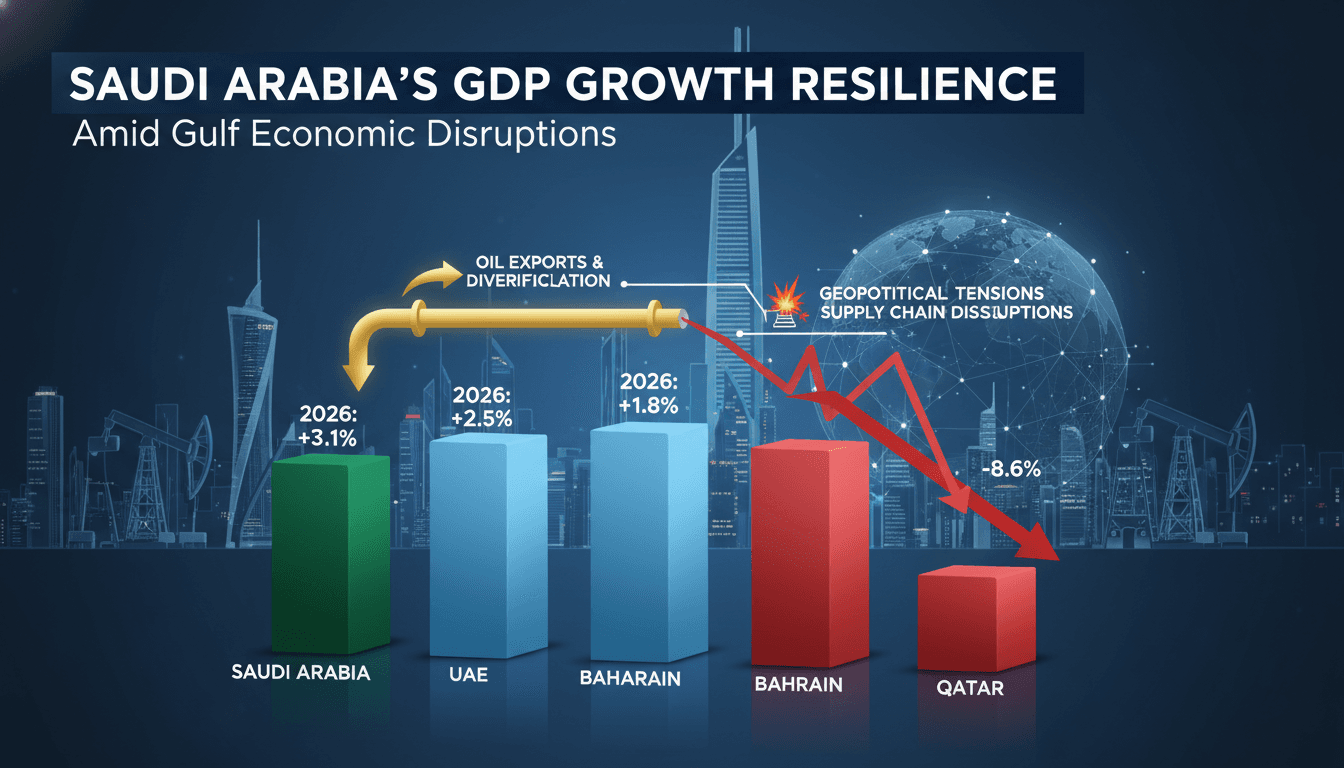
- Saudi Arabia's GDP is projected to grow by 3.1% in 2026, according to the IMF, matching global growth despite regional disruptions.
- Qatar's economy is forecasted to contract by 8.6%, the sharpest decline in the region, due to significant damage to its LNG facilities.
- The UAE's growth is also slowing, projected at 3.1%, down from earlier estimates, as the region grapples with energy supply challenges.
The context you actually need
- The Iran war has escalated, leading to the closure of the Strait of Hormuz and damaging Qatar's Ras Laffan LNG facility, which produces 93% of its LNG.
- Saudi Arabia's East-West pipeline allows it to bypass the Strait of Hormuz, ensuring continued oil exports via the Red Sea, which mitigates supply chain risks.
- The IMF's April 2026 update revised global GDP growth downward to 3.1%, reflecting the adverse impacts of geopolitical conflicts on regional economies.
What's really happening
The International Monetary Fund's (IMF) April 2026 World Economic Outlook paints a stark picture of the Gulf Cooperation Council (GCC) economies, revealing a significant divergence in growth trajectories. Saudi Arabia stands out with a projected GDP growth of 3.1%, a figure that, while down from earlier forecasts, still aligns with global growth expectations. This resilience is largely attributed to the kingdom's strategic infrastructure investments and its ability to redirect oil flows through the East-West pipeline, which connects its oil fields to the Red Sea, bypassing the volatile Strait of Hormuz.
In contrast, Qatar faces a dire economic outlook, with a staggering projected contraction of 8.6%. This sharp decline is primarily due to the damage inflicted on its Ras Laffan facility, a critical hub for liquefied natural gas (LNG) production. The facility's shutdown not only disrupts Qatar's energy exports but also sends ripples through global energy markets, given that Qatar is one of the world's leading LNG suppliers. The IMF's revision reflects a broader trend of downward adjustments for regional economies, with the UAE also experiencing a slowdown, now projected to grow at 3.1%, down from 5.8%.
The implications of these forecasts extend beyond mere numbers. Saudi Arabia's ability to maintain growth amidst geopolitical turmoil underscores its strategic importance in global energy supply chains. The kingdom's focus on diversifying its economy away from oil dependency is beginning to pay off, as infrastructure investments bolster its resilience against external shocks. Meanwhile, the UAE's economic landscape is being reshaped by the fallout from the Iran war, with significant losses reported in stock markets and a slowdown in luxury sector demand.
As the region grapples with these challenges, the IMF has warned of potential stagflation risks, prompting Gulf states to explore further pipeline expansions and economic pivots toward non-oil sectors. This shift is crucial for long-term sustainability, especially as the global energy landscape evolves in response to geopolitical tensions and climate change initiatives.
Who feels it first (and how)
- Investors in Qatar: Facing significant losses due to the economic contraction and energy supply disruptions.
- Energy sector workers in Saudi Arabia: Benefiting from continued growth and infrastructure investments.
- Luxury goods retailers in the UAE: Experiencing reduced demand as economic growth slows and consumer spending tightens.
What to watch next
- Oil prices: Fluctuations could indicate broader economic health in the region and impact global markets.
- Infrastructure projects in Saudi Arabia: Progress on diversification efforts will signal the kingdom's long-term economic strategy.
- Regional geopolitical developments: Any escalation in conflicts could further impact economic forecasts and stability.
Saudi Arabia's GDP growth is projected at 3.1% for 2026.
Qatar will continue to face economic challenges due to energy supply disruptions.
The long-term impacts of the Iran war on regional stability and economic growth.
Frequently Asked Questions
- Why it matters?
- Saudi Arabia's economic resilience amidst regional turmoil highlights its strategic importance in global energy markets.
- What happened (in 30 seconds)?
- Saudi Arabia's GDP is projected to grow by 3.1% in 2026, according to the IMF, matching global growth despite regional disruptions. Qatar's economy is forecasted to contract by 8.6%, the sharpest decline in the region, due to significant damage to its LNG facilities. The UAE's growth is also slowing, projected at 3.1%, down from earlier estimates, as the region grapples with energy supply challenges.
- What's really happening?
- The International Monetary Fund's (IMF) April 2026 World Economic Outlook paints a stark picture of the Gulf Cooperation Council (GCC) economies, revealing a significant divergence in growth trajectories. Saudi Arabia stands out with a projected GDP growth of 3.1%, a figure that, while down from earlier forecasts, still aligns with global growth expectations. This resilience is largely attributed to the kingdom's strategic infrastructure investments and its ability to redirect oil flows through
- Who feels it first (and how)?
- Investors in Qatar: Facing significant losses due to the economic contraction and energy supply disruptions. Energy sector workers in Saudi Arabia: Benefiting from continued growth and infrastructure investments. Luxury goods retailers in the UAE: Experiencing reduced demand as economic growth slows and consumer spending tightens.
- What to watch next?
- Oil prices: Fluctuations could indicate broader economic health in the region and impact global markets. Infrastructure projects in Saudi Arabia: Progress on diversification efforts will signal the kingdom's long-term economic strategy. Regional geopolitical developments: Any escalation in conflicts could further impact economic forecasts and stability.
Pan-Arab news coverage spanning politics, business, sports, and regional affairs.
"Asharq Al-Awsat reflects a broad Arab editorial perspective with strong attention to regional geopolitics."
— A47 Editor
السعودية تتصدر صمود النمو خليجياً
Amid a bleak economic outlook painted by the International Monetary Fund (IMF), which lowered its global growth forecast by 0.2 percentage points to 3.1% due to geopolitical conflicts, Saudi Arabia has emerged as a leader in resilience within the Gul...
Sports reporting with a focus on Saudi and regional competitions.
"Okaz sports coverage is broad and audience-friendly, with strong attention to Saudi teams and leagues."
— A47 Editor
«النقد الدولي»: 3.1% نمو لاقتصاد السعودية في 2026
The International Monetary Fund (IMF) has projected a 3.1% growth for Saudi Arabia's economy in 2026, indicating that the country is expected to be less affected by the ongoing US-Israeli conflict against Iran compared to its Gulf neighbors. The IMF'...
Arabic-language UAE newspaper coverage focused on domestic affairs, public institutions, business, society, and regional developments.
"Al Khaleej coverage generally reflects a mainstream UAE editorial lens with strong attention to public affairs, institutions, and regional developments."
— A47 Editor
صندوق النقد يخفض توقعات النمو العالمي إلى 3.1%
The International Monetary Fund (IMF) has revised its global economic growth forecast for the current year down to 3.1%, a decrease from the previous estimate of 3.3%. This adjustment is attributed to significant shocks in oil markets following the o...