
Astronomers Measure Power and Speed of Relativistic Jets from Cygnus X-1 Black Hole
Here's what it means for you.
This groundbreaking measurement of black hole jets could enhance global scientific collaboration and innovation, impacting various sectors including technology and education.
Why it matters
Understanding the dynamics of black holes can lead to advancements in astrophysics, influencing technologies that rely on high-energy physics.
What happened (in 30 seconds)
- On April 16, 2026, astronomers announced the first direct measurement of the instantaneous power and speed of jets from the black hole Cygnus X-1.
- The jets were measured to have a power output equivalent to 10,000 Suns and a speed of approximately 355 million mph (0.5c).
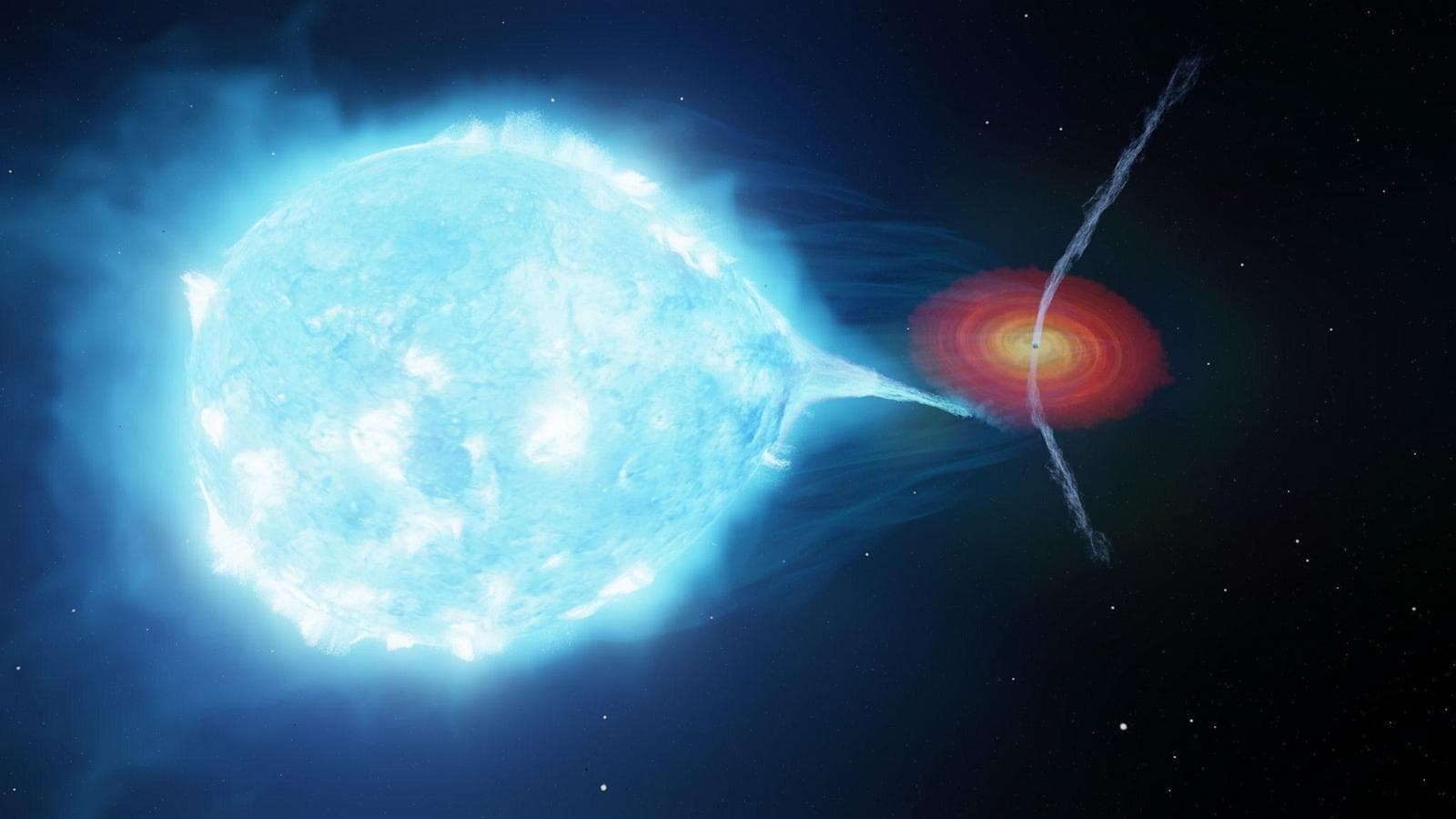
- This research utilized 18 years of high-resolution radio imaging, revealing how the jets bend due to the wind from a companion star.
The context you actually need
- Cygnus X-1 was first identified as a black hole candidate in 1971, marking a significant milestone in astrophysics.
- Previous measurements of relativistic jets required averaging over millennia, limiting understanding of their instantaneous dynamics.
- The new measurement technique can be applied to other black hole systems, potentially revolutionizing our understanding of high-energy astrophysical phenomena.
What's really happening
The recent measurement of the relativistic jets from Cygnus X-1 represents a significant leap in astrophysical research. For decades, scientists have been intrigued by the behavior of black holes and their jets, which are streams of charged particles ejected at nearly the speed of light. The discovery hinges on advanced observational techniques, particularly Very Long Baseline Interferometry (VLBI), which allows astronomers to combine data from multiple radio telescopes across the globe, achieving unprecedented resolution.
The research team, including prominent figures from the University of Oxford and Curtin University, utilized 18 years of data to analyze the jets' behavior. They observed that the jets bend due to the stellar wind from Cygnus X-1's companion star, a blue supergiant. This bending effect provided critical insights into the jets' instantaneous power and speed, quantified at approximately 10^38 watts—equivalent to the output of 10,000 Suns.
This advancement is not merely academic; it has broader implications for our understanding of the universe. By establishing a method to measure the instantaneous properties of jets, researchers can apply this technique to other black holes, potentially unlocking new insights into their formation, evolution, and the fundamental physics governing high-energy processes in the universe.
Moreover, the excitement generated by this discovery is likely to foster increased collaboration among international research teams, enhancing the global scientific community's ability to tackle complex astrophysical questions. As countries invest in space exploration and astronomical research, the techniques developed from this study could influence technological advancements in various sectors, including telecommunications, materials science, and energy production.
The implications extend beyond the scientific community. As public interest in space and astrophysics grows, educational institutions may see increased enrollment in STEM fields, driven by the allure of cutting-edge research. This could lead to a new generation of scientists and engineers equipped to tackle the challenges of tomorrow.
Who feels it first (and how)
- Astrophysicists and researchers: They gain new tools and methodologies for studying black holes and high-energy phenomena.
- Educational institutions: Increased interest in STEM fields may lead to higher enrollment and funding opportunities.
- Technology sectors: Innovations stemming from astrophysical research could influence advancements in telecommunications and energy technologies.
What to watch next
- Emerging research collaborations: Watch for new partnerships forming between universities and research institutions as they seek to apply this measurement technique to other black holes.
- Technological advancements: Keep an eye on developments in technologies that may arise from insights gained through this research, particularly in high-energy physics applications.
- Public engagement in science: Monitor trends in public interest and funding for space exploration initiatives, which may be influenced by discoveries like this one.
The instantaneous power of the jets from Cygnus X-1 is equivalent to 10,000 Suns.
The measurement technique will be applied to other black hole systems, enhancing our understanding of astrophysics.
The long-term impact on technology and education sectors remains to be fully realized.
Frequently Asked Questions
- Why it matters?
- Understanding the dynamics of black holes can lead to advancements in astrophysics, influencing technologies that rely on high-energy physics.
- What happened (in 30 seconds)?
- On April 16, 2026, astronomers announced the first direct measurement of the instantaneous power and speed of jets from the black hole Cygnus X-1. The jets were measured to have a power output equivalent to 10,000 Suns and a speed of approximately 355 million mph (0.5c). This research utilized 18 years of high-resolution radio imaging, revealing how the jets bend due to the wind from a companion star.
- What's really happening?
- The recent measurement of the relativistic jets from Cygnus X-1 represents a significant leap in astrophysical research. For decades, scientists have been intrigued by the behavior of black holes and their jets, which are streams of charged particles ejected at nearly the speed of light. The discovery hinges on advanced observational techniques, particularly Very Long Baseline Interferometry (VLBI), which allows astronomers to combine data from multiple radio telescopes across the globe, achievi
- Who feels it first (and how)?
- Astrophysicists and researchers: They gain new tools and methodologies for studying black holes and high-energy phenomena. Educational institutions: Increased interest in STEM fields may lead to higher enrollment and funding opportunities. Technology sectors: Innovations stemming from astrophysical research could influence advancements in telecommunications and energy technologies.
- What to watch next?
- Emerging research collaborations: Watch for new partnerships forming between universities and research institutions as they seek to apply this measurement technique to other black holes. Technological advancements: Keep an eye on developments in technologies that may arise from insights gained through this research, particularly in high-energy physics applications. Public engagement in science: Monitor trends in public interest and funding for space exploration initiatives, which may be infl
Science and technology stories including AI.
"Longstanding science magazine with thoughtful AI coverage."
— A47 Editor
Secrets of cosmic evolution may lurk in this black hole’s ‘dancing’ jets
A groundbreaking observation has revealed how jets emitted by black holes can influence the formation and growth of galaxies, providing new insights into cosmic evolution. This first-of-its-kind study highlights the dynamic interactions between black...
Scientific research, technology, environment, and society.
"Scientific American is one of the oldest and most authoritative science magazines, known for deep dives into science, technology, and society."
— A47 Editor
Secrets of cosmic evolution may lurk in this black hole’s ‘dancing’ jets
A groundbreaking observation has revealed how jets emitted by black holes can influence the formation and growth of galaxies, providing new insights into cosmic evolution. This first-of-its-kind study highlights the dynamic interactions between black...
Major U.S. developments and regional news.
"ABC News delivers broad national coverage with a mainstream editorial stance, focusing on accessibility and balanced reporting."
— A47 Editor
Astronomers measure the mind-blowing power and speed of black hole jets for the first time
For the first time, astronomers have successfully measured the instantaneous power of jets emitted from a black hole, revealing their extraordinary speed and energy. This groundbreaking achievement marks a significant advancement in the understanding...
Technology innovations, startups, and trends.
"ABC News delivers broad national coverage with a mainstream editorial stance, focusing on accessibility and balanced reporting."
— A47 Editor
Astronomers measure the power and speed of black hole jets for the first time
For the first time, astronomers have successfully measured the instantaneous power of jets emitted from a black hole, revealing their astonishing speed and energy output. This groundbreaking achievement marks a significant advancement in the understa...
Scientific discoveries, health, technology, and natural phenomena.
"Live Science reports on scientific discoveries, health, technology, and natural phenomena with a popular science tone."
— A47 Editor
The first black hole ever discovered is spewing 'dancing jets' at half the speed of light
Astronomers have successfully measured the energy jets emitted by Cygnus X-1, the first confirmed black hole, revealing that these jets are moving at half the speed of light. This significant finding comes more than 60 years after the black hole was ...