
China's Export Growth Declines to 2.5% as Iranian War Disrupts Global Demand
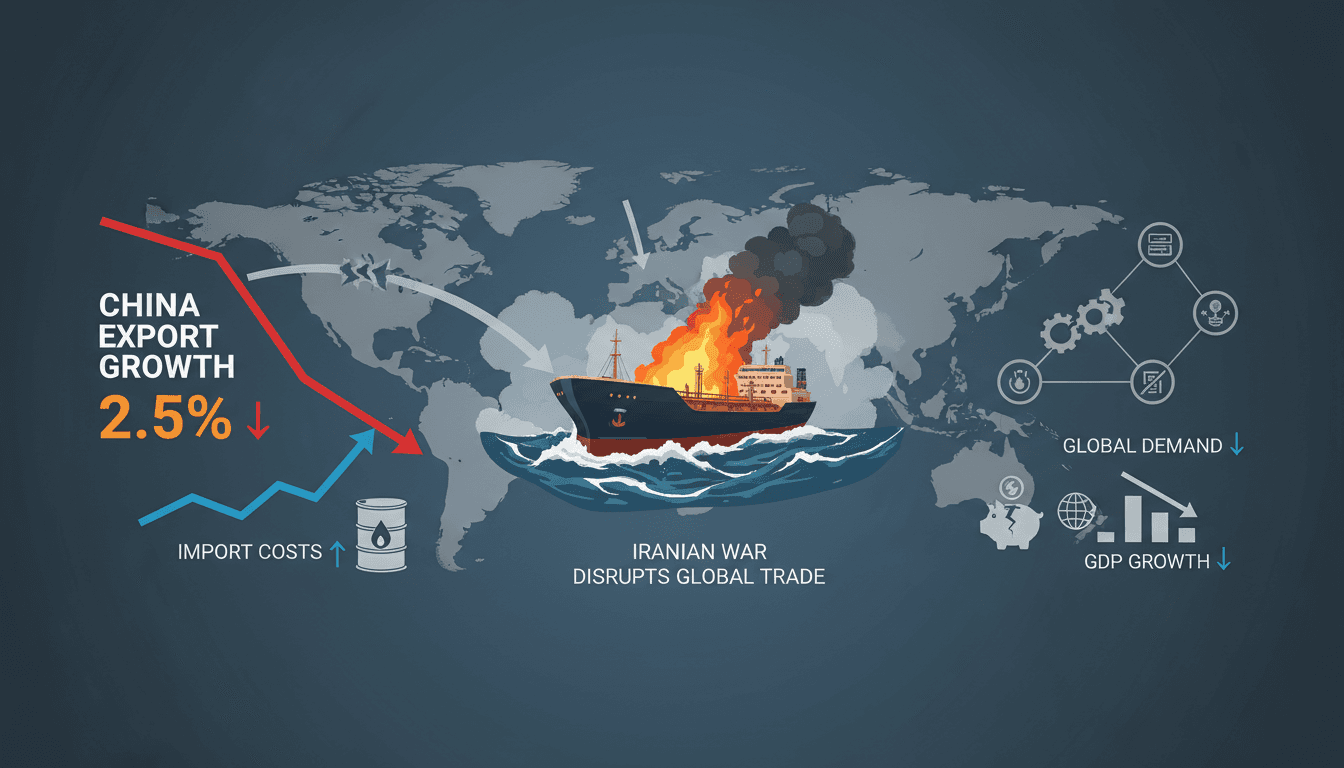
Here's what it means for you.
If you're in global trade or reliant on Chinese imports, expect rising costs and potential supply chain disruptions.
Why it matters
This slowdown signals a shift in global demand dynamics, impacting economies and industries worldwide.
What happened (in 30 seconds)
- China's exports grew by only 2.5% year-on-year in March 2026, the lowest rate in five months.
- The Iranian war disrupted global energy supplies, leading to a significant drop in international demand.
- Imports surged by 27.8%, highlighting China's vulnerability as the world's largest manufacturer and energy importer.
The context you actually need
- China's export growth was robust at 21.8% in January-February 2026, driven by demand for AI-supported electronics.
- The Iranian war escalated in early 2026, disrupting the Strait of Hormuz and causing global shocks in fuel prices and logistics costs.
- China's reliance on external demand to offset weak domestic consumption has amplified its vulnerabilities in the current climate.
What's really happening
In early 2026, China experienced a remarkable surge in exports, primarily fueled by a booming demand for AI-supported electronics and preemptive shipments ahead of potential U.S. tariffs. However, this momentum was abruptly halted by the Iranian war, which escalated tensions in the Middle East and severely disrupted global energy supplies and transportation routes. The conflict has led to significant increases in fuel prices and logistics costs, which have ripple effects across various sectors.
The General Administration of Customs reported a stark decline in export growth to just 2.5% in March 2026, a sharp contrast to the previous months' performance. This decline not only missed economist expectations of 8.3% but also highlighted the fragility of China's export-driven economy. The trade surplus fell to $51.13 billion, significantly below the anticipated $108 billion, indicating a troubling shift in trade dynamics.
Moreover, while exports faltered, imports surged by 27.8%, the highest increase since November 2021. This surge underscores China's dual role as both the world's largest manufacturer and energy importer, revealing its vulnerability to external shocks. Analysts have pointed out that the increase in imports, particularly refined petroleum, reflects the limitations of energy cost pass-through mechanisms and the erosion of global purchasing power.
The Iranian war has not only affected China's export capabilities but has also strained its domestic economy. Seasonal factors, such as the Lunar New Year factory closures, have compounded the challenges faced by low-value sectors like textiles. As China grapples with these external pressures, its reliance on international markets to bolster domestic consumption becomes increasingly precarious.
In response to these challenges, Chinese officials are leveraging strategic reserves and diversifying supply sources. Meanwhile, Russia has stepped in to offer energy support, indicating a shift in geopolitical alliances. The International Monetary Fund (IMF) has warned of slowed growth and rising inflation, further complicating the economic landscape.
Who feels it first (and how)
- Global manufacturers: Increased costs for raw materials and components from China.
- Logistics companies: Higher shipping costs and potential delays due to disrupted routes.
- Consumers: Rising prices for goods reliant on Chinese imports, particularly electronics and textiles.
- Energy-dependent sectors: Industries facing higher operational costs due to increased fuel prices.
What to watch next
- Trade surplus trends: Monitoring the trade surplus will provide insights into China's economic health and global demand.
- Energy prices: Fluctuations in global oil prices will impact China's import costs and overall economic stability.
- Geopolitical developments: Any escalation or resolution in the Iranian war could significantly alter trade dynamics and supply chains.
China's export growth has slowed significantly due to the Iranian war.
Continued volatility in global energy prices and trade dynamics.
The long-term impact on China's GDP growth and trade relationships.
Frequently Asked Questions
- Why it matters?
- This slowdown signals a shift in global demand dynamics, impacting economies and industries worldwide.
- What happened (in 30 seconds)?
- China's exports grew by only 2.5% year-on-year in March 2026, the lowest rate in five months. The Iranian war disrupted global energy supplies, leading to a significant drop in international demand. Imports surged by 27.8%, highlighting China's vulnerability as the world's largest manufacturer and energy importer.
- What's really happening?
- In early 2026, China experienced a remarkable surge in exports, primarily fueled by a booming demand for AI-supported electronics and preemptive shipments ahead of potential U.S. tariffs. However, this momentum was abruptly halted by the Iranian war, which escalated tensions in the Middle East and severely disrupted global energy supplies and transportation routes. The conflict has led to significant increases in fuel prices and logistics costs, which have ripple effects across various sectors.
- Who feels it first (and how)?
- Global manufacturers: Increased costs for raw materials and components from China. Logistics companies: Higher shipping costs and potential delays due to disrupted routes. Consumers: Rising prices for goods reliant on Chinese imports, particularly electronics and textiles. Energy-dependent sectors: Industries facing higher operational costs due to increased fuel prices.
- What to watch next?
- Trade surplus trends: Monitoring the trade surplus will provide insights into China's economic health and global demand. Energy prices: Fluctuations in global oil prices will impact China's import costs and overall economic stability. Geopolitical developments: Any escalation or resolution in the Iranian war could significantly alter trade dynamics and supply chains.
Pan-Arab news coverage spanning politics, business, sports, and regional affairs.
"Asharq Al-Awsat reflects a broad Arab editorial perspective with strong attention to regional geopolitics."
— A47 Editor
تباطؤ حاد لمحرك الصادرات الصينية مع تراجع الطلب العالمي بسبب الحرب الإيرانية
China's export engine experienced a sharp slowdown in March, attributed to the impacts of the Iranian war, which has led to shocks in energy and transportation costs. This decline reflects a significant decrease in global demand for Chinese goods ami...
Global business, markets, and technology policy/industry coverage.
"France 24 provides balanced international coverage with a European perspective."
— A47 Editor
China's exports slow amid surging costs brought on by Iran war
China's exports grew by only 2.5% in March, a significant slowdown attributed to the ongoing war in Iran, which has disrupted supply chains and increased material costs, particularly following the closure of the Strait of Hormuz.
24/7 international news from a French perspective in multiple languages.
"France 24 is viewed as a globally focused outlet with balanced coverage and a European perspective."
— A47 Editor
China's exports slow amid surging costs brought on by Iran war
China's exports grew by only 2.5% in March, a significant slowdown attributed to the ongoing war in Iran, which has disrupted supply chains and increased material costs, particularly following the closure of the Strait of Hormuz.
Social/economic commentary and analysis relevant to business and markets.
"WSJ blends data-driven economic insight with commentary on policy and society."
— A47 Editor
China’s export momentum slowed sharply in March, signaling the Middle East war is weighing on global demand and threatening a driver of growth
China's export momentum is experiencing a slowdown due to the ongoing conflict in the Middle East, particularly the war involving Iran. This situation is impacting global demand, which is a crucial growth driver for Beijing's economy.
Global political, business, and cultural coverage from WSJ international desks.
"The Wall Street Journal offers extensive international reporting with a reputation for financial insight and a center-right editorial stance."
— A47 Editor
China’s Export Momentum Slows Amid Iran War
China's export momentum is experiencing a slowdown due to the ongoing conflict in the Middle East, particularly the war involving Iran. This situation is impacting global demand, which is a crucial growth driver for Beijing's economy.
Macro commentary, policy analysis, growth/inflation themes, and global outlooks.
"Contextual macro coverage that complements day-to-day market headlines."
— A47 Editor
China’s March exports slow as Iran war wipes out AI-driven gains
China's exports have slowed significantly in March 2026, primarily due to the ongoing conflict in Iran, which has disrupted global supply chains and diminished the AI-driven economic gains previously experienced.
Macro commentary, policy analysis, growth/inflation themes, and global outlooks.
"Contextual macro coverage that complements day-to-day market headlines."
— A47 Editor
China’s exports set to lose momentum as Iran war undercuts AI-driven boom
China's exports are expected to lose momentum as the ongoing conflict in Iran disrupts global supply chains and undercuts the AI-driven economic boom that had previously bolstered trade. The war has led to significant challenges in energy and chemica...