
Gold Prices Surge Following U.S. President's Suspension of Attacks on Iran
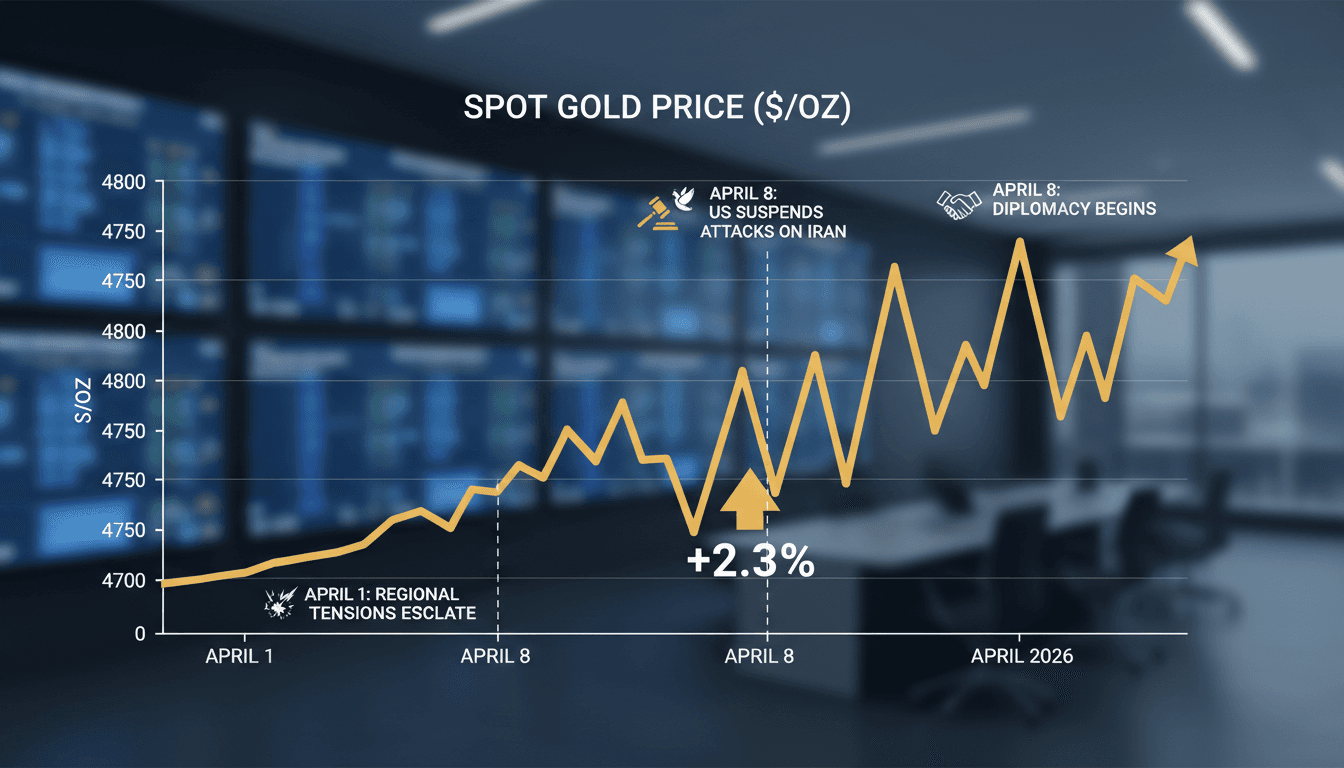
Here's what it means for you.
If you're invested in commodities or energy markets, understanding gold's price movements can help you navigate potential volatility.
Why it matters
Gold's price surge reflects investor sentiment amid geopolitical tensions, impacting global commodity markets and energy supplies.
What happened (in 30 seconds)
- Spot gold prices increased by 2.3% to $4,812.49 per ounce on April 8, 2026, marking a near three-week high.
- U.S. President Donald Trump announced a two-week pause in attacks on Iran, facilitated by Pakistan's mediation and Iran's 10-point negotiation proposal.
- Equity markets rallied as stock futures jumped, while crude oil prices fell, indicating reduced risk perception among investors.
The context you actually need
- The U.S.-Iran conflict began on February 28, 2026, leading to market volatility due to threats to the Strait of Hormuz, a crucial oil transit route.
- Gold prices had previously fallen over 8% amid escalating tensions, reflecting a flight to safety during geopolitical uncertainty.
- Pakistan's role as a mediator has been pivotal, with Iran's proposal being viewed as a potential foundation for future negotiations.
What's really happening
The recent rise in gold prices is closely tied to geopolitical developments, particularly the U.S.-Iran conflict that erupted in late February 2026. President Trump's ultimatum to Iran to reopen the Strait of Hormuz or face military action created a climate of fear and uncertainty, leading to a significant drop in gold prices as investors reacted to the escalating tensions. The conflict's implications for global oil supplies made gold, traditionally viewed as a safe haven, less attractive during this period of volatility.
However, the announcement of a two-week pause in U.S. attacks on Iran, coupled with Pakistan's mediation efforts, has shifted market sentiment. Trump's acceptance of Iran's 10-point proposal as a basis for negotiation has alleviated immediate fears of military escalation, prompting a relief rally in gold prices. As of April 8, 2026, spot gold reached $4,812.49 per ounce, the highest level since March 19, reversing the previous downward trend.
This price movement is not just a reaction to geopolitical events; it also reflects broader market dynamics. Investors are increasingly looking for safe-haven assets amid uncertainty, and gold has historically served this role. The rise in gold prices is indicative of a flight to safety, as equity markets responded positively to the de-escalation of tensions, with stock futures rising and crude oil prices falling. Analysts are closely monitoring resistance levels, with attention on the potential for gold to reach $4,930 if the current trend continues.
In Dubai, a major hub for gold trading, local traders have experienced heightened demand for gold bars, mirroring global spot gains. The Gold Souk has seen increased activity as investors seek to capitalize on the rising prices. This local demand is a reflection of the global market's response to geopolitical events, showcasing how interconnected these markets are.
Overall, the interplay between geopolitical tensions and commodity prices highlights the complexities of global markets. As tensions ease, the focus will shift to the outcomes of the upcoming negotiations and their potential impact on energy supplies and market stability.
Who feels it first (and how)
- Investors in commodities: Increased demand for gold as a safe haven asset.
- Energy sector professionals: Fluctuations in oil prices due to geopolitical developments.
- Local traders in Dubai: Heightened activity in gold trading as prices rise.
- Equity market participants: Positive sentiment from reduced geopolitical risk leading to stock market rallies.
What to watch next
- Negotiation outcomes: The scheduled talks in Islamabad on April 10 will be crucial in determining the future of U.S.-Iran relations and market stability.
- Gold price resistance levels: Analysts will be watching for any movements towards the $4,930 resistance level, which could indicate further price increases.
- Federal Reserve signals: Anticipation of inflation cues from the Fed's March minutes could influence market sentiment and commodity prices.
Gold prices are sensitive to geopolitical tensions and investor sentiment.
Continued volatility in energy markets as negotiations unfold.
The long-term implications of the U.S.-Iran negotiations on global commodity markets.
Frequently Asked Questions
- Why it matters?
- Gold's price surge reflects investor sentiment amid geopolitical tensions, impacting global commodity markets and energy supplies.
- What happened (in 30 seconds)?
- Spot gold prices increased by 2.3% to $4,812.49 per ounce on April 8, 2026, marking a near three-week high. U.S. President Donald Trump announced a two-week pause in attacks on Iran, facilitated by Pakistan's mediation and Iran's 10-point negotiation proposal. Equity markets rallied as stock futures jumped, while crude oil prices fell, indicating reduced risk perception among investors.
- What's really happening?
- The recent rise in gold prices is closely tied to geopolitical developments, particularly the U.S.-Iran conflict that erupted in late February 2026. President Trump's ultimatum to Iran to reopen the Strait of Hormuz or face military action created a climate of fear and uncertainty, leading to a significant drop in gold prices as investors reacted to the escalating tensions. The conflict's implications for global oil supplies made gold, traditionally viewed as a safe haven, less attractive during
- Who feels it first (and how)?
- Investors in commodities: Increased demand for gold as a safe haven asset. Energy sector professionals: Fluctuations in oil prices due to geopolitical developments. Local traders in Dubai: Heightened activity in gold trading as prices rise. Equity market participants: Positive sentiment from reduced geopolitical risk leading to stock market rallies.
- What to watch next?
- Negotiation outcomes: The scheduled talks in Islamabad on April 10 will be crucial in determining the future of U.S.-Iran relations and market stability. Gold price resistance levels: Analysts will be watching for any movements towards the $4,930 resistance level, which could indicate further price increases. Federal Reserve signals: Anticipation of inflation cues from the Fed's March minutes could influence market sentiment and commodity prices.
Business, markets, economy, and corporate news with strong UAE and regional relevance.
"Emirates 24|7 business coverage tends to center UAE markets, property, regulation, and regional economic developments."
— A47 Editor
Gold rises to near three-week high as Trump pauses attacks on Iran Gold rises to near three-week high as Trump pauses attacks on Iran
Gold prices surged to a near three-week high as U.S. President Donald Trump announced a two-week pause in military actions against Iran, alleviating concerns over energy-driven inflation. Spot gold rose by 2.3% to $4,812.49 per ounce, while U.S. gold...
Pan-Arab news coverage spanning politics, business, sports, and regional affairs.
"Asharq Al-Awsat reflects a broad Arab editorial perspective with strong attention to regional geopolitics."
— A47 Editor
الذهب يرتفع لأعلى مستوى في 3 أسابيع مع تعليق ترمب للهجمات على إيران
Gold prices have risen to their highest level in three weeks following U.S. President Donald Trump's announcement to suspend military strikes against Iran. This development reflects a momentary easing of geopolitical tensions in the region, which oft...