
ASML Shares Drop Following US Proposal to Restrict Semiconductor Exports to China
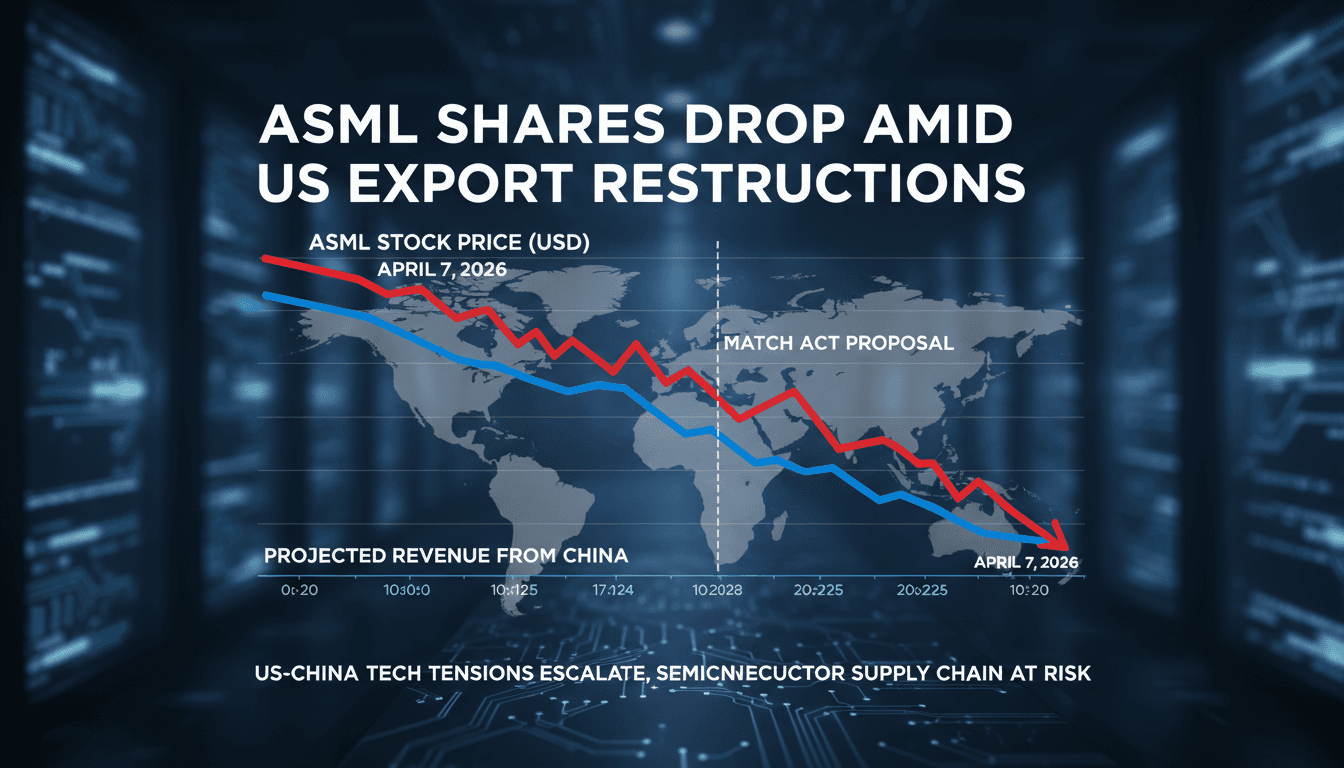
Here's what it means for you.
If you're invested in tech or semiconductor markets, this decline could signal broader shifts in supply chains and market valuations.
Why it matters
The proposed MATCH Act could significantly impact global semiconductor supply chains and the competitive landscape, particularly for companies reliant on Chinese markets.
What happened (in 30 seconds)
- ASML shares fell up to 4.7% in Amsterdam trading on April 7, 2026, following news of the MATCH Act proposal.
- The MATCH Act aims to restrict exports of semiconductor manufacturing equipment to China, targeting major firms like SMIC and Huawei.
- China accounted for 33% of ASML's sales in 2025, with projections indicating a drop to 20% in 2026 due to ongoing restrictions.
The context you actually need
- ASML Holding NV is a key player in the semiconductor equipment market, holding a near-monopoly on advanced lithography systems essential for chip production.
- US-led export controls have escalated in recent years, initially blocking extreme ultraviolet (EUV) tools while allowing deep ultraviolet (DUV) sales, which have sustained Chinese chipmaking capabilities.
- The geopolitical landscape is marked by a US-China tech rivalry, with bipartisan support in Congress to tighten controls on technology that could enhance China's semiconductor industry.
What's really happening
On April 3, 2026, a bipartisan group of US lawmakers introduced the MATCH Act, aiming to prohibit the export, sale, and servicing of semiconductor manufacturing equipment to China. This legislation is particularly focused on deep ultraviolet (DUV) lithography systems, which are crucial for producing advanced chips. The bill is designed to align multilateral technology controls and prevent entities benefiting from US CHIPS Act funds from engaging with Chinese firms like SMIC, Huawei, and YMTC.
The immediate market reaction was swift; ASML shares dropped as much as 4.7% intraday before closing 4.1% lower at 1,114 euros. This decline reflects investor concerns about the potential impact of the MATCH Act on ASML's revenue, given that China represented a significant portion of its sales—33% in 2025. Analysts have estimated that if the MATCH Act is enacted, ASML could face a low double-digit percentage hit to its earnings.
The MATCH Act is part of a broader strategy by the US government to curb China's technological advancements and maintain its competitive edge in the semiconductor industry. The legislation is seen as a response to fears that Chinese firms could leverage advanced technologies to enhance their capabilities, potentially posing a threat to US national security and economic interests.
European chip equipment peers, such as ASM International and BE Semiconductor, also experienced declines in their stock prices, indicating a wider market concern about the implications of the MATCH Act. The reaction from Chinese state media has been critical, labeling the US actions as hegemonic and indicative of a broader decoupling between the two largest economies in the world.
As the geopolitical climate continues to evolve, the semiconductor industry remains at the forefront of tensions between the US and China. The MATCH Act is just one of many measures aimed at limiting China's access to critical technologies, which could reshape global supply chains and alter the competitive landscape in the tech sector.
Who feels it first (and how)
- Investors in ASML: Immediate financial impact due to stock price decline.
- Chinese chipmakers (SMIC, Huawei, YMTC): Directly affected by restricted access to essential manufacturing equipment.
- European semiconductor equipment manufacturers: Potential revenue impacts as market sentiment shifts.
- US tech firms: Companies relying on Chinese markets may face supply chain disruptions and revenue declines.
- Global supply chain stakeholders: Increased uncertainty in semiconductor availability could affect various industries reliant on chips.
What to watch next
- Legislative progress on the MATCH Act: Monitoring how quickly this proposal moves through Congress will indicate the urgency of US-China tech tensions.
- Market reactions from other semiconductor firms: Observing stock price movements of competitors could signal broader industry sentiment and potential ripple effects.
- Chinese government responses: Any retaliatory measures or policy changes from China could impact global supply chains and market dynamics.
ASML shares declined by 4.1% on April 7, 2026, following the MATCH Act proposal.
If enacted, the MATCH Act will significantly reduce ASML's revenue from China, impacting earnings forecasts.
The long-term effects on global semiconductor supply chains and market dynamics remain uncertain as geopolitical tensions evolve.
Frequently Asked Questions
- Why it matters?
- The proposed MATCH Act could significantly impact global semiconductor supply chains and the competitive landscape, particularly for companies reliant on Chinese markets.
- What happened (in 30 seconds)?
- ASML shares fell up to 4.7% in Amsterdam trading on April 7, 2026, following news of the MATCH Act proposal. The MATCH Act aims to restrict exports of semiconductor manufacturing equipment to China, targeting major firms like SMIC and Huawei. China accounted for 33% of ASML's sales in 2025, with projections indicating a drop to 20% in 2026 due to ongoing restrictions.
- What's really happening?
- On April 3, 2026, a bipartisan group of US lawmakers introduced the MATCH Act, aiming to prohibit the export, sale, and servicing of semiconductor manufacturing equipment to China. This legislation is particularly focused on deep ultraviolet (DUV) lithography systems, which are crucial for producing advanced chips. The bill is designed to align multilateral technology controls and prevent entities benefiting from US CHIPS Act funds from engaging with Chinese firms like SMIC, Huawei, and YMTC. T
- Who feels it first (and how)?
- Investors in ASML: Immediate financial impact due to stock price decline. Chinese chipmakers (SMIC, Huawei, YMTC): Directly affected by restricted access to essential manufacturing equipment. European semiconductor equipment manufacturers: Potential revenue impacts as market sentiment shifts. US tech firms: Companies relying on Chinese markets may face supply chain disruptions and revenue declines. Global supply chain stakeholders: Increased uncertainty in semiconductor availability coul
- What to watch next?
- Legislative progress on the MATCH Act: Monitoring how quickly this proposal moves through Congress will indicate the urgency of US-China tech tensions. Market reactions from other semiconductor firms: Observing stock price movements of competitors could signal broader industry sentiment and potential ripple effects. Chinese government responses: Any retaliatory measures or policy changes from China could impact global supply chains and market dynamics.
Pan-Arab news coverage spanning politics, business, sports, and regional affairs.
"Asharq Al-Awsat reflects a broad Arab editorial perspective with strong attention to regional geopolitics."
— A47 Editor
أسهم «إيه إس إم إل» تهبط استجابة لتحركات المشرِّعين الأميركيين ضد التصدير للصين
Shares of the Dutch company ASML fell on Tuesday during the first trading session following a proposal by U.S. lawmakers for a law that could impose additional restrictions on the company's sales to China.
Market-moving headlines impacting equities, bonds, and related risk assets.
"Real-time catalysts and volatility drivers across indices and sectors."
— A47 Editor
ASML shares fall on US Congress plan to further restrict China exports
ASML shares have declined following a proposal by the US Congress to impose further restrictions on exports to China, reflecting ongoing tensions between the two nations regarding technology transfer and trade policies.