
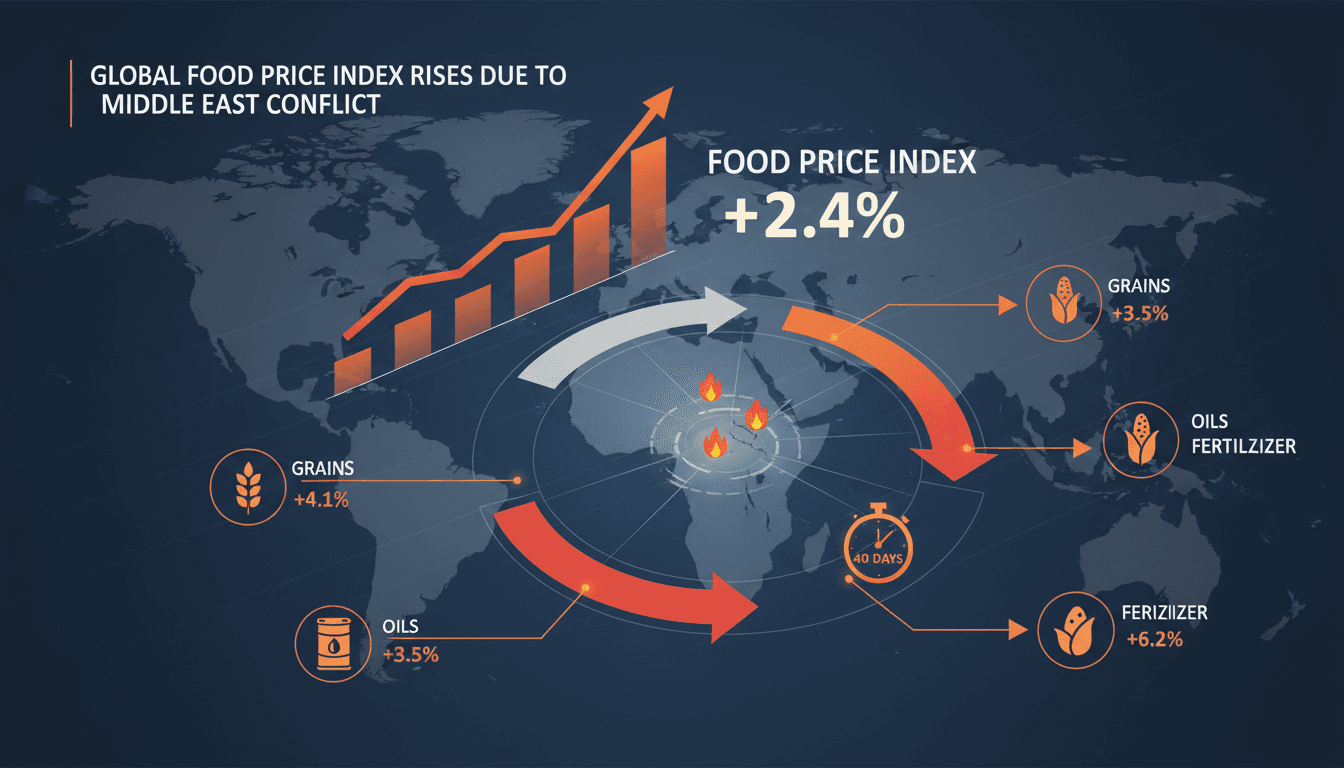
Global Food Price Index Rises 2.4% Due to Middle East Conflict
Here's what it means for you.
Rising food prices could strain your budget and alter purchasing decisions as global conflicts disrupt supply chains.
Why it matters
The surge in food prices signals potential economic instability and increased food insecurity worldwide.
What happened (in 30 seconds)
- Food Price Index rose: The UN FAO reported a 2.4% increase in the Food Price Index for March 2026, reaching 128.5 points.
- Conflict escalation: The rise is attributed to escalating conflict in the Near East, particularly the US-Israel-Iran war, which disrupted energy and fertilizer supplies.
- Commodity gains: All major commodity groups saw price increases, with vegetable oils up 5.1% and sugar up 7.2%.
The context you actually need
- Previous stability: Before February 2026, the FAO Food Price Index had stabilized for five months, supported by ample global cereal supplies.
- Geopolitical triggers: Tensions escalated on February 28, 2026, when US and Israeli forces struck Iranian military targets, leading to Iran closing the Strait of Hormuz.
- Supply chain disruptions: The closure halted one-third of global fertilizer shipments, causing a spike in oil prices and cascading costs through energy, production, and transportation networks.
What's really happening
The recent surge in the FAO Food Price Index is a direct consequence of geopolitical tensions that have disrupted critical supply chains. The conflict between the US, Israel, and Iran has led to significant increases in energy and fertilizer costs, which are essential inputs for food production. The closure of the Strait of Hormuz, a vital shipping route, has compounded these issues by halting approximately one-third of global fertilizer shipments. This disruption not only raises the cost of fertilizers but also affects the availability of these crucial resources, leading to reduced agricultural output.
As a result, the prices of major commodities have increased, with vegetable oils and sugar experiencing notable spikes. The FAO's Chief Economist, Máximo Torero, has warned that if the conflict persists beyond 40 days, the impact on agricultural yields could be severe. This situation is exacerbated by existing drought conditions in the US and reduced plantings in Australia, further tightening global food supplies.
The interconnectedness of global markets means that these price increases will likely ripple through economies, affecting everything from grocery bills to international trade agreements. Countries that rely heavily on imports for food, particularly those in vulnerable regions, may face heightened food insecurity as prices rise. The FAO forecasts that fertilizer costs could increase by 15-20% in the first half of 2026 if the crisis continues, which would further reduce planting and yields, creating a vicious cycle of rising prices and declining food availability.
In response, governments and regulatory bodies are taking action. For instance, the UAE has imposed fines on traders for unjustified price hikes, reflecting a broader trend of market controls aimed at curbing inflation. However, these measures may only provide temporary relief as the underlying issues remain unresolved.
Who feels it first (and how)
- Consumers: Households facing higher grocery bills, particularly for essential items like grains and oils.
- Farmers: Agricultural producers dealing with increased input costs and potential yield reductions.
- Import-dependent nations: Countries reliant on food imports experiencing heightened food insecurity and inflation.
- Food retailers: Businesses facing pressure to manage costs while maintaining profitability amid rising prices.
What to watch next
- Conflict duration: If the conflict continues beyond 40 days, expect further increases in food prices and potential supply shortages.
- Fertilizer costs: Monitor fertilizer price trends, as sustained high costs could lead to reduced agricultural output and higher food prices.
- Global food security reports: Watch for updates from the UN World Food Programme, which may indicate rising food insecurity levels in vulnerable nations.
The FAO Food Price Index has risen by 2.4% in March 2026.
Further price increases and potential food shortages if the conflict persists.
The long-term impacts on global food security and agricultural production.
Frequently Asked Questions
- Why it matters?
- The surge in food prices signals potential economic instability and increased food insecurity worldwide.
- What happened (in 30 seconds)?
- Food Price Index rose: The UN FAO reported a 2.4% increase in the Food Price Index for March 2026, reaching 128.5 points. Conflict escalation: The rise is attributed to escalating conflict in the Near East, particularly the US-Israel-Iran war, which disrupted energy and fertilizer supplies. Commodity gains: All major commodity groups saw price increases, with vegetable oils up 5.1% and sugar up 7.2%.
- What's really happening?
- The recent surge in the FAO Food Price Index is a direct consequence of geopolitical tensions that have disrupted critical supply chains. The conflict between the US, Israel, and Iran has led to significant increases in energy and fertilizer costs, which are essential inputs for food production. The closure of the Strait of Hormuz, a vital shipping route, has compounded these issues by halting approximately one-third of global fertilizer shipments. This disruption not only raises the cost of fer
- Who feels it first (and how)?
- Consumers: Households facing higher grocery bills, particularly for essential items like grains and oils. Farmers: Agricultural producers dealing with increased input costs and potential yield reductions. Import-dependent nations: Countries reliant on food imports experiencing heightened food insecurity and inflation. Food retailers: Businesses facing pressure to manage costs while maintaining profitability amid rising prices.
- What to watch next?
- Conflict duration: If the conflict continues beyond 40 days, expect further increases in food prices and potential supply shortages. Fertilizer costs: Monitor fertilizer price trends, as sustained high costs could lead to reduced agricultural output and higher food prices. Global food security reports: Watch for updates from the UN World Food Programme, which may indicate rising food insecurity levels in vulnerable nations.
Top international stories selected by The Guardian editors.
"The Guardian is known for its progressive editorial stance and in-depth analysis."
— A47 Editor
Food prices spiked in March as Middle East conflict drove up energy costs, UN says
Food prices surged in March, driven by escalating conflict in the Middle East, which has led to increased energy costs and freight expenses globally, according to a UN report. The food commodity price index rose by 2.4%, marking its second consecutiv...
Regional and international reporting focused on Middle Eastern politics, diplomacy, and economics.
"Asharq Al-Awsat is a Saudi-owned international newspaper reflecting mainstream Gulf political perspectives."
— A47 Editor
World Food Prices Rose in March as Iran War Lifted Energy Costs, FAO Says
World food prices rose in March due to increased energy costs linked to the ongoing conflict in Iran, as reported by the FAO. The war has disrupted oil supplies, leading to higher fuel prices that have a direct impact on food production and distribut...
Global markets, investing, and macroeconomics from a premier financial newsroom.
"Bloomberg is respected for in-depth financial reporting and data-driven analysis."
— A47 Editor
Middle East Conflict Weighs on Global Food Prices, FAO Says
Global food prices have seen an increase in March, primarily driven by rising energy costs and higher freight charges linked to the ongoing conflict in the Middle East, as reported by the FAO.