
France to Migrate 2.5 Million Government Workstations from Windows to Linux
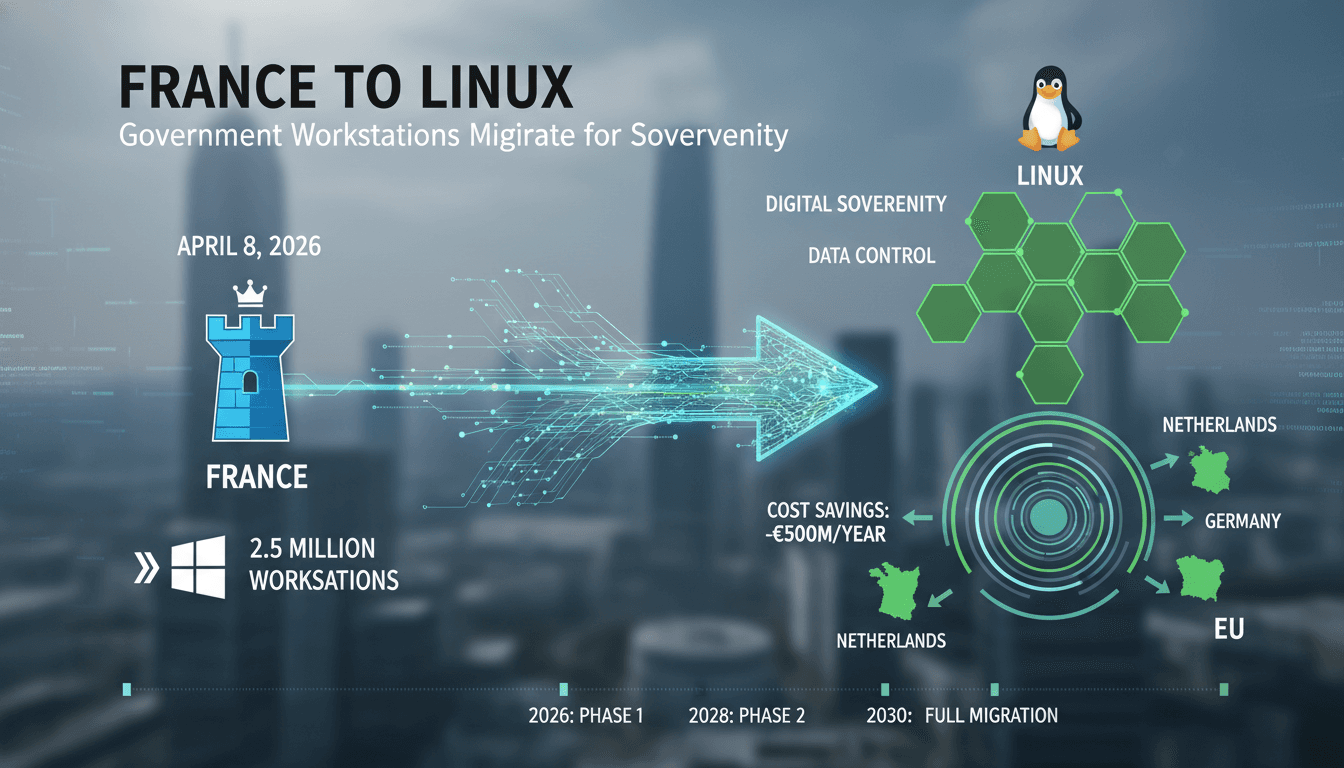
Here's what it means for you.
If you rely on government services in France, expect a shift in how digital interactions are managed, potentially impacting service delivery and data privacy.
Why it matters
This initiative signals a broader trend towards digital sovereignty in Europe, influencing how governments manage technology dependencies.
What happened (in 30 seconds)
- On April 8, 2026, France's DINUM announced a plan to replace 2.5 million Windows desktops with Linux to enhance digital sovereignty.
- By autumn 2026, ministries must submit migration plans, aiming for full transition by 2027.
- Key motivations include reducing reliance on U.S. technology, improving data control, and utilizing domestic solutions like GendBuntu.
The context you actually need
- Longstanding efforts: France has been working to reduce dependencies on non-European software since at least 2008, with the Gendarmerie's GendBuntu deployment as a key example.
- Geopolitical concerns: The move is part of a larger EU strategy to mitigate U.S. tech dominance, especially in light of recent sanctions and data control issues.
- Financial incentives: Previous implementations of GendBuntu have resulted in significant cost savings, exceeding €2 million annually.
What's really happening
France's decision to migrate 2.5 million workstations from Microsoft Windows to Linux is a strategic maneuver aimed at achieving digital sovereignty. This shift is not merely about changing operating systems; it reflects a broader ambition to reclaim control over technology and data management within government operations. The Interministerial Directorate for Digital Affairs (DINUM) is spearheading this initiative, requiring all ministries to submit detailed migration plans by autumn 2026, with a full transition targeted for 2027.
The impetus behind this migration stems from a desire to reduce reliance on U.S. technology providers, which has become increasingly critical in the context of geopolitical tensions and data privacy concerns. By moving to Linux, particularly a customized version like GendBuntu, France aims to leverage proven domestic solutions that enhance data control and security. The Gendarmerie Nationale's successful deployment of GendBuntu since 2008 across over 100,000 workstations serves as a model, demonstrating both the feasibility and benefits of such a transition.
Financially, the shift is expected to yield substantial savings. The Gendarmerie's experience has shown that using open-source solutions can lead to significant cost reductions, which is a compelling argument for other ministries to follow suit. Additionally, the broader EU context, where concerns over U.S. tech dominance are mounting, adds urgency to this initiative. The French government is not alone in this endeavor; similar moves are anticipated from other EU nations, such as the Netherlands and Germany, as they seek to bolster their own digital sovereignty.
However, the transition is not without challenges. Compatibility issues with existing applications and the need for extensive training on new systems are significant hurdles that ministries will need to address. The tech community has expressed optimism about the potential for increased Linux adoption, but skepticism remains regarding the ability to replace Microsoft Office equivalents effectively. As the migration unfolds, the French government will need to navigate these complexities while ensuring that the transition does not disrupt essential services.
Who feels it first (and how)
- Government employees: Civil servants will experience immediate changes in their daily work environments and tools.
- IT departments: These teams will face the challenge of implementing new systems and training staff.
- Tech vendors: Companies providing software and support services may see shifts in demand as government contracts change.
What to watch next
- Ministry compliance: Monitor how quickly and effectively ministries submit their migration plans, as this will indicate the initiative's momentum.
- User feedback: Pay attention to reactions from government employees regarding usability and functionality of the new systems, which will impact overall satisfaction.
- EU responses: Watch for similar initiatives from other EU countries, as France's move could inspire a wave of digital sovereignty efforts across Europe.
France is committed to migrating 2.5 million workstations from Windows to Linux by 2027.
Other EU nations may follow France's lead in pursuing digital sovereignty and reducing reliance on U.S. technology.
The extent to which application compatibility issues will affect the transition and user experience remains uncertain.
Frequently Asked Questions
- Why it matters?
- This initiative signals a broader trend towards digital sovereignty in Europe, influencing how governments manage technology dependencies.
- What happened (in 30 seconds)?
- On April 8, 2026, France's DINUM announced a plan to replace 2.5 million Windows desktops with Linux to enhance digital sovereignty. By autumn 2026, ministries must submit migration plans, aiming for full transition by 2027. Key motivations include reducing reliance on U.S. technology, improving data control, and utilizing domestic solutions like GendBuntu.
- What's really happening?
- France's decision to migrate 2.5 million workstations from Microsoft Windows to Linux is a strategic maneuver aimed at achieving digital sovereignty. This shift is not merely about changing operating systems; it reflects a broader ambition to reclaim control over technology and data management within government operations. The Interministerial Directorate for Digital Affairs (DINUM) is spearheading this initiative, requiring all ministries to submit detailed migration plans by autumn 2026, with
- Who feels it first (and how)?
- Government employees: Civil servants will experience immediate changes in their daily work environments and tools. IT departments: These teams will face the challenge of implementing new systems and training staff. Tech vendors: Companies providing software and support services may see shifts in demand as government contracts change.
- What to watch next?
- Ministry compliance: Monitor how quickly and effectively ministries submit their migration plans, as this will indicate the initiative's momentum. User feedback: Pay attention to reactions from government employees regarding usability and functionality of the new systems, which will impact overall satisfaction. EU responses: Watch for similar initiatives from other EU countries, as France's move could inspire a wave of digital sovereignty efforts across Europe.
Enterprise-focused AI news and analysis.
"Practical AI strategies and tools for IT leaders."
— A47 Editor
France is replacing 2.5 million Windows desktops with Linux - and I mapped out its new stack
France has initiated a significant transition to replace 2.5 million Windows desktops with Linux as part of a government plan aimed at enhancing digital sovereignty and reducing reliance on foreign technology. This shift marks a pivotal move away fro...
Business tech news, enterprise IT, and innovation analysis.
"ZDNet offers enterprise IT news, reviews, and strategy guidance."
— A47 Editor
France is replacing 2.5 million Windows desktops with Linux - and I mapped out its new stack
France has initiated a significant transition to replace 2.5 million Windows desktops with Linux as part of a government plan aimed at enhancing digital sovereignty and reducing reliance on foreign technology. This shift marks a pivotal move away fro...
Consumer tech news, reviews, and buying guides for gadgets and electronics.
"TechRadar is known for comprehensive buying advice, hardware reviews, and consumer tech news targeted at mainstream audiences."
— A47 Editor
'Regain control of our digital destiny': France to ditch Windows for Linux to reduce reliance on US tech
France has initiated a significant transition from Windows operating systems to open-source Linux alternatives as part of its strategy to enhance digital sovereignty and reduce reliance on US technology. This move marks a pivotal shift in the country...
Tech news, hardware, and AI tools coverage.
"PC/tech site increasingly covering AI hardware and apps."
— A47 Editor
France starts moving government systems from Windows to Linux
France's Inter-ministerial Digital Directorate (DINUM) has initiated a transition of government systems from Microsoft Windows to Linux, aiming to enhance digital sovereignty and reduce reliance on non-European software. This strategic shift reflects...