
IMF Highlights Financial Risks in Emerging Markets from Portfolio Investment Dominance
Here's what it means for you.
If you're invested in emerging markets, be prepared for potential volatility as portfolio flows dominate financing.
Why it matters
This shift elevates the risk of sudden financial shocks that could impact global markets and investments.
What happened (in 30 seconds)
- IMF report released: On April 7, 2026, the IMF highlighted increased financial risks in emerging markets due to portfolio investors.
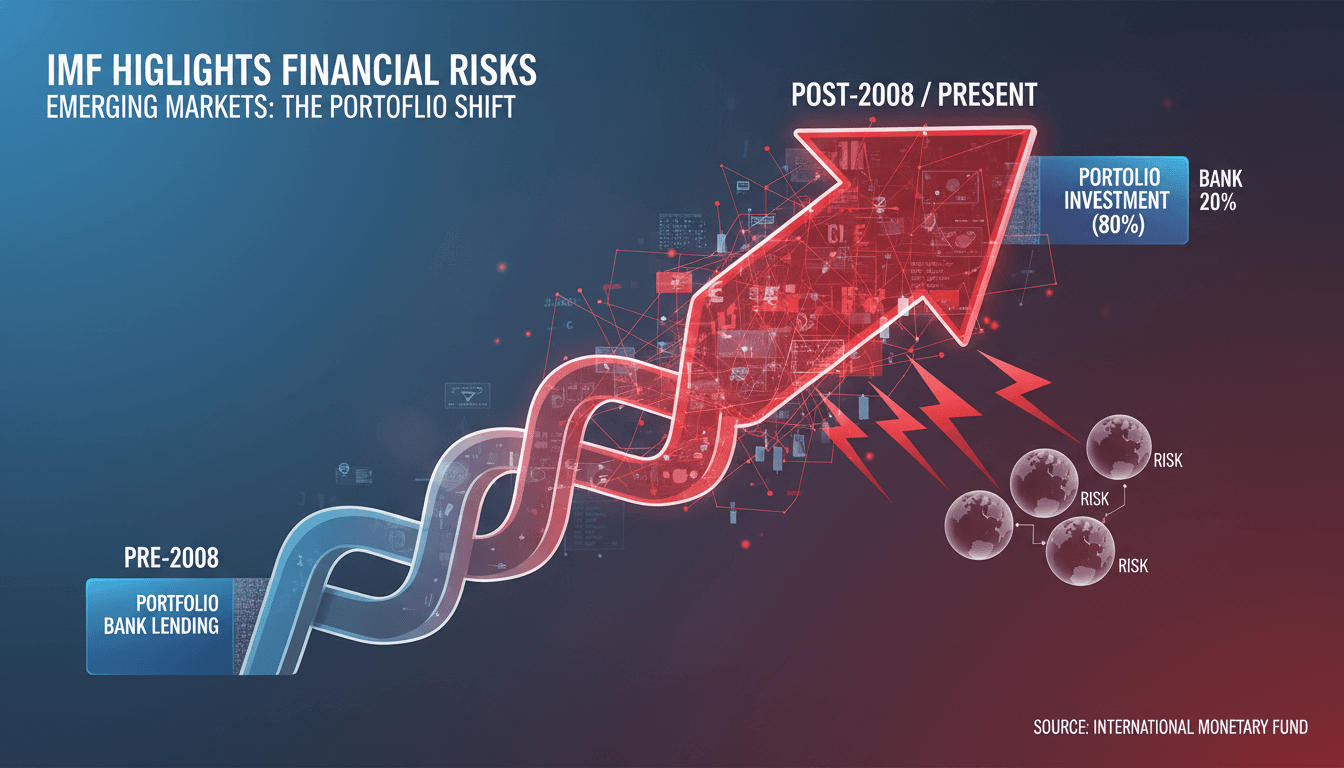
- Dominance of portfolio flows: Portfolio investments now account for 80% of debt inflows in emerging markets, doubling over the past two decades.
- Call for policy measures: The IMF recommends building foreign exchange reserves and enhancing institutional quality to mitigate risks.
The context you actually need
- Post-2008 shift: Following the 2008 financial crisis, banks reduced lending to emerging markets, leading to a surge in non-bank portfolio investments.
- Cumulative inflows: Since 2008, nearly $4 trillion has flowed into emerging markets, providing access to cheaper capital but increasing vulnerability.
- Global financial conditions: Portfolio investors are highly sensitive to changes in global financial conditions, leading to rapid capital outflows during crises.
What's really happening
The IMF's Global Financial Stability Report reveals a significant evolution in how emerging markets are financed. Over the past two decades, the reliance on portfolio investors—such as hedge funds, pension funds, and insurers—has surged, with these entities now accounting for 80% of debt inflows. This shift has profound implications for the stability of emerging market economies.
Historically, after the 2008 global financial crisis, international banks curtailed lending to these markets, prompting a pivot towards portfolio investments. This transition has resulted in nearly $4 trillion in cumulative inflows since 2008, enabling emerging markets to access longer-term, lower-cost debt amidst an environment of abundant global liquidity. However, this influx of "hot money" has also introduced significant risks. Portfolio investors tend to be skittish, reacting swiftly to shifts in global financial conditions, which can lead to sudden capital outflows, currency depreciations, and widened spreads during times of crisis.
Recent geopolitical events, such as the Iran war that began in late February 2026, have highlighted these vulnerabilities. For instance, Hungary's forint experienced a 20% appreciation against the USD due to foreign holdings but faced a sharp depreciation amid capital outflows triggered by heightened global tensions. This scenario underscores the precarious nature of relying heavily on portfolio flows for financing.
The IMF's report emphasizes the need for emerging markets to bolster their foreign exchange reserves, enhance institutional quality, and ensure debt sustainability to mitigate the risks associated with these volatile capital flows. The report also points to the rapid growth of cross-border private credit and stablecoin flows linked to cryptocurrency volatility as additional emerging risks that could exacerbate financial instability.
In summary, while portfolio investments have provided much-needed capital to emerging markets, they have also created a precarious financial landscape that is highly susceptible to global shocks. The IMF's warning serves as a crucial reminder for policymakers and investors alike to remain vigilant in the face of these evolving financial dynamics.
Who feels it first (and how)
- Portfolio investors: Hedge funds and pension funds may experience rapid changes in investment returns.
- Emerging market governments: Countries relying on foreign capital may face increased borrowing costs and currency volatility.
- Local businesses: Companies in emerging markets could see reduced access to financing and increased operational costs.
What to watch next
- Geopolitical developments: Ongoing tensions, such as the Iran war, could trigger further capital outflows and market volatility.
- Central bank policies: Changes in monetary policy from major economies may influence global liquidity and impact portfolio flows.
- Emerging market reforms: Watch for policy measures aimed at strengthening foreign exchange reserves and institutional quality, as these could stabilize markets.
Portfolio flows now dominate emerging market financing, accounting for 80% of debt inflows.
Increased volatility in emerging markets as portfolio investors react to global financial conditions.
The specific governmental responses from emerging markets to the IMF's recommendations.
Frequently Asked Questions
- Why it matters?
- This shift elevates the risk of sudden financial shocks that could impact global markets and investments.
- What happened (in 30 seconds)?
- IMF report released: On April 7, 2026, the IMF highlighted increased financial risks in emerging markets due to portfolio investors. Dominance of portfolio flows: Portfolio investments now account for 80% of debt inflows in emerging markets, doubling over the past two decades. Call for policy measures: The IMF recommends building foreign exchange reserves and enhancing institutional quality to mitigate risks.
- What's really happening?
- The IMF's Global Financial Stability Report reveals a significant evolution in how emerging markets are financed. Over the past two decades, the reliance on portfolio investors—such as hedge funds, pension funds, and insurers—has surged, with these entities now accounting for 80% of debt inflows. This shift has profound implications for the stability of emerging market economies. Historically, after the 2008 global financial crisis, international banks curtailed lending to these markets, prompt
- Who feels it first (and how)?
- Portfolio investors: Hedge funds and pension funds may experience rapid changes in investment returns. Emerging market governments: Countries relying on foreign capital may face increased borrowing costs and currency volatility. Local businesses: Companies in emerging markets could see reduced access to financing and increased operational costs.
- What to watch next?
- Geopolitical developments: Ongoing tensions, such as the Iran war, could trigger further capital outflows and market volatility. Central bank policies: Changes in monetary policy from major economies may influence global liquidity and impact portfolio flows. Emerging market reforms: Watch for policy measures aimed at strengthening foreign exchange reserves and institutional quality, as these could stabilize markets.
Macro commentary, policy analysis, growth/inflation themes, and global outlooks.
"Contextual macro coverage that complements day-to-day market headlines."
— A47 Editor
Hot money increasingly dominates emerging markets financing, raising risks, IMF says
The International Monetary Fund (IMF) has reported that 'hot money' is increasingly dominating financing in emerging markets, raising significant risks for these economies. This trend indicates a reliance on volatile capital flows, which can lead to ...
UK and international business news, economics, and corporate coverage.
"The Guardian’s business section covers finance and markets with a progressive editorial tone."
— A47 Editor
Hedge fund borrowing exposes emerging markets to greater Iran war risk, says IMF
The International Monetary Fund (IMF) has warned that emerging markets are increasingly vulnerable to higher interest rates and currency shocks due to their growing dependence on hedge funds and other market investors amid the ongoing conflict in Ira...
News from the United States including domestic politics, society, and culture.
"The Guardian is known for its progressive editorial stance and in-depth analysis, often advocating for social justice, environmental issues, and liberal values."
— A47 Editor
Hedge fund borrowing exposes emerging markets to greater Iran war risk, says IMF
The International Monetary Fund (IMF) has warned that emerging markets are increasingly vulnerable to higher interest rates and currency shocks due to their growing dependence on hedge funds and other market investors amid the ongoing conflict in Ira...
International coverage from The Guardian's global desks.
"The Guardian is known for its progressive editorial stance and in-depth analysis."
— A47 Editor
Hedge fund borrowing exposes emerging markets to greater Iran war risk, says IMF
The International Monetary Fund (IMF) has warned that emerging markets are increasingly vulnerable to higher interest rates and currency shocks due to their growing dependence on hedge funds and other market investors amid the ongoing conflict in Ira...