
Pakistan Seeks Financing Options to Repay $3.5 Billion UAE Loan Due April 2026
Here's what it means for you.
The financial stability of Pakistan impacts regional economic dynamics, which can affect expatriate communities and remittance flows.
Why it matters
This situation highlights the interconnectedness of global finance and the potential ripple effects on economies reliant on remittances.
What happened (in 30 seconds)
- Pakistan's Finance Minister Muhammad Aurangzeb announced on April 13, 2026, the exploration of financing options to repay a $3.5 billion loan to the UAE due this month.
- The UAE loan, which has been rolled over since 2018, now demands full repayment amid regional tensions and policy shifts.
- Saudi Arabia pledged an additional $3 billion deposit to support Pakistan's repayment efforts, with IMF assistance also anticipated.
The context you actually need
- The $3.5 billion facility includes a $3 billion loan at approximately 6% interest and $450 million in overdue deposits, initially provided to bolster Pakistan's balance of payments.
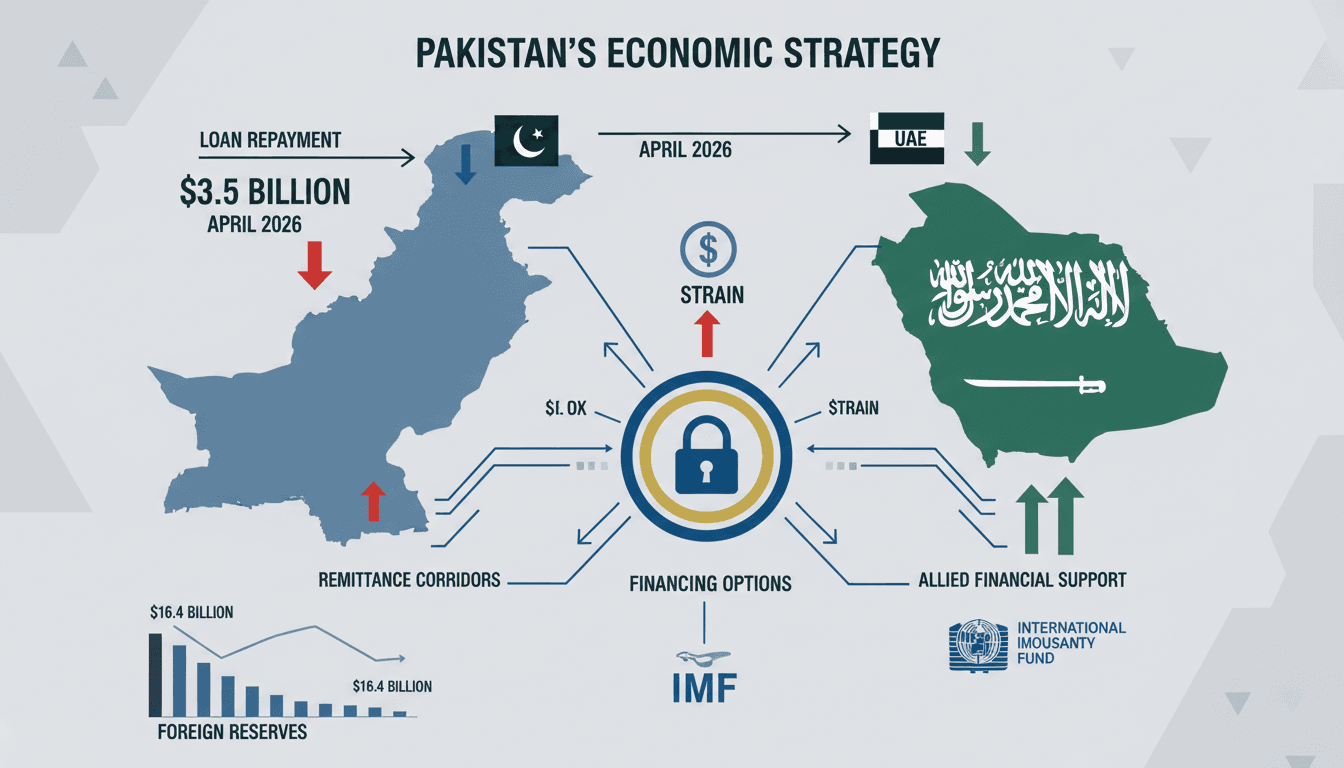
- Pakistan's foreign reserves stood at $16.4 billion as of March 27, 2026, equivalent to 2.8 months of import cover, significantly strained by the UAE repayment.
- The repayment deadline has shifted from annual rollovers to monthly extensions, reflecting increased pressure on Pakistan's economy amid geopolitical tensions.
What's really happening
Pakistan's financial landscape is under significant strain as it navigates the complexities of repaying a substantial loan to the UAE. The $3.5 billion facility, which has been a lifeline since 2019, is now a pressing obligation that the government must address. The shift from annual rollovers to monthly extensions indicates a tightening of financial support from the UAE, driven by regional instability and changing policy priorities.
The urgency of the repayment is underscored by the fact that Pakistan's foreign reserves are already precariously low, standing at $16.4 billion as of late March 2026. This amount only covers 2.8 months of imports, leaving the country vulnerable to external shocks. The repayment of the UAE loan, which includes $450 million in overdue deposits, is expected to further strain these reserves, potentially leading to a liquidity crisis if not managed effectively.
In response, Finance Minister Aurangzeb has outlined a range of financing options, including Eurobonds, Islamic sukuk, and commercial loans, to meet the repayment deadline. The inclusion of Saudi assistance as a potential avenue for support reflects the broader geopolitical dynamics at play, as Pakistan seeks to maintain its financial stability while navigating complex relationships with its allies.
The recent pledge of a $3 billion deposit from Saudi Arabia is a critical development, providing immediate relief and bolstering Pakistan's capacity to service its debts. This support is essential not only for meeting the UAE loan obligations but also for maintaining compliance with the International Monetary Fund (IMF) program, which is crucial for Pakistan's economic recovery.
As Pakistan works to stabilize its economy, the implications extend beyond its borders. The UAE's role as a financial hub and the presence of a large Pakistani expatriate workforce in Dubai mean that the outcomes of this situation could influence remittance flows, projected at $41.5 billion nationally. A stable Pakistan is vital for the economic health of the region, and any disruptions could have cascading effects on expatriates and their families.
Who feels it first (and how)
- Pakistani expatriates in the UAE: Potential fluctuations in remittance flows could impact their families back home.
- Investors in Eurobonds: Changes in Pakistan's creditworthiness may affect investment decisions and returns.
- Local businesses in Pakistan: Economic instability could lead to reduced consumer spending and investment.
What to watch next
- IMF board decisions: Approval of the anticipated $1.3 billion tranche in late April or early May will be crucial for Pakistan's financial health.
- Foreign reserve updates: Monitoring changes in Pakistan's foreign reserves will indicate the effectiveness of repayment strategies and overall economic stability.
- Saudi financial support: Further commitments from Saudi Arabia could signal ongoing regional support and influence Pakistan's economic trajectory.
Pakistan is exploring multiple financing options to repay the UAE loan.
The IMF will approve the pending tranche, providing essential support.
The long-term implications of the UAE's shift in loan policy on Pakistan's economic stability.
Frequently Asked Questions
- Why it matters?
- This situation highlights the interconnectedness of global finance and the potential ripple effects on economies reliant on remittances.
- What happened (in 30 seconds)?
- Pakistan's Finance Minister Muhammad Aurangzeb announced on April 13, 2026, the exploration of financing options to repay a $3.5 billion loan to the UAE due this month. The UAE loan, which has been rolled over since 2018, now demands full repayment amid regional tensions and policy shifts. Saudi Arabia pledged an additional $3 billion deposit to support Pakistan's repayment efforts, with IMF assistance also anticipated.
- What's really happening?
- Pakistan's financial landscape is under significant strain as it navigates the complexities of repaying a substantial loan to the UAE. The $3.5 billion facility, which has been a lifeline since 2019, is now a pressing obligation that the government must address. The shift from annual rollovers to monthly extensions indicates a tightening of financial support from the UAE, driven by regional instability and changing policy priorities. The urgency of the repayment is underscored by the fact that
- Who feels it first (and how)?
- Pakistani expatriates in the UAE: Potential fluctuations in remittance flows could impact their families back home. Investors in Eurobonds: Changes in Pakistan's creditworthiness may affect investment decisions and returns. Local businesses in Pakistan: Economic instability could lead to reduced consumer spending and investment.
- What to watch next?
- IMF board decisions: Approval of the anticipated $1.3 billion tranche in late April or early May will be crucial for Pakistan's financial health. Foreign reserve updates: Monitoring changes in Pakistan's foreign reserves will indicate the effectiveness of repayment strategies and overall economic stability. Saudi financial support: Further commitments from Saudi Arabia could signal ongoing regional support and influence Pakistan's economic trajectory.
Regional and international reporting focused on Middle Eastern politics, diplomacy, and economics.
"Asharq Al-Awsat is a Saudi-owned international newspaper reflecting mainstream Gulf political perspectives."
— A47 Editor
Pakistan Says Looking at Options to Repay $3.5 Billion UAE Loan
Pakistan is currently exploring options to repay a $3.5 billion loan from the United Arab Emirates (UAE), reflecting ongoing financial challenges faced by the country. This situation arises amid a backdrop of significant economic pressures and the ne...
Pan-Arab news coverage spanning politics, business, sports, and regional affairs.
"Asharq Al-Awsat reflects a broad Arab editorial perspective with strong attention to regional geopolitics."
— A47 Editor
باكستان تدرس بدائل تمويلية لسداد 3.5 مليار دولار للإمارات
Pakistan's Finance Minister, Mohammad Aurangzeb, announced that the country is exploring financing options to replace a $3.5 billion facility from the UAE. This move indicates a strategic reassessment of Pakistan's financial commitments and partnersh...
Global markets, investing, and macroeconomics from a premier financial newsroom.
"Bloomberg is respected for in-depth financial reporting and data-driven analysis."
— A47 Editor
Pakistan Weighs ‘All Options’ to Sustain Reserves After UAE Move
Pakistan is exploring various financing options to sustain its foreign-exchange reserves after the United Arab Emirates requested full repayment of a $3 billion loan. This situation arises as the country grapples with soaring oil prices and economic ...