
World Bank Projects 32% Surge in Global Energy Prices for 2026 Amid Middle East and Ukraine Conflicts
Why it matters
Simultaneous geopolitical conflicts and climate-driven agricultural disruptions have combined to produce the sharpest contraction in global oil supply since the 1980s outside of pandemic years, resetting inflation trajectories for energy-importing markets.
What happened (in 30 seconds)
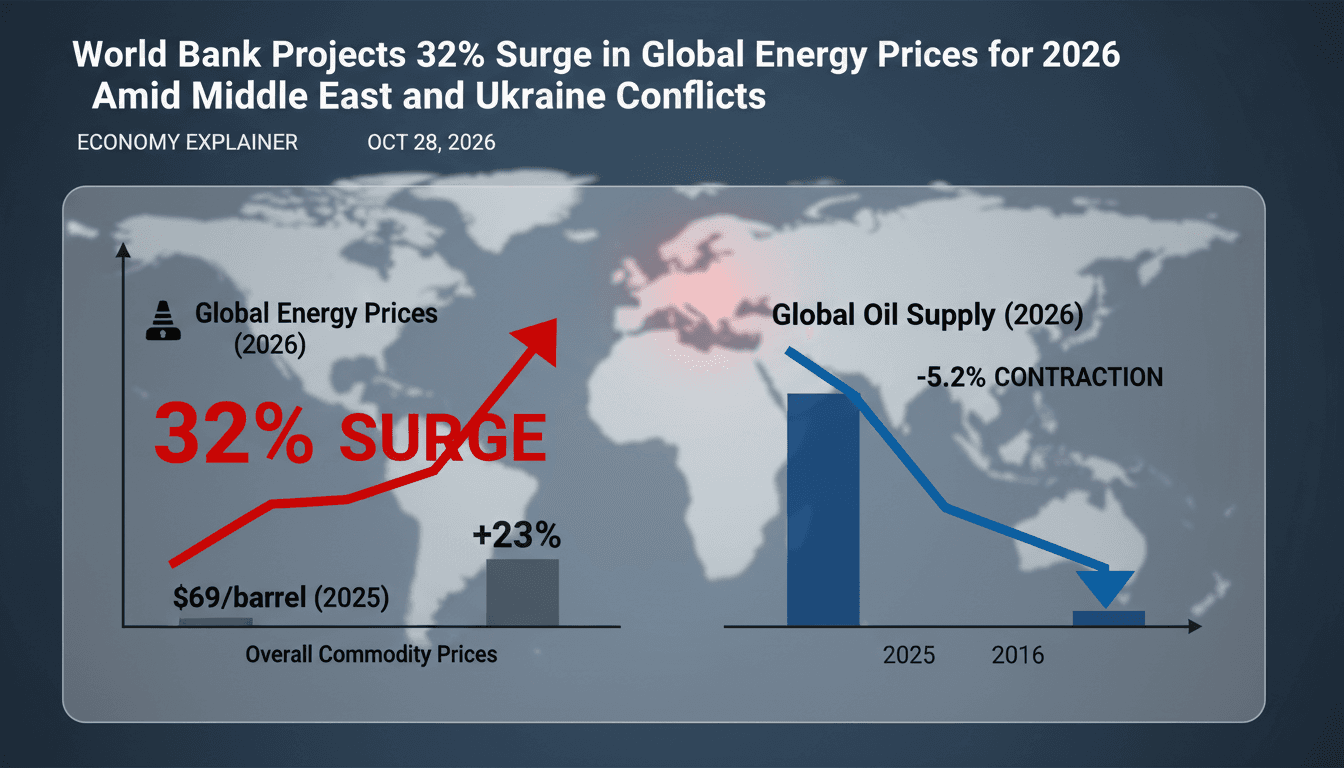
- The World Bank revised its forecast upward, projecting a 32% rise in global energy prices for 2026 alongside a 23% climb across broader commodity indices.
- Crude benchmarks surged, with Brent crude expected to average $91 per barrel in 2026—up from $69 in 2025—while European natural gas faces projected jumps of nearly 60%.
- Supply metrics tightened sharply, driven by an anticipated 5.2% decline in global oil supply stemming from ongoing conflicts in the Middle East and Ukraine.
The context you actually need
- Three years of declining costs have reversed, replacing a cycle of downward price corrections with a multi-front supply crunch across fossil fuels, base metals, and agricultural goods.
- Compounding climate and trade bottlenecks are amplifying shocks, as disrupted Black Sea grain transit aligns with record El Niño weather patterns that threaten agricultural yields worldwide.
- Multilateral lenders are scaling financial buffers, with the World Bank deploying $8.7 billion across 25 affected countries and preparing contingency capacity of up to $100 billion if disruption deepens.
What's really happening
The projected 32% increase in global energy costs is not an isolated pricing anomaly; it represents the structural convergence of depleted physical inventories and non-linear geopolitical risks. Over the preceding three years, global commodity markets operated under declining price trends. That trajectory ended as active combat in Ukraine and the Middle East simultaneously constricted refining flows, pipeline transit, and primary extraction assets.
According to the World Bank’s October 28, 2026 Commodity Markets Outlook, global oil supply is forecast to contract by 5.2%. Outside of extraordinary pandemic shocks, this marks the most significant single-year supply retraction since the 1980s. Because inventories were already drawn down prior to this cycle, markets have lost the liquid reserves necessary to absorb real-time disruptions. As a result, Brent crude is projected to average $91 per barrel throughout 2026, marking a 31.8% increase from its 2025 baseline of $69 per barrel, with live market pricing already touching $115 per barrel during periods of heightened friction.
This supply tightness extends directly into input alternatives. European natural gas faces projected price spikes of nearly 60%, removing cheap fuel switching as a viable hedge for industrial operators. The pricing pressure is compounded on the agricultural side: Black Sea shipping disruptions and persistent El Niño conditions are expected to lift food commodities by 10% in 2026 and another 7% in 2027, while industrial metals face a 25% increase.
The mechanism transferring these input costs into the broader economy is direct. For energy-importing jurisdictions, raw fuel receipts immediately inflate electricity generation tariffs and freight forwarding rates. The International Monetary Fund projects headline global inflation will advance to 4.7% in 2026, up from previous baselines, before cooling toward 4.1% in 2027. If tensions escalate or severe weather intensifies, the World Bank's adverse modeling outlines a sustained scenario where Brent averages $105 per barrel into 2027, locking enterprise supply chains and households into prolonged, defensive cost-management cycles.
Who feels it first (and how)
- Enterprise supply chain directors and freight carriers: Absorb immediate margin compression as higher marine fuel and diesel costs compound with 25% higher industrial metal prices.
- Residents and consumer households in energy-importing markets: Face rising household expenses, elevated utility billing, and higher retail prices as local transport costs adjust to global fuel benchmarks.
- Energy-intensive manufacturers: Encounter sharp operational cost increases across production plants reliant on European natural gas, where prices are projected to rise nearly 60%.
- Developing import economies: Confront acute balance-of-payments pressures and worsening food security as energy imports absorb foreign exchange reserves alongside 10% higher agricultural commodity costs.
What to watch next
- Brent crude support levels at $91: Tracks whether prompt contracts stabilize near the World Bank's baseline or push toward the $105 adverse scenario amid escalations.
- Black Sea freight volumes and throughput: Serves as a leading indicator for global grain stability and agricultural commodity pricing through late 2026.
- IMF global headline inflation prints: Indicates whether imported energy costs will force central banks to maintain restrictive interest rate policies beyond the 4.7% projection.
Energy prices are projected to rise 32% in 2026, reversing three consecutive years of declines, while global oil supply contracts by 5.2%.
Headline global inflation will track near 4.7% through 2026, maintaining elevated operating and living costs for net energy importers before easing toward 4.1% in 2027.
Whether geopolitical escalations will realize the adverse scenario of $105 per barrel Brent crude, requiring the deployment of the World Bank's $80–100 billion emergency lending capacity.
Frequently Asked Questions
- Why it matters?
- Simultaneous geopolitical conflicts and climate-driven agricultural disruptions have combined to produce the sharpest contraction in global oil supply since the 1980s outside of pandemic years, resetting inflation trajectories for energy-importing markets.
- What happened (in 30 seconds)?
- The World Bank revised its forecast upward, projecting a 32% rise in global energy prices for 2026 alongside a 23% climb across broader commodity indices. Crude benchmarks surged, with Brent crude expected to average $91 per barrel in 2026—up from $69 in 2025—while European natural gas faces projected jumps of nearly 60%. Supply metrics tightened sharply, driven by an anticipated 5.2% decline in global oil supply stemming from ongoing conflicts in the Middle East and Ukraine.
- What's really happening?
- The projected 32% increase in global energy costs is not an isolated pricing anomaly; it represents the structural convergence of depleted physical inventories and non-linear geopolitical risks. Over the preceding three years, global commodity markets operated under declining price trends. That trajectory ended as active combat in Ukraine and the Middle East simultaneously constricted refining flows, pipeline transit, and primary extraction assets. According to the World Bank’s October 28, 2026
- Who feels it first (and how)?
- Enterprise supply chain directors and freight carriers: Absorb immediate margin compression as higher marine fuel and diesel costs compound with 25% higher industrial metal prices. Residents and consumer households in energy-importing markets: Face rising household expenses, elevated utility billing, and higher retail prices as local transport costs adjust to global fuel benchmarks. Energy-intensive manufacturers: Encounter sharp operational cost increases across production plants reliant on Eur
- What to watch next?
- Brent crude support levels at $91: Tracks whether prompt contracts stabilize near the World Bank's baseline or push toward the $105 adverse scenario amid escalations. Black Sea freight volumes and throughput: Serves as a leading indicator for global grain stability and agricultural commodity pricing through late 2026. IMF global headline inflation prints: Indicates whether imported energy costs will force central banks to maintain restrictive interest rate policies beyond the 4.7% projection.
UAE-based English-language newspaper covering regional politics, economics, and global affairs.
"The National reflects Emirati policy perspectives while maintaining international editorial standards."
— A47 Editor
Energy prices to climb 32% this year as global shocks mount, World Bank says
The World Bank says energy prices are set to climb 32% this year as global shocks mount, according to a report published by The National. The forecast reflects escalating supply pressures and inflationary strains across energy markets.
Key macro releases (CPI, jobs, PMIs), surprise indexes, and market implications.
"Great for data-print awareness and instant read-through to rates and risk assets."
— A47 Editor
World Bank sees commodity prices up 23% in 2026 due to Middle East war, other shocks
The World Bank has projected that commodity prices will rise about 23% in 2026, citing the Middle East war and other shocks, according to a report carried by Investing.com. Bloomberg reported on October 28, 2026 that the bank raised its commodity pri...
Global markets, investing, and macroeconomics from a premier financial newsroom.
"Bloomberg is respected for in-depth financial reporting and data-driven analysis."
— A47 Editor
World Bank Raises Commodity Price Outlook Citing War and El Niño
The World Bank has raised its commodity price forecasts, citing disruptions to energy supplies from the Middle East war and the threat to harvests posed by El Niño, according to a report published by Bloomberg on October 28, 2026.