
Waller Backs December Fed Hike and Opens Door to 50 Basis Point Move After Hot October CPI
Why it matters
The convergence of a 0.3% core inflation print and hawkish Federal Reserve forward guidance brings larger interest rate hikes back into play, forcing global markets to rapidly reprice funding conditions.
What happened (in 30 seconds)
- Waller set a hawkish benchmark: Speaking in London on November 10, 2026, Federal Reserve Governor Christopher Waller backed a minimum 25 basis point hike for the December 8–9 FOMC meeting and floated a 50 basis point hike if core inflation failed to ease.
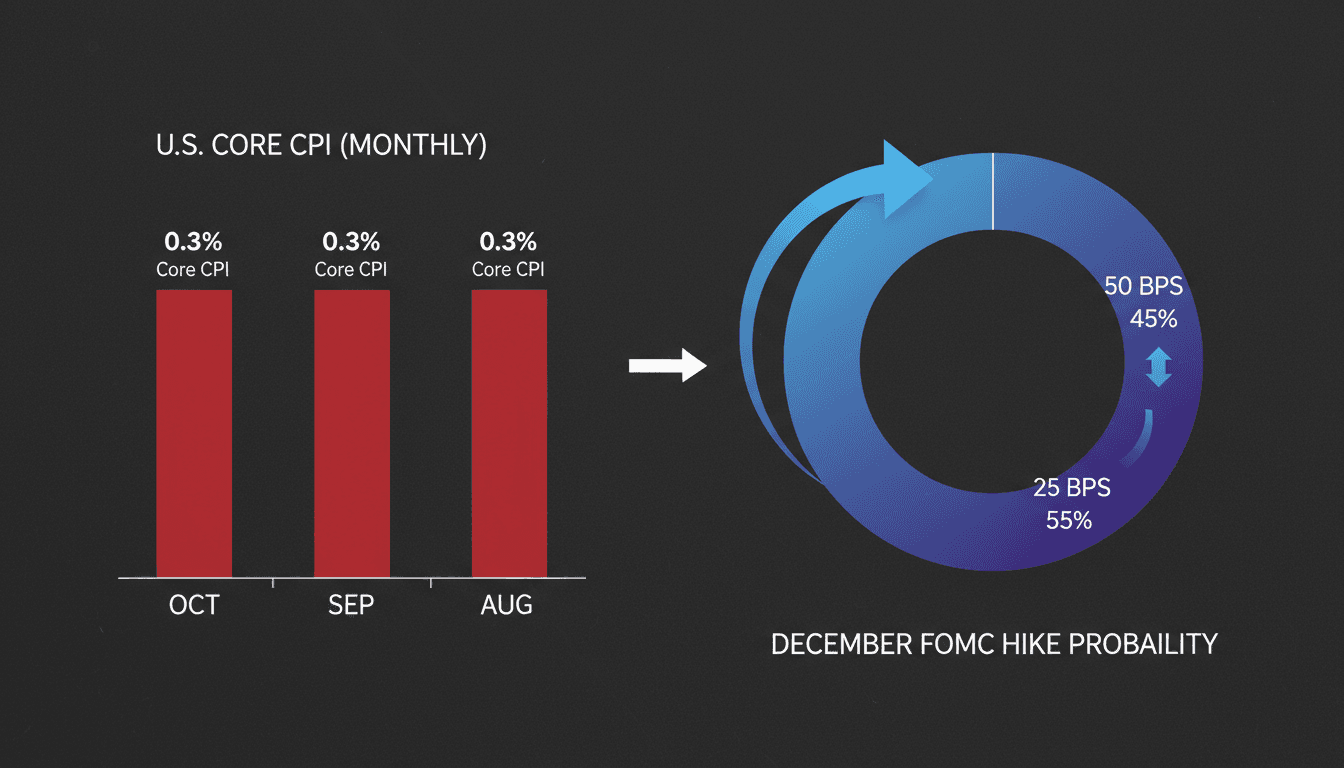
- Inflation matched the trigger: Hours later, the U.S. Bureau of Labor Statistics reported a 0.4% monthly headline CPI increase and a third straight 0.3% monthly core CPI gain, meeting Waller's condition for accelerated tightening.
- Markets immediately repriced: Two-year Treasury yields jumped, equity futures dipped, Dallas Fed President Lorie Logan echoed the potential for faster moves, and implied odds of a half-point December hike climbed from near zero to roughly 15%.
The context you actually need
- Sticky core numbers: The Federal Reserve held policy rates steady in October 2026 after a stretch above its 2% target, but three consecutive monthly core CPI prints of 0.3% demonstrated that underlying price pressures were no longer moderating.
- Broadening inflation drivers: Fed officials grew increasingly concerned over the expanding breadth of price pressures, volatile energy markets, and potential demand spillovers linked to sustained capital spending on artificial intelligence infrastructure.
- Credibility over accommodation: Waller’s explicit signaling prior to the CPI release served to prepare market participants, intentionally setting a rigid threshold to safeguard the central bank's inflation-fighting credibility against an active labor market.
What's really happening
The policy debate within the Federal Reserve is undergoing a structural pivot from managing a potential easing cycle to defending central bank credibility against sticky price pressures. When Governor Waller explicitly conditioned a 50 basis point rate increase on a 0.3% month-over-month core CPI outcome, he created an operational benchmark that the subsequent Bureau of Labor Statistics release immediately validated.
This dynamic matters because central bankers rarely pre-commit to larger rate adjustments unless internal models show price stickiness spreading beyond temporary supply anomalies. A single monthly core reading of 0.3% translates to an annualized pace well above the Fed's 2% objective. Marking the third consecutive month at that rate indicates that persistent consumer demand, resilient labor conditions, and continuous capital outlays are neutralizing previous monetary restriction.
The mechanism at work is monetary transmission through rate expectations. By floating the half-point option in London hours before the domestic data crossed the tape, Waller created an asymmetric policy corridor. If October inflation had surprised to the downside, the baseline remained a 25 basis point hike. When the print arrived hot—revealing a 0.4% headline expansion alongside the 0.3% core gain—it converted a tail-risk scenario into an active baseline discussion. Dallas Fed President Lorie Logan reinforced this shift, demonstrating institutional consensus around tightening if baseline inflation fails to cool.
For the global financial architecture, this shift ends the assumption that central bank policy will gently taper off. Higher short-end Treasury yields directly alter discount rates across every asset class. For regional financial epicenters like Dubai, where local currencies are pegged directly to the U.S. dollar, domestic monetary authorities mirror Federal Reserve rate adjustments lockstep. Consequently, local debt facilities, commercial property financing, and liquidity pools face an instant repricing risk. Capital allocation shifts toward risk-free, dollar-denominated cash yields, raising the hurdle rate for regional venture funds, sovereign debt issuances, and global trade financing facilities.
Who feels it first (and how)
- Corporate treasury teams: Operators managing variable-rate balance sheets face direct borrowing increases as benchmark short-end financing rates adjust upward.
- Global commercial real estate developers: Projects reliant on cross-border debt syndication in dollar-pegged markets like Dubai confront elevated capitalization rates and tighter refinancing terms.
- Fixed-income portfolio managers: Fund managers holding front-end sovereign and corporate credit absorb immediate capital losses as the 2-year Treasury yield climbs to reflect the higher terminal rate trajectory.
- Energy and trade finance operators: Transacting in dollars under stronger exchange-rate pressure raises transaction costs and capital requirements for commodity clearing and cross-border logistics.
What to watch next
- The December 8–9 FOMC rate decision: Central bankers will determine whether to proceed with a standard 25 basis point adjustment or execute the newly opened 50 basis point scenario.
- Follow-up speeches from FOMC voting members: Comments from remaining leadership will indicate whether Waller and Logan have built a working majority for accelerated action.
- Energy price volatility and commodity inputs: Persistent momentum in headline energy data will dictate whether cost pressures expand further into November data sets.
October 2026 core CPI rose 0.3% month-over-month for the third straight month, and Governor Waller committed to backing at least a 25 basis point hike in December.
The Federal Reserve will implement higher benchmark borrowing costs at its December meeting, elevating debt service burdens across dollar-linked economies.
Whether sufficient consensus exists among FOMC voters to escalate the planned December adjustment from a 25 basis point move to a 50 basis point hike.
Frequently Asked Questions
- Why it matters?
- The convergence of a 0.3% core inflation print and hawkish Federal Reserve forward guidance brings larger interest rate hikes back into play, forcing global markets to rapidly reprice funding conditions.
- What happened (in 30 seconds)?
- Waller set a hawkish benchmark: Speaking in London on November 10, 2026, Federal Reserve Governor Christopher Waller backed a minimum 25 basis point hike for the December 8–9 FOMC meeting and floated a 50 basis point hike if core inflation failed to ease. Inflation matched the trigger: Hours later, the U.S. Bureau of Labor Statistics reported a 0.4% monthly headline CPI increase and a third straight 0.3% monthly core CPI gain, meeting Waller's condition for accelerated tightening. Markets immedi
- What's really happening?
- The policy debate within the Federal Reserve is undergoing a structural pivot from managing a potential easing cycle to defending central bank credibility against sticky price pressures. When Governor Waller explicitly conditioned a 50 basis point rate increase on a 0.3% month-over-month core CPI outcome, he created an operational benchmark that the subsequent Bureau of Labor Statistics release immediately validated. This dynamic matters because central bankers rarely pre-commit to larger rate
- Who feels it first (and how)?
- Corporate treasury teams: Operators managing variable-rate balance sheets face direct borrowing increases as benchmark short-end financing rates adjust upward. Global commercial real estate developers: Projects reliant on cross-border debt syndication in dollar-pegged markets like Dubai confront elevated capitalization rates and tighter refinancing terms. Fixed-income portfolio managers: Fund managers holding front-end sovereign and corporate credit absorb immediate capital losses as the 2-year
- What to watch next?
- The December 8–9 FOMC rate decision: Central bankers will determine whether to proceed with a standard 25 basis point adjustment or execute the newly opened 50 basis point scenario. Follow-up speeches from FOMC voting members: Comments from remaining leadership will indicate whether Waller and Logan have built a working majority for accelerated action. Energy price volatility and commodity inputs: Persistent momentum in headline energy data will dictate whether cost pressures expand further into
Global markets, investing, and macroeconomics from a premier financial newsroom.
"Bloomberg is respected for in-depth financial reporting and data-driven analysis."
— A47 Editor
Fed’s Waller Sparks Larger Rate Hike Debate After Hot Inflation
Federal Reserve Governor Christopher Waller said on Tuesday that he supports a rate hike in December and raised the possibility of a half-percentage-point increase if inflation accelerates, after October consumer price data came in hotter than expect...
Editor-curated FT homepage stories spanning markets, business, world, and opinion.
"The Financial Times is a globally respected business publication with a centrist/center-left tone and strong markets focus."
— A47 Editor
Top Fed official considers largest rate rise since 2022
Fed Governor Christopher Waller said policymakers should weigh a 50 basis point rate increase, the largest since 2022, if US inflation fails to slow, after October consumer prices rose 0.4% month-over-month, more than economists had expected. The Fed...
Global business headlines with AI angles.
"General business outlet that frequently covers AI."
— A47 Editor
A Fed Governor Said He'd be Open to a Half-Point Rate Hike if Inflation Came in Hotter. That Just Happened.
Federal Reserve Governor Waller said in London that he was "leaning toward" a half-point rate hike even if October inflation came in softer than expected, and that he would back "more robust action" if the reading was higher than forecasts. The remar...
Macro commentary, policy analysis, growth/inflation themes, and global outlooks.
"Contextual macro coverage that complements day-to-day market headlines."
— A47 Editor
Fed’s Waller says larger hike should be considered if October CPI runs hot
Fed Governor Christopher Waller said a larger interest rate hike should be considered if October's consumer price index (CPI) report shows inflation running hot, according to Investing.com. The comments frame the October policy decision as hinging on...
Macro commentary, policy analysis, growth/inflation themes, and global outlooks.
"Contextual macro coverage that complements day-to-day market headlines."
— A47 Editor
Fed’s Waller plans to support at least a quarter-point rate hike in December
Federal Reserve Governor Christopher Waller said he plans to support at least a quarter-point interest rate hike in December, according to a report published by Investing.com on November 10, 2026. The Fed kept its benchmark rate at 3.75%-4% at its la...
Global markets, investing, and macroeconomics from a premier financial newsroom.
"Bloomberg is respected for in-depth financial reporting and data-driven analysis."
— A47 Editor
Fed's Waller Supports Rate Hike in December
Federal Reserve Governor Christopher Waller said he supports an interest-rate hike in December and warned that if inflation accelerates further, he would back a half-percentage-point increase to protect the central bank's credibility. He made the rem...