
US October CPI Overshoot Lifts Treasury Yields and Pressures Equities Ahead of Possible December Fed Hike
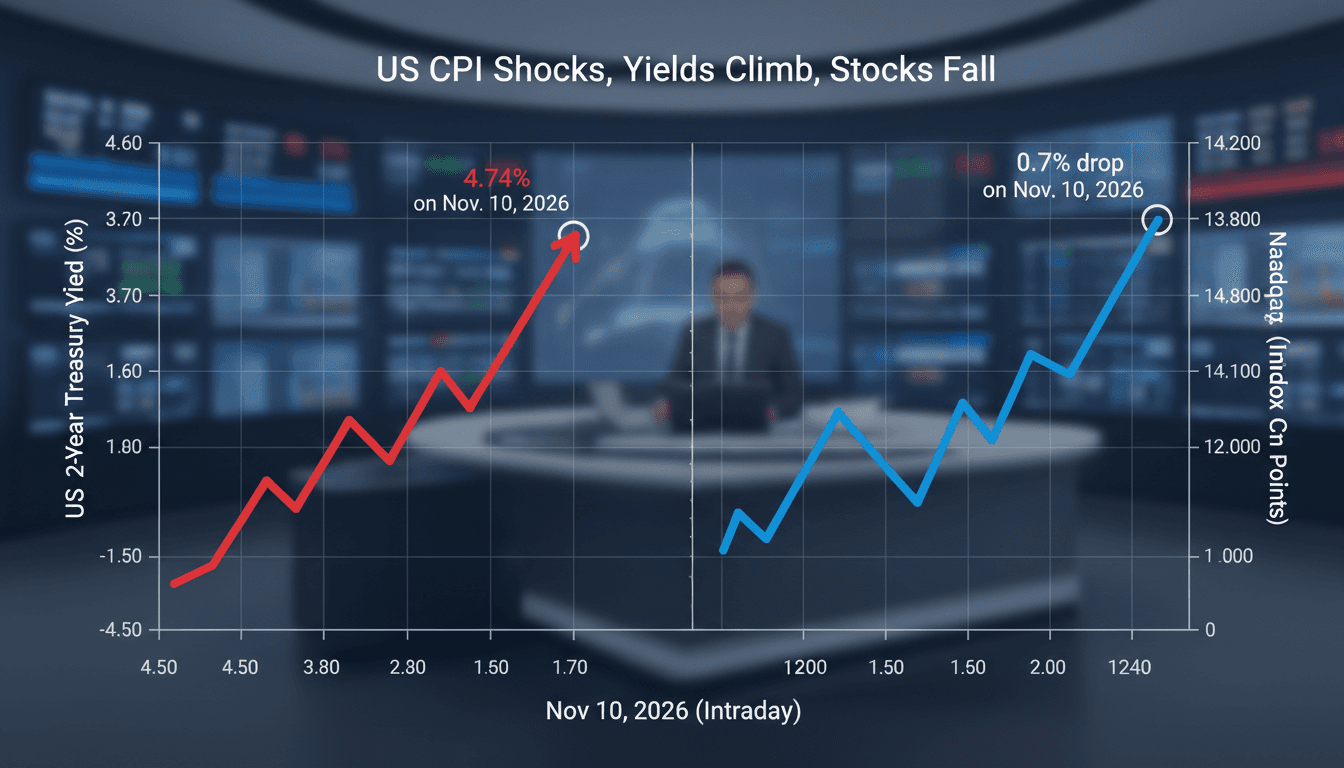
Persistent price pressures in the world's largest economy are driving up borrowing costs globally, tightening valuation multiples on growth portfolios, and raising financing hurdles across dollar-linked markets.
Why it matters
A simultaneous uptick in core inflation prints and short-term sovereign bond yields alters the global cost of capital, forcing central banks to hold rates higher for longer and recalibrating risk pricing across asset classes.
What happened (in 30 seconds)
* October inflation prints surprised to the upside, as the US Bureau of Labor Statistics reported a month-over-month headline Consumer Price Index increase of 0.4% against consensus estimates of 0.3%, while core CPI expanded 0.3% against expectations of 0.2%. * Sovereign yields surged across the curve, led by the policy-sensitive 2-year Treasury yield, which jumped nearly 19 basis points to 4.74%—marking its largest single-day advance in over twelve months—while the 10-year Treasury yield briefly hit 5%. * Equities pulled back on monetary tightening signals, with the Nasdaq Composite dropping 0.74%, the S&P 500 falling 0.38%, and the Dow Jones Industrial Average dipping 0.3% following hawkish guidance from Federal Reserve officials Christopher Waller and Lorie Logan.
The context you actually need
* Disinflation stalled before this release, following persistent monthly price pressures that included a 0.6% headline CPI reading in September 2026, challenging earlier market assumptions of an easing cycle. * Fed guidance pivoted toward overt hawkishness, with Federal Reserve Governor Christopher Waller explicitly confirming pre-market support for a December interest rate hike and opening the door to a potential 50 basis point increase if elevated inflation persisted. * Broader macro currents collided, as earlier trade policy measures from 2025 tariffs continued to filter through goods pricing, while softening crude oil prices following US comments regarding Iran partially cushioned headline energy inputs.
What's really happening
The mechanics behind this market shift reflect an abrupt repricing of terminal policy rates rather than an isolated reaction to a single monthly data point.
When month-over-month headline CPI prints at 0.4% alongside a 0.3% core increase, it indicates that price stickiness is entrenched across services and domestic production inputs. The market entered November 2026 positioned for a policy trajectory that anticipated steady disinflation. Instead, the persistence of price gains—building on September's 0.6% print—demonstrates that aggregate demand and cost-push factors remain resilient enough to keep inflation running above the Federal Reserve's target.
The primary mechanism driving this response is the short-term interest rate market. Federal Reserve officials, notably Governor Christopher Waller and Dallas Fed President Lorie Logan, conditioned their forward guidance on structural data validation. Waller’s willingness to consider a December rate hike, including a tail-risk probability of a 50 basis point adjustment, immediately re-anchored the short end of the yield curve. Traders responded by pricing in nearly 99% odds of a December rate hike. Because the 2-year Treasury reflects near-term monetary policy expectations, its 19 basis point rise to 4.74% shows institutional capital adjusting to prolonged liquidity constraints.
Concurrently, the long end of the curve reacted to both higher baseline inflation expectations and the cost of debt service, briefly driving the 10-year Treasury to 5%. In financial valuation models, higher discount rates mechanically depress the net present value of future corporate cash flows. This structural mathematical link explains why equity declines were concentrated in high-multiple technology equities, visible in the Nasdaq Composite's 0.74% decline, where components like Nvidia faced immediate selling.
At the macro balance sheet level, these developments reinforce US dollar strength while pushing down alternative stores of value like gold. In dollar-pegged economies like the UAE, elevated US Treasury yields translate directly into domestic monetary tightness because the central bank must track Fed policy to maintain the peg. While Dubai’s services, financial hub activity, and tourism sectors operate with strong organic momentum, sustained dollar strength increases imported goods pricing from non-dollar regions, while lower crude oil benchmarks introduce marginal fiscal trade-offs across broader regional hydrocarbon revenues. Capital allocators face an environment where risk-free paper yields near 5%, raising the hurdle rate for every private equity, real estate, and growth venture allocation globally.
Who feels it first (and how)
* Growth and technology equity investors: Portfolio valuations compress as higher discount rates reduce the current value of distant cash flows, evidenced by tech-led sell-offs across major benchmarks. * Corporate treasurers and borrowers: Entities rolling over debt facilities face elevated interest coverage ratios as benchmark yields establish a floor near 4.74% to 5.00%. * Expatriates and consumers in dollar-pegged hubs (such as Dubai): The appreciating US dollar alters purchasing parity, stabilizing import values from weakening currency blocs while tightening local lending conditions and mortgages tied to interbank benchmarks. * Fixed-income fund managers: Portfolios holding duration risk experience capital losses as benchmark bond yields adjust upward to match revised Federal Reserve terminal rate pricing.
What to watch next
* The Federal Open Market Committee's December policy decision, which will formally validate whether the nearly 99% implied odds of an interest rate increase—or the minority scenario of a 50 basis point hike—materialize. * Subsequent core inflation prints, which will demonstrate whether the 0.3% core CPI increase was a temporary anomaly or part of an accelerating quarter-over-quarter trend. * Global sovereign bond spread reactions, specifically how corporate credit spreads and emerging market sovereign debt absorb elevated US benchmark rates near 5%.
October 2026 headline CPI advanced 0.4% month-over-month, the 2-year Treasury yield rose 19 basis points to 4.74%, and the Nasdaq Composite fell 0.74%.
The Federal Reserve will maintain restrictive policy settings through the close of 2026, holding borrowing costs high across global dollar-denominated facilities.
Whether softening crude oil markets will offset service-sector inflation sufficiently to avert an aggressive 50 basis point rate hike in upcoming policy sessions.
Frequently Asked Questions
- Why it matters?
- A simultaneous uptick in core inflation prints and short-term sovereign bond yields alters the global cost of capital, forcing central banks to hold rates higher for longer and recalibrating risk pricing across asset classes.
- What happened (in 30 seconds)?
- October inflation prints surprised to the upside, as the US Bureau of Labor Statistics reported a month-over-month headline Consumer Price Index increase of 0.4% against consensus estimates of 0.3%, while core CPI expanded 0.3% against expectations of 0.2%. Sovereign yields surged across the curve, led by the policy-sensitive 2-year Treasury yield, which jumped nearly 19 basis points to 4.74%—marking its largest single-day advance in over twelve months—while the 10-year Treasury yield briefly hi
- What's really happening?
- The mechanics behind this market shift reflect an abrupt repricing of terminal policy rates rather than an isolated reaction to a single monthly data point. When month-over-month headline CPI prints at 0.4% alongside a 0.3% core increase, it indicates that price stickiness is entrenched across services and domestic production inputs. The market entered November 2026 positioned for a policy trajectory that anticipated steady disinflation. Instead, the persistence of price gains—building on Sept
- Who feels it first (and how)?
- Growth and technology equity investors: Portfolio valuations compress as higher discount rates reduce the current value of distant cash flows, evidenced by tech-led sell-offs across major benchmarks. Corporate treasurers and borrowers: Entities rolling over debt facilities face elevated interest coverage ratios as benchmark yields establish a floor near 4.74% to 5.00%. Expatriates and consumers in dollar-pegged hubs (such as Dubai): The appreciating US dollar alters purchasing parity, stabilizin
- What to watch next?
- The Federal Open Market Committee's December policy decision, which will formally validate whether the nearly 99% implied odds of an interest rate increase—or the minority scenario of a 50 basis point hike—materialize. Subsequent core inflation prints, which will demonstrate whether the 0.3% core CPI increase was a temporary anomaly or part of an accelerating quarter-over-quarter trend. Global sovereign bond spread reactions, specifically how corporate credit spreads and emerging market sovereig
Markets desk coverage, trading insights, and investor updates.
"WSJ’s markets reporting provides in-depth analysis and context for investors."
— A47 Editor
Stock Market News, November 10, 2026: Yields Jump as Inflation Comes in Hotter Than Expected
U.S. bond yields jumped on November 10, 2026 after inflation data came in hotter than expected, weighing on stocks, while Nvidia shares continued to slide and CoreWeave gained in after-hours trading, according to The Wall Street Journal.
Global markets, investing, and macroeconomics from a premier financial newsroom.
"Bloomberg is respected for in-depth financial reporting and data-driven analysis."
— A47 Editor
Stocks Rise as Investors Shrug Off Nvidia Probe; Trump Says Iran Strikes Unlikely
US equity futures rose after the S&P 500 posted its worst week since April 2025, even as Nvidia shares dropped sharply. The chipmaker's board launched an independent investigation after CEO Jensen Huang admitted to an extramarital affair with Alice H...
Technology business and AI-related headlines.
"Data-driven tech newsroom with global scope."
— A47 Editor
S&P 500 Rallies Most Since April as Oil Drop Lures Back Buyers
US stocks posted their biggest rally in over seven months as investors returned to buy after a sharp tech-led selloff the previous week, with a drop in oil prices providing an additional boost on Monday, according to Bloomberg Technology.
Technology business news, market impacts, and innovation trends.
"Bloomberg is a premier financial and tech news provider, respected for its in-depth reporting and analytical rigor."
— A47 Editor
S&P 500 Rallies Most Since April as Oil Drop Lures Back Buyers
US stocks posted their biggest rally in over seven months as investors returned to buy after a sharp tech-led selloff the previous week, with a drop in oil prices providing an additional boost on Monday, according to Bloomberg Technology.