
Spain Passes Limited Housing Reforms by Single Vote After Nationwide General Strike
Why it matters
The single-vote passage of eviction restrictions under interim parliamentary rule exposes how demographic housing deficits are directly destabilizing Southern European legislative agendas and investor certainty.
What happened (in 30 seconds)
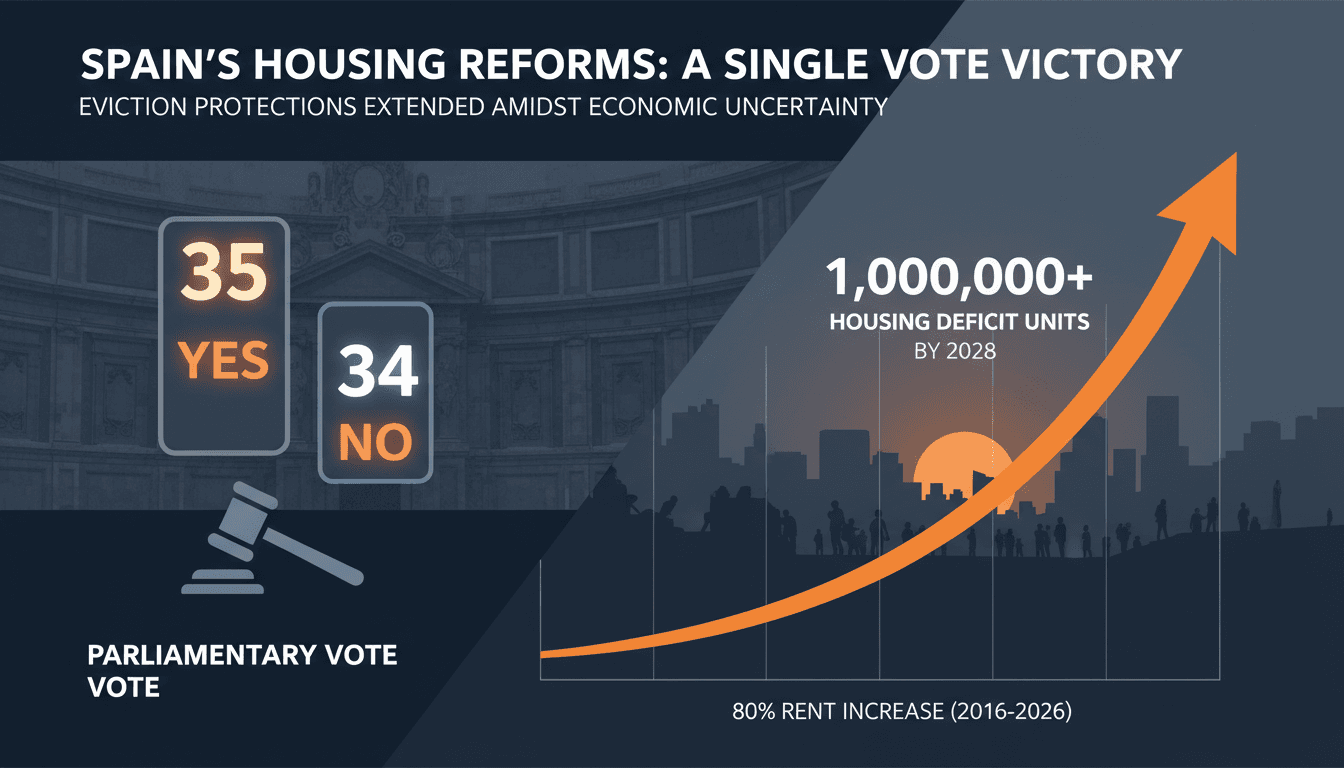
* A razor-thin legislative passage: On November 12, 2026, Spain’s interim lower house Permanent Deputation ratified a revised housing decree by a 35–34 vote margin, while rejecting a concurrent measure proposing automatic lease renewals. * Widespread industrial action: The parliamentary vote followed a 24-hour nationwide general strike on November 11, 2026—Spain’s first in 14 years—drawing an estimated 3 to 4 million participants across major metropolitan areas, manufacturing hubs, and commercial ports. * Targeted regulatory limits: The ratified measures extend eviction protections for vulnerable households through 2030 and establish bans on speculative real estate acquisitions transacted below 70% of benchmark property value.
The context you actually need
* A structural supply-demand mismatch: Spain currently faces a structural deficit of 750,000 housing units, a deficit that Bank of Spain projections indicate will expand past one million units by 2028. * A decade of price inflation: Over the past ten years, Spanish rental rates climbed roughly 80% while underlying residential property acquisition prices appreciated by 63%, driven by tourism demand, speculative capital flows, and low construction volumes. * Escalating social and electoral volatility: Public mobilizations surged following the September 2026 eviction and subsequent October passing of 87-year-old María del Carmen Abascal, prompting encampments in Madrid's Puerta del Sol and forcing an early snap general election scheduled for November 29, 2026.
What's really happening
The passage of Spain’s housing decree by a single vote reveals the acute tension between capital deployment incentives and urban political survivability. Prime Minister Pedro Sánchez’s minority coalition resorted to the interim parliament’s 69-member Permanent Deputation to push through defensive interventions after broader legislative packages collapsed.
The underlying mechanics rest on structural asset scarcity rather than cyclical price movements. Over the past decade, average residential rental costs across Spain expanded by roughly 80%, while aggregate home asset values climbed 63%. In core urban centers, the capitalization of residential units into short-term tourist accommodation and distressed-asset portfolios compressed the long-term rental stock. The central bank quantifies Spain’s current domestic housing shortfall at 750,000 units, expanding toward more than one million units by 2028.
The approved decree introduces two regulatory interventions designed to address social pressure without requiring public treasury outlays. First, it extends tenant eviction moratoriums for households classified as vulnerable through 2030. Second, it penalizes speculative bottom-fishing by restricting property transactions completed at discounts exceeding 30% relative to recognized property value.
However, the political compromise resulted in the explicit rejection of automatic lease renewals, illustrating the limits of coalition leverage. Landlords and institutional property owners retain the capacity to terminate non-vulnerable leases upon contractual expiration.
The economic trade-off is immediate. Renters gain targeted defensive protections against sudden displacement, but institutional capital faces elevated asset illiquidity. Capping acquisition discounts alters distressed-debt and non-performing-loan resolutions, reducing the margins for funds specializing in recapitalizing distressed real estate balance sheets.
Furthermore, these interventions arrive with an expiration horizon tied directly to the ballot box. With snap elections scheduled for November 29, 2026, and the opposition Popular Party polling ahead on a platform of total repeal and construction-focused deregulation, these reforms act as temporary institutional stopgaps. The systemic supply deficit remains unaddressed, leaving operational capital caught in an unpredictable regulatory cycle.
Who feels it first (and how)
* Distressed real estate funds and private equity buyers: Operators face an operational halt on deep-discount acquisition strategies due to the statutory ban on acquisitions transacted below 70% of assessed property valuations. * Vulnerable urban tenant cohorts: Low-income families and protected demographic segments gain legal immunity against eviction proceedings through 2030, reducing near-term displacement risks across high-rent metropolitan centers. * Industrial logistics and port operators: Supply chain operators in maritime ports and manufacturing corridors face lingering labor friction and scheduling realignments after absorbative disruptions during the 3-to-4-million-worker strike. * Cross-border real estate allocators: International investors face immediate uncertainty concerning rental yield forecasts, with baseline policy settings contingent on the outcome of the November 29 snap general election.
What to watch next
* The November 29 snap election outcome: A victory by the opposition Popular Party will likely trigger the immediate legislative repeal of both eviction moratoriums and transaction discount caps, reverting policy to supply-side deregulation. * Institutional listing withdrawals: Private residential owners and corporate landlords may temporarily withhold vacant units from long-term lease markets to assess regulatory permanence, tightening short-term rental liquidity. * Central bank deficit updates: Subsequent quarterly data from the Bank of Spain tracking whether domestic housing deficit estimates breach the 800,000 threshold ahead of the baseline 2028 trajectory.
The interim lower house ratified eviction shields through 2030 and restricted property purchases below 70% of asset value by a 35–34 margin, following a 24-hour general strike involving an estimated 3 to 4 million people.
Real estate investment volumes in Spanish residential portfolios will slow significantly through late 2026 as institutional allocators price in repeal risks or structural regulatory enforcement.
Whether a newly formed parliamentary majority after November 29 can implement sustainable construction incentives sufficient to bridge the projected one-million-unit housing shortage by 2028.
Frequently Asked Questions
- Why it matters?
- The single-vote passage of eviction restrictions under interim parliamentary rule exposes how demographic housing deficits are directly destabilizing Southern European legislative agendas and investor certainty.
- What happened (in 30 seconds)?
- A razor-thin legislative passage: On November 12, 2026, Spain’s interim lower house Permanent Deputation ratified a revised housing decree by a 35–34 vote margin, while rejecting a concurrent measure proposing automatic lease renewals. Widespread industrial action: The parliamentary vote followed a 24-hour nationwide general strike on November 11, 2026—Spain’s first in 14 years—drawing an estimated 3 to 4 million participants across major metropolitan areas, manufacturing hubs, and commercial po
- What's really happening?
- The passage of Spain’s housing decree by a single vote reveals the acute tension between capital deployment incentives and urban political survivability. Prime Minister Pedro Sánchez’s minority coalition resorted to the interim parliament’s 69-member Permanent Deputation to push through defensive interventions after broader legislative packages collapsed. The underlying mechanics rest on structural asset scarcity rather than cyclical price movements. Over the past decade, average residential r
- Who feels it first (and how)?
- Distressed real estate funds and private equity buyers: Operators face an operational halt on deep-discount acquisition strategies due to the statutory ban on acquisitions transacted below 70% of assessed property valuations. Vulnerable urban tenant cohorts: Low-income families and protected demographic segments gain legal immunity against eviction proceedings through 2030, reducing near-term displacement risks across high-rent metropolitan centers. Industrial logistics and port operators: Suppl
- What to watch next?
- The November 29 snap election outcome: A victory by the opposition Popular Party will likely trigger the immediate legislative repeal of both eviction moratoriums and transaction discount caps, reverting policy to supply-side deregulation. Institutional listing withdrawals: Private residential owners and corporate landlords may temporarily withhold vacant units from long-term lease markets to assess regulatory permanence, tightening short-term rental liquidity. Central bank deficit updates: Subs
Global news coverage with extensive reporting on Middle Eastern conflicts and geopolitics.
"Al Jazeera is a Qatar-based broadcaster known for wide regional coverage and alternative perspectives."
— A47 Editor
Spain approves housing reforms after nationwide strike over costs
Spain approved new housing reforms that limit evictions following a 24-hour nationwide general strike, the first in 14 years, called by the country's two largest unions over soaring housing costs and the rising cost of living. The base report notes t...
Comprehensive coverage of Middle Eastern and global issues.
"Al Jazeera is a prominent voice from the Global South, especially the Middle East, with an emphasis on underreported stories."
— A47 Editor
Spain approves housing reforms after nationwide strike over costs
Spain approved new housing reforms that limit evictions following a 24-hour nationwide general strike, the first in 14 years, called by the country's two largest unions over soaring housing costs and the rising cost of living. The base report notes t...
Arabic-language political and world news coverage for UAE readers.
"Emarat Al Youm world coverage usually presents international developments through a UAE and Arab audience lens."
— A47 Editor
لإنهاء أزمة السكن.. إسبانيا تُقيد زيادة الإيجارات والإخلاء لإنهاء أزمة السكن.. إسبانيا تُقيد زيادة الإيجارات والإخلاء
Spain's parliament has approved a package of exceptional measures aimed at capping rent increases and protecting tenants from eviction, in an attempt to contain the country's housing crisis, according to a report by Emarat Al Youm.
English-language news from Qatar covering domestic and regional affairs.
"Gulf Times reflects Qatari perspectives on regional developments."
— A47 Editor
Spanish parliament passes housing measures after protests, strike
Spain's parliament on Thursday passed measures restricting evictions and aiming to make housing more affordable, following a general strike and weeks of protests over the country's housing crisis that prompted Prime Minister Pedro Sanchez to call a s...