
Fed December Hike Odds Rise to 88.8 Percent Following Hot October CPI Data
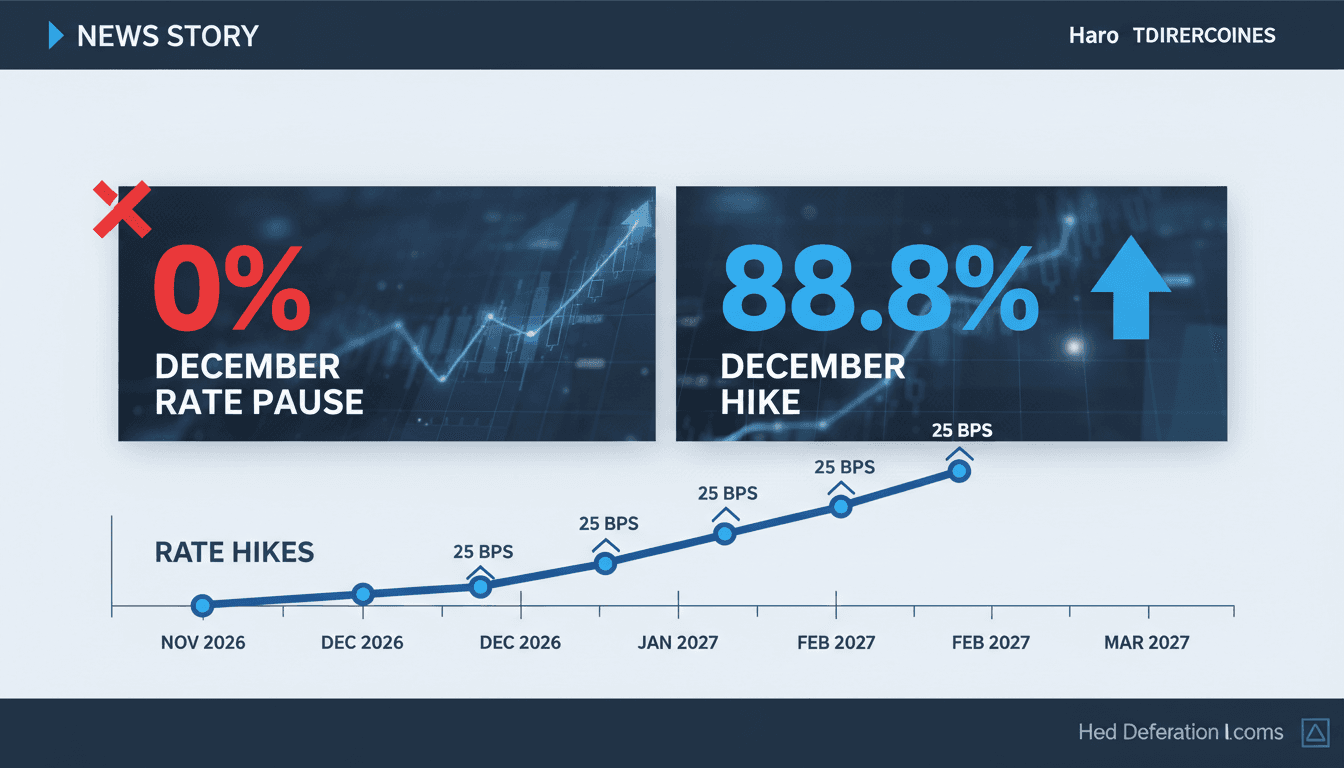
Persistent inflation pressures and rising U.S. policy rate expectations increase debt service costs across dollar-pegged markets, compress equity valuations, and require operators to re-evaluate capital allocation through early 2027.
Why it matters
The total elimination of pause pricing alongside an 88.8% implied probability of an upcoming rate increase signals that central banks face structural, capacity-driven price pressures that overrule expectations of monetary easing.
What happened (in 30 seconds)
- Rate hike odds surged: On November 10, 2026, CME FedWatch data recalibrated to reflect an 88.8% probability of a 25 basis point Federal Reserve benchmark rate increase in December, rising from approximately 72% the previous week.
- A pause was priced out: Following the October consumer price index release, market pricing assigned zero probability to a December rate hold, while creating an 11.2% probability of a 50 basis point hike.
- Officials reinforced tightening: Hawkish public commentary from Federal Reserve Governor Christopher Waller supporting an adjustment and Philadelphia Fed President Anna Paulson backing gradual tightening substantiated the shift alongside robust third-quarter GDP readings.
The context you actually need
- The policy cycle restarted in autumn: The Federal Reserve implemented a 25 basis point rate increase in September 2026—marking the first increase in three years—before holding rates unchanged in October to assess downstream economic momentum.
- Macro resilience removed easing pressure: Third-quarter gross domestic product expansion alongside stronger-than-forecast October nonfarm payrolls removed operational concerns regarding labor market deterioration or immediate growth deceleration.
- Inflation drivers have shifted: The October CPI data exceeded baseline forecasts due to sustained energy inputs and specific price increases linked to rapid artificial intelligence infrastructure deployment, testing the central bank’s 2% annual inflation objective.
What's really happening
The rapid recalibration of interest rate futures from a 72% probability to an 88.8% likelihood of a December tightening reflects a structural shift in monetary policy mechanics. When the October consumer price index print exceeded analytical projections, market participants had to dismantle their base-case assumption of an extended policy plateau. The underlying dynamics show that consumer price growth is no longer responding solely to cyclical supply-chain friction; instead, it is being fueled by capital-intensive industrial demand, notably energy consumption and physical buildouts related to artificial intelligence infrastructure.
Because third-quarter gross domestic product and October nonfarm payrolls showed sustained expansion, the Federal Reserve operates without the traditional trade-off between curbing inflation and defending employment. When labor markets remain tight and output indicators stay positive, central bank decision-makers are incentivized to front-load policy adjustments to anchor inflation expectations firmly at their 2% target. Governor Christopher Waller’s explicit advocacy for a December tightening and Philadelphia Fed President Anna Paulson’s preference for gradual policy firming indicate that institutional leadership views inflation persistence as a primary stability risk.
This shift triggers an immediate operational realignment across global investment banks. Brokerages such as Goldman Sachs, Deutsche Bank, and ANZ responded to the CPI release and subsequent Fed communications by extending their forecasted tightening trajectories into early 2027. Goldman Sachs added an expected 25 basis point rate increase in March 2027, while Deutsche Bank incorporated an additional increase as early as January. The market pricing an 11.2% chance of a 50 basis point adjustment indicates that market makers are hedging against an even faster acceleration of rate hikes if subsequent economic prints do not moderate.
For commercial operators, this alters the cost of capital calculations through the next two fiscal years. When benchmark rates climb in the world’s primary reserve currency, international capital naturally seeks higher risk-adjusted yields in sovereign paper. This dynamic establishes a higher baseline yield across all asset classes, penalizing corporate debt issuance and reducing the terminal multiples that public and private markets assign to enterprise valuations. Rather than preparing for balance sheet relief, treasury departments must plan for sustained liquidity absorption.
Who feels it first (and how)
- Corporate treasury executives: Financial officers managing variable-rate credit facilities face immediate upward adjustments in borrowing costs, reducing cash flow margins into 2027.
- Dubai property and business operators: Because the United Arab Emirates dirham maintains a peg to the U.S. dollar, local financing structures and commercial mortgage products adjust upward in parallel with Fed policy, impacting debt-financed real estate acquisitions and corporate leverage.
- Growth equity and tech asset managers: Valuations for cash-flow-negative enterprises face downward pressure as the discount rate applied to future earnings rises alongside Treasury benchmark yields.
- Import-dependent businesses in dollar-pegged markets: A structurally stronger U.S. dollar alters relative cross-border pricing, increasing procurement costs for commodities and foreign currency inputs while supporting dollar-denominated purchasing power abroad.
What to watch next
- November 2026 inflation prints: Consecutive acceleration in core goods and energy indexes would solidify baseline expectations for a 25 basis point December move and lift the probability of a 50 basis point hike.
- Central bank guidance at upcoming speaking events: Commentary from Chair Kevin Warsh will indicate whether committee consensus favors a deliberate quarter-point pace or an accelerated tightening regime into the first quarter of 2027.
- Institutional forecast adjustments: Revisions from major investment desks extending their tightening timelines into mid-2027 will indicate whether the broader bond market is pricing in a higher neutral interest rate for the cycle.
The CME FedWatch tool priced an 88.8% probability of a 25 basis point increase and an 11.2% chance of a 50 basis point increase for December 2026, leaving a 0% implied probability of an interest rate pause.
The Federal Reserve will implement at least one rate increase before the close of 2026, forcing international central banks that maintain currency pegs to adjust their domestic benchmark lending rates accordingly.
Whether rising costs tied to artificial intelligence physical infrastructure and power generation represent a temporary capital expenditure surge or a permanent structural floor that keeps inflation above 2% over the multi-year horizon.
Frequently Asked Questions
- Why it matters?
- The total elimination of pause pricing alongside an 88.8% implied probability of an upcoming rate increase signals that central banks face structural, capacity-driven price pressures that overrule expectations of monetary easing.
- What happened (in 30 seconds)?
- Rate hike odds surged: On November 10, 2026, CME FedWatch data recalibrated to reflect an 88.8% probability of a 25 basis point Federal Reserve benchmark rate increase in December, rising from approximately 72% the previous week. A pause was priced out: Following the October consumer price index release, market pricing assigned zero probability to a December rate hold, while creating an 11.2% probability of a 50 basis point hike. Officials reinforced tightening: Hawkish public commentary from Fe
- What's really happening?
- The rapid recalibration of interest rate futures from a 72% probability to an 88.8% likelihood of a December tightening reflects a structural shift in monetary policy mechanics. When the October consumer price index print exceeded analytical projections, market participants had to dismantle their base-case assumption of an extended policy plateau. The underlying dynamics show that consumer price growth is no longer responding solely to cyclical supply-chain friction; instead, it is being fueled
- Who feels it first (and how)?
- Corporate treasury executives: Financial officers managing variable-rate credit facilities face immediate upward adjustments in borrowing costs, reducing cash flow margins into 2027. Dubai property and business operators: Because the United Arab Emirates dirham maintains a peg to the U.S. dollar, local financing structures and commercial mortgage products adjust upward in parallel with Fed policy, impacting debt-financed real estate acquisitions and corporate leverage. Growth equity and tech ass
- What to watch next?
- November 2026 inflation prints: Consecutive acceleration in core goods and energy indexes would solidify baseline expectations for a 25 basis point December move and lift the probability of a 50 basis point hike. Central bank guidance at upcoming speaking events: Commentary from Chair Kevin Warsh will indicate whether committee consensus favors a deliberate quarter-point pace or an accelerated tightening regime into the first quarter of 2027. Institutional forecast adjustments: Revisions from ma
Macro commentary, policy analysis, growth/inflation themes, and global outlooks.
"Contextual macro coverage that complements day-to-day market headlines."
— A47 Editor
Fed rate hike odds in December at 88% after hot CPI- CME Fedwatch
Investing.com reported that CME FedWatch data showed the probability of a Federal Reserve rate hike in December rising to 88% after October consumer prices rose 0.4% month-over-month, more than economists expected. The Fed had held its benchmark rate...
Business, investment, entrepreneurship, leadership, and innovation.
"Forbes is known for its coverage of business leaders, market trends, and entrepreneurial ventures with a pro-business editorial stance."
— A47 Editor
Interest Rate Hike Odds Rise—After October Inflation Exceeded Economists’ Expectations
Forbes reports that U.S. consumer prices rose more than economists expected in October, increasing the likelihood that the Federal Reserve will raise interest rates at its December meeting. The base story frames the development as negative for market...
Real-time updates, analysis, and reports on the blockchain and cryptocurrency sectors.
"Crypto News delivers real-time updates, analysis, and reports on the blockchain and cryptocurrency sectors."
— A47 Editor
Polymarket puts December Fed hike odds at 85% after hot CPI
Polymarket traders priced an 85% chance of a quarter-point Federal Reserve rate hike in December as of Nov. 10, after October's hotter-than-expected inflation report. Bets on a larger move pushed the combined probability of tighter policy to about 97...
Global business headlines with AI angles.
"General business outlet that frequently covers AI."
— A47 Editor
Inflation Came in Hotter Than Expected in October. A Rate Hike is All But Certain Now.
U.S. consumer prices rose more than expected in October, pushing the implied probability of a Federal Reserve rate hike to 98.8%, according to CME Group data. The base report frames the inflation surprise as making a rate increase all but certain.