
USTR Proposes Conditional 15% to 40% Tariffs on 14 Trading Partners Tied to Bilateral Trade Deal Outcomes
Why it matters
The move replaces predictable trade baselines with an incentive-driven enforcement mechanism that penalizes stalling partners while granting lower duty tiers to economies that sign bilateral pacts.
What happened (in 30 seconds)
* Washington published a tiered tariff schedule targeting 14 major trading partners—including China, India, Vietnam, and the European Union—with proposed top rates between 15% and 40%. * The proposed rates are explicitly conditional, meaning trading partners can secure lower baseline duties if they conclude bilateral negotiations before early 2027 deadlines. * The policy framework targets industrial overcapacity, tying duty relief directly to partner commitments on manufacturing subsidies, labor standards, and market access.
The context you actually need
* Earlier blanket tariffs faced legal invalidation, prompting the administration to pivot away from broad executive orders struck down by the Supreme Court in February 2026. * An eight-month investigation provided the statutory foundation, utilizing Trade Act of 1974 authorities centered on foreign state subsidies and excess production capacity. * A major deadline governs the timeline, as an existing bilateral trade truce between Washington and Beijing is scheduled to expire on January 10, 2027.
What's really happening
The November 25 framework announced by US Trade Representative Jamieson Greer shifts trade policy from static boundary protection to transactional negotiation leverage. Rather than imposing uniform duties, the structure establishes a dual-tier tariff system. Economies that conclude negotiated agreements secure lower baseline rates, while those that fail to reach terms face steep penalty rates when enforcement begins in January 2027.
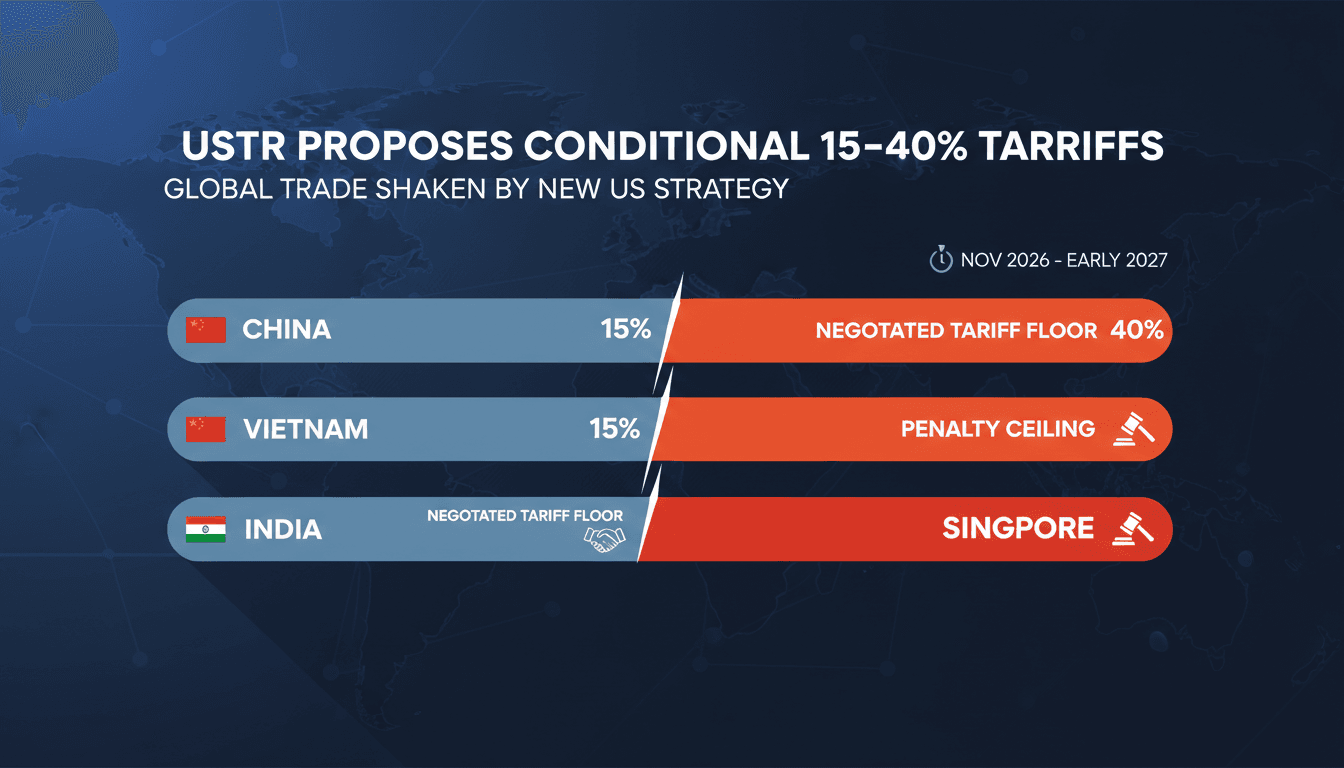
The quantitative spread between these tiers defines the negotiating pressure. China faces an existing 20% cap under its current truce, which escalates to 40% if negotiations fail. Vietnam faces a choice between a negotiated 20% rate and a 35% non-compliance penalty. India operates between a 17% negotiated floor and a 25% ceiling, while Singapore faces rates between 10% and 20%. The European Union confronts threats above its prior 15% understanding.
This rate architecture responds directly to structural supply dynamics. China recorded a goods trade surplus exceeding $1 trillion in the first ten months of 2026, intensifying Washington’s focus on industrial overcapacity funded by state subsidies. Because the Supreme Court dismantled earlier blanket import duties in early 2026, the administration requires a durable legal mechanism. By framing excess industrial capacity under the Trade Act of 1974, trade officials tie duties to documented industrial policy distortions rather than emergency declarations.
The immediate incentive structure fragments traditional trade blocs. Instead of collective resistance, individual trading partners face distinct economic incentives to finalize bilateral concessions. Vietnam and India immediately signaled commitments to accelerate bilateral talks to lock in lower duties, seeking a relative cost advantage over regional competitors. Conversely, officials in Brussels, Beijing, and Singapore criticized the framework, arguing it bypasses established international trade protocols.
For international commerce, this setup formalizes managed trade. Partner economies cannot rely on broad multilateral exemptions; access to the consumer market in the United States now requires codified concessions on subsidies, production volume, and labor standards. By making high tariffs the default outcome of expired deadlines, trade authorities have constructed an automated forcing mechanism ahead of the first quarter of 2027.
Who feels it first (and how)
* Electronics and industrial assemblers in Vietnam: Operations face an immediate 15-percentage-point cost divergence between the negotiated 20% rate and the threatened 35% penalty. * Manufacturing exporters in India: Capital allocation decisions must adjust for a potential jump from 17% to 25% tariffs based on bilateral discussions. * Bilateral trade negotiators in Brussels and Beijing: Policy teams must determine whether to grant formal subsidy concessions or accept escalated duties reaching up to 40%. * Import-reliant Gulf and Middle East operators: Regional distributors face indirect margin pressure as elevated transshipment and component costs ripple through interconnected supply chains.
What to watch next
* The January 10, 2027 truce milestone: Tracks whether Washington and Beijing renew terms or allow baseline rates on Chinese goods to jump from 20% to 40%. * Fast-track bilateral signings: Demonstrates whether India or Vietnam formalizes concession terms to permanently secure their lower tariff tiers. * Domestic statutory challenges: Measures whether congressional oversight, led by figures like Senator Ron Wyden, or legal challenges mount against Trade Act authorities.
USTR published proposed duty ceilings ranging from 15% to 40% across 14 trading partners, explicitly linking tariff reductions to bilateral negotiations.
Asian manufacturing exporters will accelerate bilateral deal-making to avoid falling into higher default tariff brackets before January 2027.
Whether the Trade Act of 1974 legal foundation will withstand ongoing federal judicial review following the Supreme Court's February 2026 precedent.
Frequently Asked Questions
- Why it matters?
- The move replaces predictable trade baselines with an incentive-driven enforcement mechanism that penalizes stalling partners while granting lower duty tiers to economies that sign bilateral pacts.
- What happened (in 30 seconds)?
- Washington published a tiered tariff schedule targeting 14 major trading partners—including China, India, Vietnam, and the European Union—with proposed top rates between 15% and 40%. The proposed rates are explicitly conditional, meaning trading partners can secure lower baseline duties if they conclude bilateral negotiations before early 2027 deadlines. The policy framework targets industrial overcapacity, tying duty relief directly to partner commitments on manufacturing subsidies, labor stand
- What's really happening?
- The November 25 framework announced by US Trade Representative Jamieson Greer shifts trade policy from static boundary protection to transactional negotiation leverage. Rather than imposing uniform duties, the structure establishes a dual-tier tariff system. Economies that conclude negotiated agreements secure lower baseline rates, while those that fail to reach terms face steep penalty rates when enforcement begins in January 2027. The quantitative spread between these tiers defines the negoti
- Who feels it first (and how)?
- Electronics and industrial assemblers in Vietnam: Operations face an immediate 15-percentage-point cost divergence between the negotiated 20% rate and the threatened 35% penalty. Manufacturing exporters in India: Capital allocation decisions must adjust for a potential jump from 17% to 25% tariffs based on bilateral discussions. Bilateral trade negotiators in Brussels and Beijing: Policy teams must determine whether to grant formal subsidy concessions or accept escalated duties reaching up to 40
- What to watch next?
- The January 10, 2027 truce milestone: Tracks whether Washington and Beijing renew terms or allow baseline rates on Chinese goods to jump from 20% to 40%. Fast-track bilateral signings: Demonstrates whether India or Vietnam formalizes concession terms to permanently secure their lower tariff tiers. Domestic statutory challenges: Measures whether congressional oversight, led by figures like Senator Ron Wyden, or legal challenges mount against Trade Act authorities.
Global news coverage with extensive reporting on Middle Eastern conflicts and geopolitics.
"Al Jazeera is a Qatar-based broadcaster known for wide regional coverage and alternative perspectives."
— A47 Editor
Are Trump’s tariffs aimed at securing US-friendly trade deals?
The United States has proposed tariffs on 14 economies, including China, India and Vietnam, according to reporting on the Trump administration's trade policy, with the base article noting that further tariff hikes could follow if trade negotiations f...
Comprehensive coverage of Middle Eastern and global issues.
"Al Jazeera is a prominent voice from the Global South, especially the Middle East, with an emphasis on underreported stories."
— A47 Editor
Are Trump’s tariffs aimed at securing US-friendly trade deals?
The United States has proposed tariffs on 14 economies, including China, India and Vietnam, according to reporting on the Trump administration's trade policy, with the base article noting that further tariff hikes could follow if trade negotiations f...
Macro commentary, policy analysis, growth/inflation themes, and global outlooks.
"Contextual macro coverage that complements day-to-day market headlines."
— A47 Editor
Analysis-Trump’s new tariffs aim to prise global trade from China’s grip
The United States has moved to introduce new tariffs targeting major trading partners including China, the European Union, Japan and South Korea, with the base report framing the measures as an effort to shift global trade away from China's dominant ...
Global business headlines with AI angles.
"General business outlet that frequently covers AI."
— A47 Editor
Trump Prepares New Tariffs On China And Dozens Of Countries. Beijing Could Face Higher Levies: Report
Donald Trump is preparing new tariffs targeting China and dozens of other countries, with Beijing potentially facing higher levies, according to a report. Japan, South Korea and the European Union could retain tariff rates of 15% or lower, while Indi...