
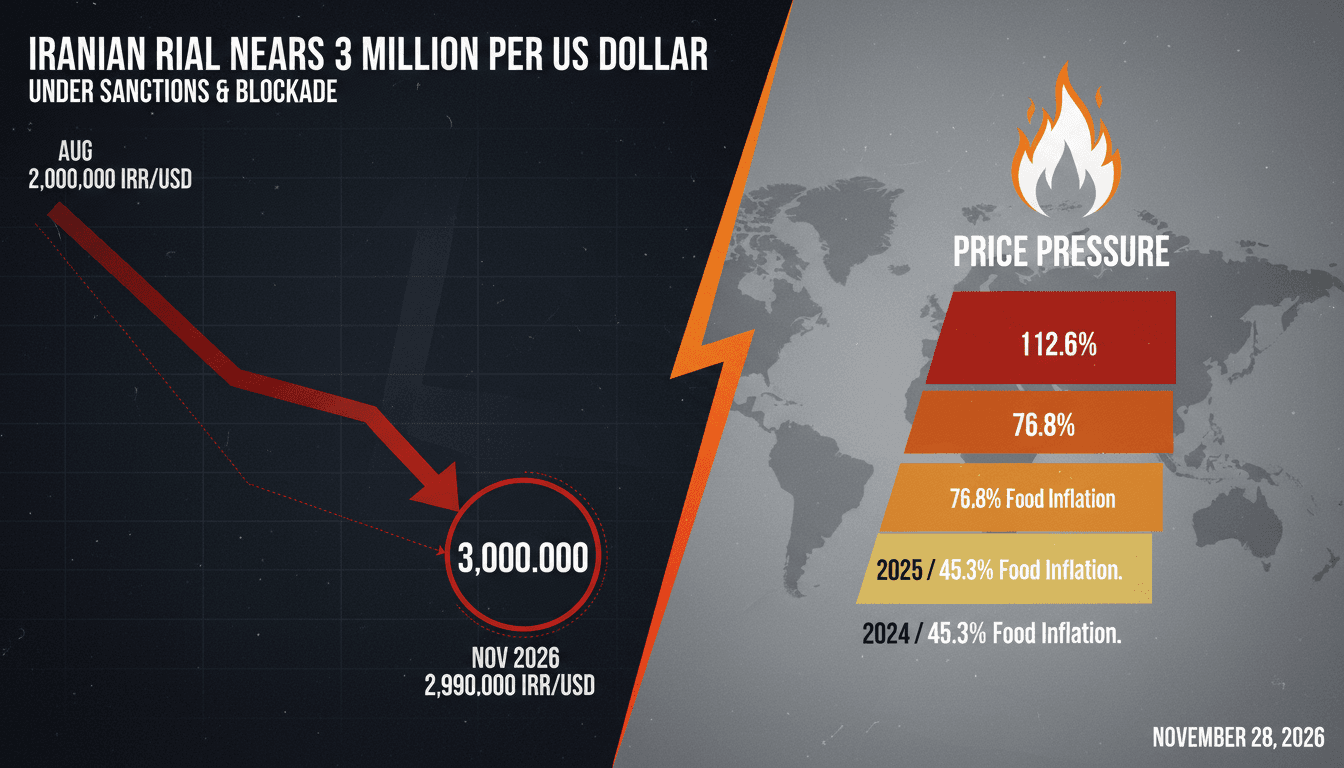
Iranian Rial Nears 3 Million Per US Dollar in Record Free-Market Low Under Sanctions and Naval Blockade
Why it matters
A currency approaching a nominal threshold of 3 million per dollar marks the breakdown of foreign exchange predictability, reinforcing inflationary feedback loops across regional trading hubs.
What happened (in 30 seconds)
- The exchange rate hit an all-time low: On November 28, 2026, the Iranian rial traded between 2.99 million and 2.997 million per US dollar on free-market platforms like bon-bast.com and alanchand.com, representing a 1.77% single-day depreciation.
- Enforcement mechanisms tightened: The decline follows maritime restrictions established via a July 2026 naval blockade, layered on top of Task Force Iron Gate restrictions introduced earlier in November targeting land and Caspian transit.
- Official reserves remain bifurcated: Central Bank Governor Abdolnaser Hemmati confirmed the state maintains adequate hard currency for essential goods and medicine, even as retail buyers exited the domestic currency for foreign banknotes and gold.
The context you actually need
- A multi-stage devaluation: The currency crossed the 2 million threshold in August 2026 before slipping beyond 2.85 million by November 24, demonstrating consistent downward momentum across the second half of the year.
- Triple-digit price pressure: Domestic inflation metrics show headline consumer prices up 88.7% year-on-year in October 2026, overall annual inflation at 76.8%, and food costs climbing 112.6%.
- Cumulative disruption: The current drop extends structural pressures that began with the reimposition of US sanctions in 2018, exacerbated by nine months of regional conflict active since February 2026.
What's really happening
The mechanics behind the rial’s approach to 3 million per dollar reflect a supply squeeze on trade channels paired with domestic capital flight.
When cross-border logistics face physical and financial barriers—such as the July 2026 maritime blockade and November’s Task Force Iron Gate restrictions along Caspian and land borders—the velocity of foreign exchange inflows drops. Even if central bank reserves hold sufficient allocations for sovereign imports of wheat or pharmaceutical compounds, the private secondary market must operate entirely on scarce liquidity. Importers outside priority state quotas bid aggressively for shrinking pools of physical dollars and dirhams to clear regional invoices.
This structural shortage directly alters the incentives of domestic economic actors. When food inflation registers at 112.6% and October consumer price indices show an 88.7% annualized increase, holding local currency carries a predictable, compounding cost. Households and enterprise treasuries naturally seek preservation assets. By converting rials into US dollar notes and physical gold coins, market participants accelerate the exact depreciation they are attempting to hedge against. The transaction volume moves away from official clearing networks and into unregulated free-market desks.
For regional commercial centers like Dubai, these mechanics influence the operational overhead of exchange houses and cross-border settlement intermediaries. As the spread between official allocations and open-market transactions widens, traditional counterparty arrangements face acute price volatility. Traders operating in non-sanctioned bilateral consumer staples encounter heightened settlement friction, as foreign exchange volatility complicates standard payment terms.
Furthermore, central bank statements attributing market moves to psychological indicators reflect the policy limits of conventional currency defense. When physical trade routes face external monitoring, rate-hike defenses or verbal assurances fail to counterbalance the structural deficit of incoming trade receipts. The result is a self-fulfilling dynamic: as the 3 million psychological threshold approaches, market participants demand a larger premium to hold local tender, cementing rapid currency depreciation into baseline consumer pricing.
Who feels it first (and how)
- Domestic wage earners: Salaried workers face declining purchasing power as local currency income fails to match food inflation running at 112.6%.
- Regional exchange houses and remittance brokers: Outlets managing flows between the Gulf and Iran encounter widened bid-ask spreads and severe rate-lock risk within intraday settlements.
- Cross-border merchant networks: Traders dealing in unlisted consumer goods face unpredictable invoice settlements, forcing transitions toward barter mechanisms or hard asset prepayments.
- Household savers: Middle- and lower-income families lacking immediate access to foreign currency or gold markets absorb the full impact of domestic wealth erosion.
What to watch next
- The 3 million psychological barrier: Watch whether free-market platforms record sustained trading above 3 million per dollar, as crossing this line typically triggers inventory hoarding by retailers.
- Central bank currency allocation tiers: Monitor whether Governor Hemmati adjusts the qualification criteria for subsidized import dollars, which would push more commercial entities into the open market.
- Enforcement perimeter data: Track operational reports from Task Force Iron Gate monitoring along land corridors and the Caspian Sea, as tighter transit checks directly correlate with parallel-market dollar premiums.
The free-market rial traded at 2.99 million to 2.997 million per US dollar on November 28, 2026, accompanied by official annual inflation figures of 76.8%.
Consumer prices will continue upward revisions into the close of the quarter as wholesale merchants price replacement inventories at the sub-3-million replacement rate.
The durability of sovereign foreign currency reserves allocated for essential imports, and whether official exchange channels will remain insulated from the widening open-market spread.
Frequently Asked Questions
- Why it matters?
- A currency approaching a nominal threshold of 3 million per dollar marks the breakdown of foreign exchange predictability, reinforcing inflationary feedback loops across regional trading hubs.
- What happened (in 30 seconds)?
- The exchange rate hit an all-time low: On November 28, 2026, the Iranian rial traded between 2.99 million and 2.997 million per US dollar on free-market platforms like bon-bast.com and alanchand.com, representing a 1.77% single-day depreciation. Enforcement mechanisms tightened: The decline follows maritime restrictions established via a July 2026 naval blockade, layered on top of Task Force Iron Gate restrictions introduced earlier in November targeting land and Caspian transit. Official reserv
- What's really happening?
- The mechanics behind the rial’s approach to 3 million per dollar reflect a supply squeeze on trade channels paired with domestic capital flight. When cross-border logistics face physical and financial barriers—such as the July 2026 maritime blockade and November’s Task Force Iron Gate restrictions along Caspian and land borders—the velocity of foreign exchange inflows drops. Even if central bank reserves hold sufficient allocations for sovereign imports of wheat or pharmaceutical compounds, th
- Who feels it first (and how)?
- Domestic wage earners: Salaried workers face declining purchasing power as local currency income fails to match food inflation running at 112.6%. Regional exchange houses and remittance brokers: Outlets managing flows between the Gulf and Iran encounter widened bid-ask spreads and severe rate-lock risk within intraday settlements. Cross-border merchant networks: Traders dealing in unlisted consumer goods face unpredictable invoice settlements, forcing transitions toward barter mechanisms or hard
- What to watch next?
- The 3 million psychological barrier: Watch whether free-market platforms record sustained trading above 3 million per dollar, as crossing this line typically triggers inventory hoarding by retailers. Central bank currency allocation tiers: Monitor whether Governor Hemmati adjusts the qualification criteria for subsidized import dollars, which would push more commercial entities into the open market. Enforcement perimeter data: Track operational reports from Task Force Iron Gate monitoring along
Sports reporting with a focus on Saudi and regional competitions.
"Okaz sports coverage is broad and audience-friendly, with strong attention to Saudi teams and leagues."
— A47 Editor
عملة إيران تهوي.. الريال يهبط إلى 3 ملايين للدولار
The Iranian rial fell to a record low against the US dollar, approaching the three million rial threshold, according to market trackers cited by news sites. One source put the dollar at about 2.99 million rials, up from 2.93 million the previous day,...
Arabic-language coverage of international news and geopolitics.
"RT Arabic is a Russian state-funded outlet often criticized for promoting Kremlin-aligned narratives."
— A47 Editor
تراجع قياسي للعملة الإيرانية يضعها على أعتاب 3 ملايين ريال للدولار
The Iranian currency fell to a record low on Saturday, approaching the psychological threshold of 3 million rials to the US dollar on the parallel market, as inflationary pressures in the country intensified.
Currency market headlines, FX rates, central-bank chatter, and macro drivers moving major pairs.
"Investing.com’s forex stream is useful for fast updates across USD, EUR, JPY, GBP and emerging-market FX."
— A47 Editor
Iran rial falls to near 3 million to US dollar as sanctions, blockade weigh
The Iranian rial has fallen to near 3 million to the US dollar, as US sanctions and a naval blockade weigh on the currency, according to a markets report from Investing.com. The decline reflects the financial strain on Iran amid an ongoing standoff w...