
Finland and Norway Leaders Hold Rare 90-Minute Call With Putin Exposing European Divisions on Ukraine Diplomacy
Why it matters
The first high-level European dialogue with Moscow since mid-2025 reveals emerging divisions inside regional alliances as states balance shared security obligations against changing U.S. negotiating positions.
What happened (in 30 seconds)
- High-level dialogue resumed on October 27, 2026, when Finnish President Alexander Stubb and Norwegian Prime Minister Jonas Gahr Støre held a 90-minute phone call with Russian President Vladimir Putin.
- The agenda focused on de-escalation and delivering strategic parameters ahead of upcoming U.S.-brokered talks, with the Nordic leaders debriefing Ukrainian President Volodymyr Zelenskyy immediately following the exchange.
- Allied friction surfaced instantly, as leadership in Denmark and Sweden publicly raised procedural concerns over a perceived lack of advance coordination among regional partners.
The context you actually need
- A multi-year diplomatic freeze had seen most Western European capitals avoid direct engagement with Moscow since 2022 to maintain a coordinated front backing Ukraine.
- Geographic reality shapes Nordic policy, as shared land borders and critical Arctic and maritime corridors expose Finland and Norway to direct cross-border security and infrastructure exposure.
- Broader geopolitical realignments—including shifting U.S. foreign policy postures under President Donald Trump and planned mediation forums in Abu Dhabi—are accelerating individual European attempts to secure direct input on eventual settlement frameworks.
What's really happening
The outreach by Helsinki and Oslo reflects a structural shift from collective deterrence toward strategic self-positioning. While Western capitals maintained unified diplomatic disengagement through the early years of the conflict, the approach faces structural limits as parallel mediation tracks gain momentum outside European institutions.
Underlying this direct engagement is an alignment of baseline incentives. Finland shares a 1,340-kilometer land border with Russia, and Norway manages sensitive energy infrastructure alongside shared maritime boundaries in the High North. For these capitals, the risk of exclusion from great-power negotiation frameworks outweighs the diplomatic cost of intra-bloc friction. With U.S. diplomacy increasingly orienting toward active negotiation frameworks, regional states face a choice: coordinate via multilateral consensus that moves slowly, or establish direct bilateral lines to safeguard national geographic interests.
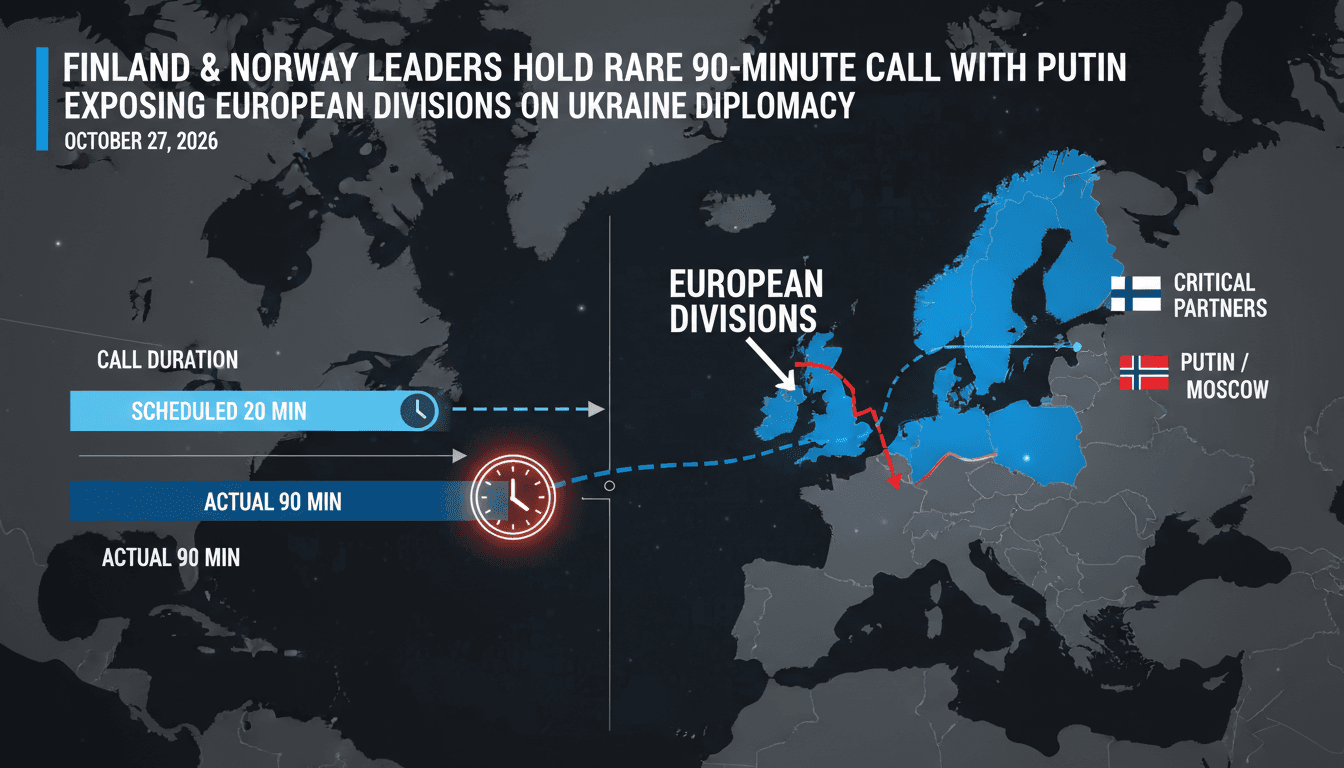
The mechanics of the call highlight these conflicting pressures. Initially intended as a brief 20-to-30-minute exchange, the discussion extended to 90 minutes. Rather than yielding concessions, the exchange served as a testing ground for hardening baseline demands. The Kremlin reiterated its core positions and systemic critiques of NATO expansion, while Stubb and Støre framed the dialogue as a pragmatic mechanism to relay clear parameters directly to Moscow ahead of third-party talks.
This bilateral pivot instantly revealed friction among Nordic peers. Denmark and Sweden raised public objections, arguing that independent engagement dilutes collective European leverage and risks establishing fragmented channels with the Kremlin. Norway disputed the claim that allies were uninformed, underscoring an operational divide between front-line border states with direct operational vulnerabilities and partners favoring strict diplomatic quarantine.
Ultimately, the call demonstrates that the unified European front is increasingly competing with regional national security mandates. As multilateral discussions approach, individual European governments are calculating that sitting outside the communications chain carries greater systemic exposure than breaking diplomatic protocol.
Who feels it first (and how)
- European energy procurement desks, who must assess whether early-stage diplomatic communications alter baseline assumptions around maritime transit security and long-term supply normalization.
- Nordic defense and border infrastructure planners, as front-line states balance multilateral treaty compliance against the operational realities of managing shared land and maritime boundaries.
- Global diplomatic delegations and mediation teams, particularly those preparing for secondary-market summits such as the Abu Dhabi talks, which must accommodate fragmented European inputs rather than a unified bloc stance.
What to watch next
- Multilateral pushback metrics: Watch the next European Council working sessions to see if formal procedural guidelines are introduced to restrict unauthorized bilateral engagement with Moscow.
- Diplomatic format developments in Abu Dhabi: Monitor whether European states secure direct representation or find themselves dependent on U.S.-brokered agendas during planned talks.
- Border and maritime infrastructure activity: Track operational indicators along Finland's eastern frontier and Norway’s offshore sectors for practical changes in security postures following the call.
Alexander Stubb and Jonas Gahr Støre conducted an unscheduled 90-minute call with Vladimir Putin on October 27, 2026, subsequently debriefing President Zelenskyy amid public criticism from Denmark and Sweden.
Divergent threat perceptions between frontline Nordic states and broader European partners will continue to generate ad-hoc diplomatic initiatives ahead of international peace talks.
Whether direct bilateral outreach alters Moscow's baseline negotiating demands or successfully secures European leverage in upcoming U.S.-led negotiation tracks.
Frequently Asked Questions
- Why it matters?
- The first high-level European dialogue with Moscow since mid-2025 reveals emerging divisions inside regional alliances as states balance shared security obligations against changing U.S. negotiating positions.
- What happened (in 30 seconds)?
- High-level dialogue resumed on October 27, 2026, when Finnish President Alexander Stubb and Norwegian Prime Minister Jonas Gahr Støre held a 90-minute phone call with Russian President Vladimir Putin. The agenda focused on de-escalation and delivering strategic parameters ahead of upcoming U.S.-brokered talks, with the Nordic leaders debriefing Ukrainian President Volodymyr Zelenskyy immediately following the exchange. Allied friction surfaced instantly, as leadership in Denmark and Sweden publi
- What's really happening?
- The outreach by Helsinki and Oslo reflects a structural shift from collective deterrence toward strategic self-positioning. While Western capitals maintained unified diplomatic disengagement through the early years of the conflict, the approach faces structural limits as parallel mediation tracks gain momentum outside European institutions. Underlying this direct engagement is an alignment of baseline incentives. Finland shares a 1,340-kilometer land border with Russia, and Norway manages sensi
- Who feels it first (and how)?
- European energy procurement desks, who must assess whether early-stage diplomatic communications alter baseline assumptions around maritime transit security and long-term supply normalization. Nordic defense and border infrastructure planners, as front-line states balance multilateral treaty compliance against the operational realities of managing shared land and maritime boundaries. Global diplomatic delegations and mediation teams, particularly those preparing for secondary-market summits such
- What to watch next?
- Multilateral pushback metrics: Watch the next European Council working sessions to see if formal procedural guidelines are introduced to restrict unauthorized bilateral engagement with Moscow. Diplomatic format developments in Abu Dhabi: Monitor whether European states secure direct representation or find themselves dependent on U.S.-brokered agendas during planned talks. Border and maritime infrastructure activity: Track operational indicators along Finland's eastern frontier and Norway’s offsh
RT is a Russian state-funded network covering global events from a Russian perspective.
"RT is widely criticized for promoting pro-Kremlin narratives and is considered by many to be a state propaganda outlet."
— A47 Editor
Two European leaders called Putin. Why did it cause such a stir?
Finland's President Alexander Stubb and Norwegian Prime Minister Jonas Gahr Støre held a rare call with Russian President Vladimir Putin on ending the war in Ukraine, a contact that drew significant attention because direct Western engagement with Mo...
Arabic-language coverage of international news and geopolitics.
"RT Arabic is a Russian state-funded outlet often criticized for promoting Kremlin-aligned narratives."
— A47 Editor
صحيفة فنلندية تكشف كواليس اتصال ستوب وستوره ببوتين
Finnish President Alexander Stubb and Norwegian Prime Minister Jonas Gahr Støre held a phone call with Russian President Vladimir Putin, reported by RT Arabic and drawn from Finnish daily Ilta-Sanomat, which said the contact reflected a European push...
News and current affairs from across Europe.
"The Guardian is known for its progressive editorial stance and in-depth analysis."
— A47 Editor
Kyiv hopes for ‘new momentum’ in peace talks after Finnish and Norwegian leaders’ call with Putin – as it happened
Finnish President Alexander Stubb and Norwegian Prime Minister Jonas Gahr Støre held a rare call with Russian President Vladimir Putin on peace negotiations over Ukraine, which Stubb and Støre described as substantive, as Kyiv hoped for "new momentum...
Capitol Hill news, legislation, and policy insight.
"The Hill specializes in U.S. politics and policy, with a focus on Capitol Hill developments and a reputation for insider reporting."
— A47 Editor
Finland's Stubb and Norway PM call Putin in break with previous European stance
Finnish President Alexander Stubb and Norwegian Prime Minister Jonas Gahr Støre initiated a direct call with Russian President Vladimir Putin on Tuesday morning, amid broader diplomatic efforts to wind down Russia's yearslong war with Ukraine. In a j...
UAE-based English-language newspaper covering regional politics, economics, and global affairs.
"The National reflects Emirati policy perspectives while maintaining international editorial standards."
— A47 Editor
Finland and Norway leaders speak to Putin before Ukraine peace talks
Finland and Norway's leaders held a rare phone call with Russian President Vladimir Putin ahead of US-brokered Ukraine peace talks in Abu Dhabi, aiming to press for direct discussions to end the war. The call came as Russian ballistic missile strikes...
Macro commentary, policy analysis, growth/inflation themes, and global outlooks.
"Contextual macro coverage that complements day-to-day market headlines."
— A47 Editor
Finnish and Norwegian leaders hold phone call with Putin on Ukraine war
Finnish and Norwegian leaders held a phone call with Russian President Vladimir Putin on the war in Ukraine, according to Investing.com. The base report is brief and does not detail the specific positions or outcomes discussed during the call.
Arabic-language coverage of international news and geopolitics.
"RT Arabic is a Russian state-funded outlet often criticized for promoting Kremlin-aligned narratives."
— A47 Editor
فنلندا تعلن عن محادثة ثلاثية بين الرئيسين بوتين وستوب ورئيس وزراء النرويج حول أزمة أوكرانيا
Finland's presidential office announced a phone call held today between Russian President Vladimir Putin, Finnish President Alexander Stubb, and Norwegian Prime Minister Jonas Gahr Støre, in which the three leaders discussed the crisis in Ukraine, ac...