
Israel October 2026 Election Yields No Governing Majority as Netanyahu Bloc Reaches 53 Seats and Eisenkot Alliance 48
Why it matters
A fractured 120-seat parliament blocks fiscal and strategic normalization, locking regional trade corridors and energy investments into an extended holding pattern.
What happened (in 30 seconds)
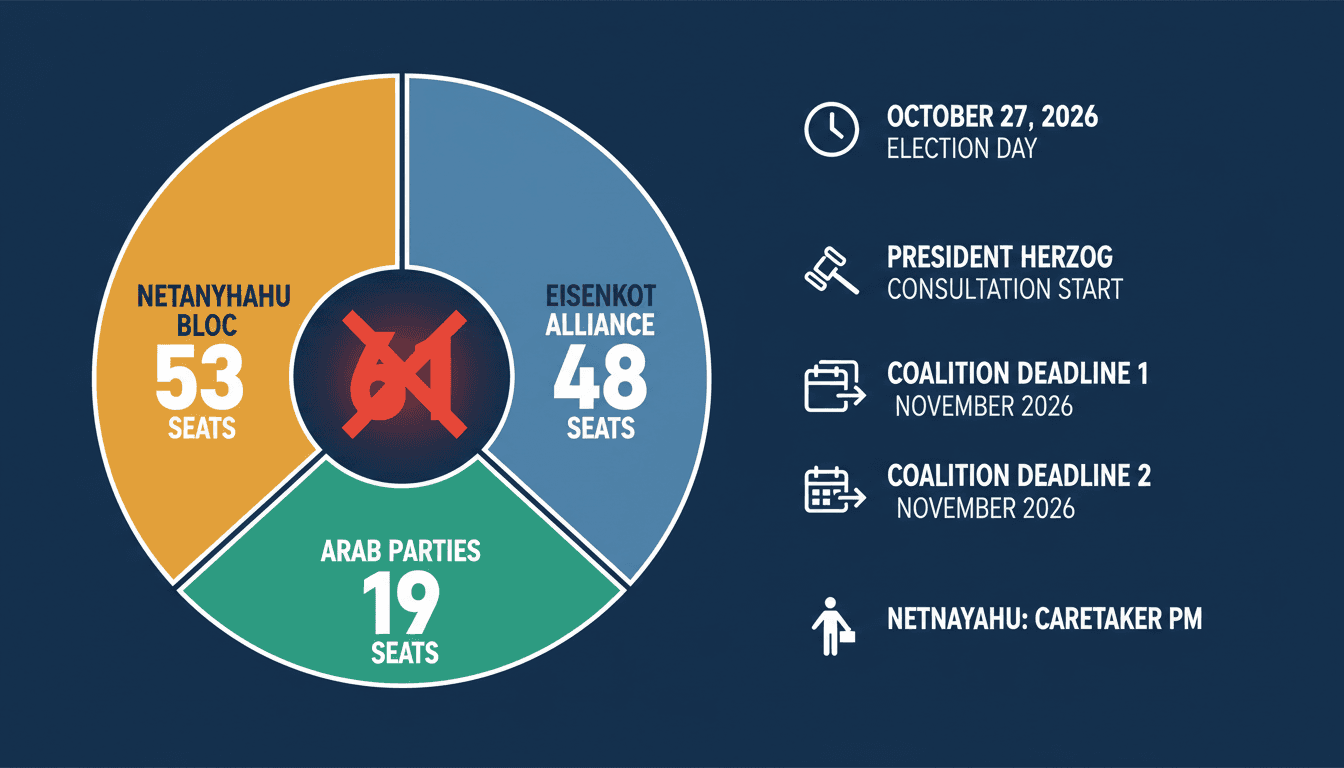
* Voters produced an absolute parliamentary deadlock: In the October 27, 2026 Knesset elections, Prime Minister Benjamin Netanyahu's right-wing alliance secured 53 seats, falling short of the 61 seats needed to form a governing majority. * The opposition alliance stalled: The primary opposition bloc led by Gadi Eisenkot captured 48 seats, leaving both major coalitions mathematically dependent on outside factions to govern. * Arab parties surged to record representation: Arab lists claimed 19 seats amid a 77.7% voter turnout—the highest recorded participation rate since 1999—establishing an influential third voting bloc.
The context you actually need
* Post-conflict governance pressures: This election marked the first national vote following the October 7, 2023 attacks and subsequent operations across Gaza, Lebanon, and the West Bank, centering voter choices strictly on security protocols and administrative competence. * The constitutional clock is running: With no side reaching the 61-seat threshold, President Isaac Herzog began formal consultations to assign a mandate, while Netanyahu retains executive authority as caretaker prime minister. * Bilateral normalization remains exposed: Prolonged administrative gridlock complicates institutional follow-through on cross-border economic initiatives, including UAE-Israel commercial integration and shared security frameworks established over recent years.
What's really happening
The election outcome is not merely a political stalemate; it is an incentive architecture that incentivizes delay over resolution. Under basic parliamentary arithmetic, neither primary bloc controls an organic path to the 61 seats required to govern. Netanyahu's 53 seats and Eisenkot's 48 seats leave both leaders facing severe structural friction. For Eisenkot, assembling an alternative majority requires integrating Arab parties holding 19 seats. For Netanyahu, closing an eight-seat shortfall requires fracturing opposition factions or pulling defectors across deeply polarized lines.
When formal coalitions fail to crystallize, the legal default preserves the executive status quo. Caretaker administrations operate with defined administrative limitations, yet they maintain complete control over operational defense directives, regulatory timelines, and fiscal contingencies. This dynamic produces an incumbency advantage for the sitting prime minister. The institutional incentive for a caretaker prime minister is to prolong exploratory talks, exhaust the formal mandate windows managed by President Herzog, and pivot toward fresh elections in early 2027 if rival alliances cannot achieve parity.
For corporate operators and capital allocators across the Middle East, this structural limbo carries concrete operational consequences. A caretaker government cannot easily pass structural multi-year budgets, authorize bilateral trade frameworks, or execute broad regional infrastructure projects that require legislative ratification. However, day-to-day security posture and border containment mechanisms continue unabated, as broad domestic consensus on defense and deterrence persists across both major parliamentary blocs.
The commercial impact centers on risk pricing. Cross-border capital between Tel Aviv, Abu Dhabi, and wider international hubs operates on predictable regulatory and diplomatic timetables. Prolonged coalition negotiations generate headline sensitivity across regional energy supply chains, commercial aviation routing, and institutional venture capital flows. Instead of a decisive strategic pivot, markets must price in a protracted negotiation phase that keeps regional integration initiatives in an administrative holding pattern while operational security policy runs on autopilot.
Who feels it first (and how)
* Regional energy traders and infrastructure operators: Experience pricing adjustments and short-term volatility based on fluctuating security headlines without definitive diplomatic resolution. * Cross-border UAE-Israel venture funds and trade desks: Face administrative slowdowns as bilateral trade expansion initiatives pause awaiting ratified ministerial appointments. * Sovereign debt and macro risk analysts: Must adjust risk premiums on regional sovereign paper while modeling the probability of repeat legislative polls in spring 2027. * Corporate supply chain directors in the Eastern Mediterranean: Face lingering transit and freight insurance premiums due to an unresolved security environment.
What to watch next
* Presidential mandate designation: Track whether President Isaac Herzog assigns the initial government-formation mandate to Netanyahu or Eisenkot, which establishes the formal 28-day negotiation window. * Arab party coalition negotiations: Monitor whether Eisenkot's bloc formally enters structured talks with the Joint List and Ra'am factions to test the viability of a 67-seat legislative baseline. * Caretaker fiscal authorizations: Watch whether the caretaker administration can pass emergency spending measures before year-end, signaling the domestic economy's resilience against prolonged political drift.
The Knesset is deadlocked at 53 seats for Netanyahu's bloc, 48 seats for Eisenkot's bloc, and 19 seats for Arab parties, with zero blocs controlling the 61 seats required for a majority.
Government formation talks will extend through the maximum statutory negotiation period, keeping Netanyahu in place as caretaker prime minister into early 2027.
Whether cross-bloc compromises will produce an emergency national unity government or trigger a fresh round of parliamentary elections in the spring.
Frequently Asked Questions
- Why it matters?
- A fractured 120-seat parliament blocks fiscal and strategic normalization, locking regional trade corridors and energy investments into an extended holding pattern.
- What happened (in 30 seconds)?
- Voters produced an absolute parliamentary deadlock: In the October 27, 2026 Knesset elections, Prime Minister Benjamin Netanyahu's right-wing alliance secured 53 seats, falling short of the 61 seats needed to form a governing majority. The opposition alliance stalled: The primary opposition bloc led by Gadi Eisenkot captured 48 seats, leaving both major coalitions mathematically dependent on outside factions to govern. Arab parties surged to record representation: Arab lists claimed 19 seats ami
- What's really happening?
- The election outcome is not merely a political stalemate; it is an incentive architecture that incentivizes delay over resolution. Under basic parliamentary arithmetic, neither primary bloc controls an organic path to the 61 seats required to govern. Netanyahu's 53 seats and Eisenkot's 48 seats leave both leaders facing severe structural friction. For Eisenkot, assembling an alternative majority requires integrating Arab parties holding 19 seats. For Netanyahu, closing an eight-seat shortfall re
- Who feels it first (and how)?
- Regional energy traders and infrastructure operators: Experience pricing adjustments and short-term volatility based on fluctuating security headlines without definitive diplomatic resolution. Cross-border UAE-Israel venture funds and trade desks: Face administrative slowdowns as bilateral trade expansion initiatives pause awaiting ratified ministerial appointments. Sovereign debt and macro risk analysts: Must adjust risk premiums on regional sovereign paper while modeling the probability of rep
- What to watch next?
- Presidential mandate designation: Track whether President Isaac Herzog assigns the initial government-formation mandate to Netanyahu or Eisenkot, which establishes the formal 28-day negotiation window. Arab party coalition negotiations: Monitor whether Eisenkot's bloc formally enters structured talks with the Joint List and Ra'am factions to test the viability of a 67-seat legislative baseline. Caretaker fiscal authorizations: Watch whether the caretaker administration can pass emergency spendin
Global news coverage with extensive reporting on Middle Eastern conflicts and geopolitics.
"Al Jazeera is a Qatar-based broadcaster known for wide regional coverage and alternative perspectives."
— A47 Editor
What are the implications of Israel’s elections?
Israelis voted on October 27, 2026 in their first national election since Hamas's October 7, 2023 attacks, which triggered a prolonged war in Gaza, and the result produced no clear winner. Exit polls and partial results showed Prime Minister Benjamin...
Comprehensive coverage of Middle Eastern and global issues.
"Al Jazeera is a prominent voice from the Global South, especially the Middle East, with an emphasis on underreported stories."
— A47 Editor
What are the implications of Israel’s elections?
Israelis voted on October 27, 2026 in their first national election since Hamas's October 7, 2023 attacks, which triggered a prolonged war in Gaza, and the result produced no clear winner. Exit polls and partial results showed Prime Minister Benjamin...
Global coverage of politics, crises, and international affairs.
"HuffPost provides progressive-oriented reporting on international developments, often focusing on humanitarian and social justice issues."
— A47 Editor
Exit Polls Suggest No Clear Winner In Israel's Election, But Netanyahu Is Far From Defeated
Israel held its first national election since the Hamas attacks of October 7, 2023 on October 27, 2026, and early exit polls showed Prime Minister Benjamin Netanyahu's bloc and opposition challenger Gadi Eisenkot's bloc deadlocked, leaving no clear w...
Coverage of current events and conflicts in the Middle East.
"France 24 is viewed as a globally focused outlet with balanced coverage and a European perspective."
— A47 Editor
Israelis vote in a tense election: What's at stake?
Israelis went to the polls on Tuesday, October 27, in a tense national election widely seen as a referendum on Prime Minister Benjamin Netanyahu's leadership since the Hamas-led October 7, 2023 attack and the wars that have since shaken the Middle Ea...
European coverage of Middle East politics and security issues.
"France 24 offers international reporting with a European editorial perspective."
— A47 Editor
Israel: Netanyahu supporters gather as PM votes
Israelis went to the polls in the first national election since Hamas's October 7, 2023 attack, and Prime Minister Benjamin Netanyahu cast his ballot as supporters gathered outside a polling station in Jerusalem, according to France 24's Clovis Casal...
24/7 international news from a French perspective in multiple languages.
"France 24 is viewed as a globally focused outlet with balanced coverage and a European perspective."
— A47 Editor
Israel: Netanyahu supporters gather as PM votes
Israelis went to the polls in the first national election since Hamas's October 7, 2023 attack, and Prime Minister Benjamin Netanyahu cast his ballot as supporters gathered outside a polling station in Jerusalem, according to France 24's Clovis Casal...
International coverage of politics, culture, and current affairs.
"BBC News is widely regarded as a reputable international news organization, known for its impartial tone and public service mandate."
— A47 Editor
Turnout so far highest in decades as Israelis vote in pivotal election
Israelis went to the polls on October 27, 2026, in the first national election since the October 7, 2023 Hamas attacks, with turnout reported as the highest in decades. The vote is widely seen as a referendum on Prime Minister Benjamin Netanyahu's le...
24/7 international news from a French perspective in multiple languages.
"France 24 is viewed as a globally focused outlet with balanced coverage and a European perspective."
— A47 Editor
Israelis vote in first national election since October 7 attack
Israelis are voting in a pivotal national election on Tuesday, October 27, the first since Hamas's October 7, 2023 attack, as the country grapples with unresolved wars and deep divisions over the character of the state and who should lead it. FRANCE ...
European coverage of Middle East politics and security issues.
"France 24 offers international reporting with a European editorial perspective."
— A47 Editor
Netanyahu's political survival on the line as Israel heads to the polls
Israelis went to the polls on October 27, 2026, in the first national election since Hamas's October 7, 2023 attack, a vote widely framed as a referendum on Prime Minister Benjamin Netanyahu's political survival after three years of war in Gaza, conf...
24/7 international news from a French perspective in multiple languages.
"France 24 is viewed as a globally focused outlet with balanced coverage and a European perspective."
— A47 Editor
Netanyahu's political survival on the line as Israel heads to the polls
Israelis went to the polls on October 27, 2026, in the first national election since Hamas's October 7, 2023 attack, a vote widely framed as a referendum on Prime Minister Benjamin Netanyahu's political survival after three years of war in Gaza, conf...
European coverage of Middle East politics and security issues.
"France 24 offers international reporting with a European editorial perspective."
— A47 Editor
Israeli elections: voters turnout reaches '16.7%' four hours after polls open
Israelis went to the polls on Tuesday, October 27, in the first national election since the October 7, 2023 Hamas attack, with voters delivering a verdict on veteran Prime Minister Benjamin Netanyahu and the country's rightward drift. Turnout had rea...
24/7 international news from a French perspective in multiple languages.
"France 24 is viewed as a globally focused outlet with balanced coverage and a European perspective."
— A47 Editor
Israeli elections: voters turnout reaches '16.7%' four hours after polls open
Israelis went to the polls on Tuesday, October 27, in the first national election since the October 7, 2023 Hamas attack, with voters delivering a verdict on veteran Prime Minister Benjamin Netanyahu and the country's rightward drift. Turnout had rea...
Conservative-leaning coverage of current events.
"Fox News is a highly influential conservative news outlet known for right-leaning political commentary and coverage."
— A47 Editor
Israel heads into deeply divided election as Oct 7 reckoning looms: What to know
Israel is heading into a deeply divided general election, its first national vote since the Oct. 7, 2023 attacks, with no political bloc expected to secure a clear majority. The contest is widely framed as a referendum on Prime Minister Benjamin Neta...
International stories from NPR’s global desk.
"NPR is an American public media organization known for thoughtful reporting and a slightly left-leaning editorial tone."
— A47 Editor
A quick guide to Israel's high-stakes election
Israel is holding its first national election since the Hamas-led attacks of October 7, 2023, which triggered a prolonged war in Gaza and a chain of regional conflicts. The vote is widely viewed as a referendum on Prime Minister Benjamin Netanyahu's ...
Coverage of current events and conflicts in the Middle East.
"France 24 is viewed as a globally focused outlet with balanced coverage and a European perspective."
— A47 Editor
Israelis vote in tense election seen as a referendum on Netanyahu
Israelis went to the polls on Tuesday, October 27, in the first national election since Hamas's October 7, 2023 attack, a vote widely seen as a referendum on Prime Minister Benjamin Netanyahu's political survival after three years of regional wars; N...
European coverage of Middle East politics and security issues.
"France 24 offers international reporting with a European editorial perspective."
— A47 Editor
Israelis vote in tense election seen as a referendum on Netanyahu
Israelis are voting on Tuesday in the first general election since the October 7, 2023 Hamas attack, with Prime Minister Benjamin Netanyahu facing a fight for political survival after three years of regional wars. He is running neck and neck with cen...