
Netanyahu Bloc Falls Short of Majority as Israeli Election Raises Renewed Iran Strike Risk
Why it matters
A fractured Knesset leaves political leadership leaning heavily on external security moves alongside Washington, altering baseline risk models for global crude supply passing through the Strait of Hormuz.
What happened (in 30 seconds)
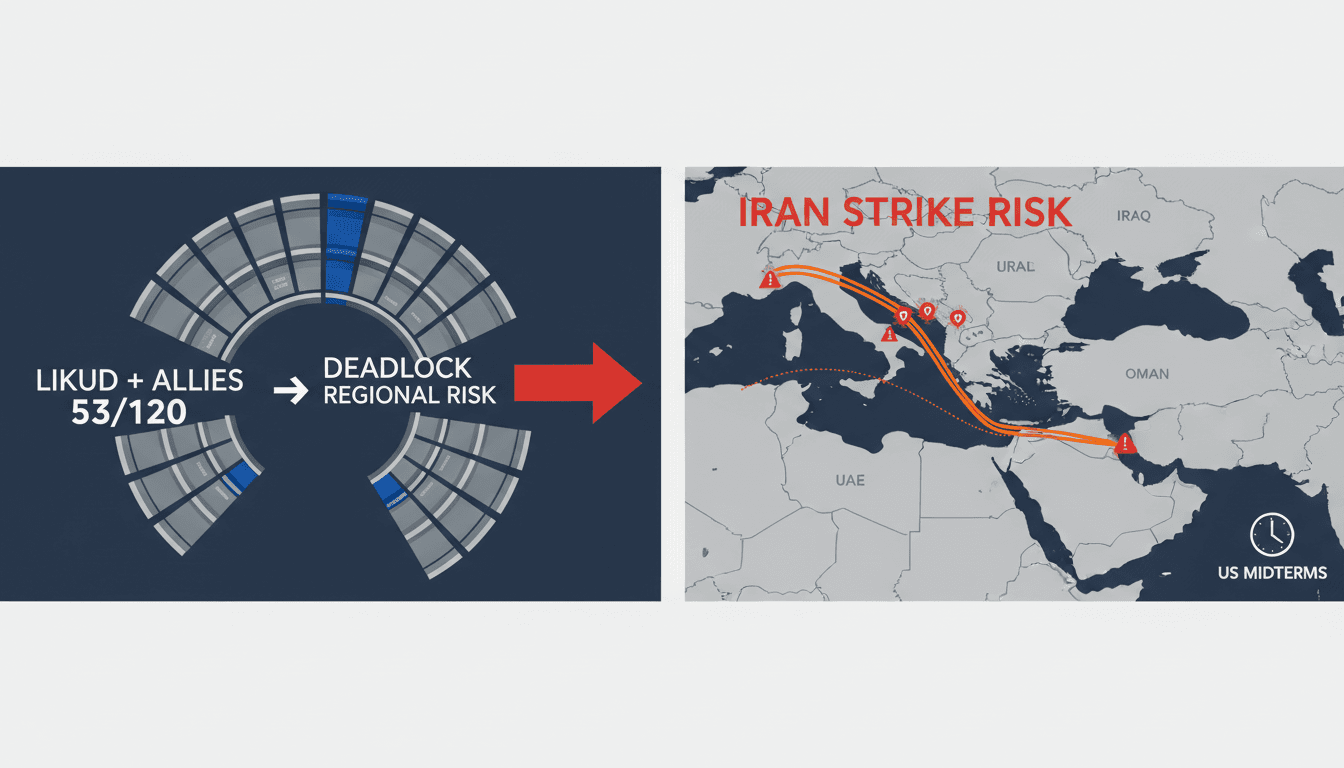
* Vote counting concluded on October 29, 2026, confirming a deadlocked Knesset. Benjamin Netanyahu's right-wing bloc secured 53 seats, the opposition bloc led by Gadi Eisenkot secured 48 seats, and Arab parties won a record 19 seats out of 120 total. * No faction controls a governing majority. Netanyahu remains in office as caretaker prime minister, giving him procedural control over the security apparatus while protracted coalition negotiations play out. * Security incentives are shifting toward pre-emptive action. Primary analysis indicates that Israeli leadership is evaluating coordinated military strikes against Iran's nuclear and energy infrastructure, potentially timed alongside US political cycles.
The context you actually need
* The 53-seat tally creates an administrative stalemate. Without the 61 seats needed for a parliamentary majority, the caretaker structure preserves the status quo executive authority without immediate legislative accountability. * Strategic alignment with Washington defines the timing. Israeli decision-makers are factoring in alignment with US President Donald Trump, weighing military initiatives after US midterm elections to limit domestic political friction in the United States. * Prior confrontations established the operational precedent. Following the October 7, 2023 attacks and subsequent cross-border operations, direct exchanges between Israel and Iran have progressively eroded established deterrent boundaries across the region.
What's really happening
The mechanics behind the October 27, 2026 election results point toward structural incentives rather than routine parliamentary bargaining. When a parliamentary system produces a 53–48 split with a third bloc holding 19 seats, the cost of forming a domestic governing coalition rises sharply. For an incumbent caretaker prime minister, domestic legislative compromise carries high friction. By contrast, executive authority over national defense remains intact during a transition.
This dynamic shifts the primary arena of political leverage toward foreign policy and national defense. Throughout the 2026 campaign, counter-Iran messaging served as a foundational narrative. Analysts tracking the outcome observe that addressing Iran's nuclear development directly offers a pathway to consolidate domestic political standing while resetting strategic relationships abroad.
The operational viability of unilateral strikes remains limited. Independent defense assessments establish that air operations alone face severe technical barriers to neutralizing deeply buried Iranian facilities without sustained, coordinated logistical support from the United States. Consequently, the strategic window relies entirely on mutual alignment between Jerusalem and Washington. The post-US midterm window represents the specific period where decision-makers expect the lowest domestic friction for joint security initiatives.
For the Gulf, this creates an asymmetric risk profile. A joint or unilateral campaign against Iranian territory introduces direct downstream risks of retaliatory missile or drone strikes on energy infrastructure across the Gulf, alongside commercial interdictions in the Strait of Hormuz. Iran has historically offset pressure on its nuclear facilities by threatening global energy supply lines to drive up prices and impose economic costs on international trade partners.
Because coalition negotiations in Jerusalem will stretch over months, the caretaker status prolongs institutional uncertainty. With domestic governance stalled, security policy becomes the primary instrument for setting the political agenda, significantly increasing the probability of kinetic action.
Who feels it first (and how)
* Energy trading desks in Dubai and Singapore: Face immediate price spikes and heightened hedging costs due to physical chokepoint exposure around the Strait of Hormuz. * Maritime logistics operators and insurers: Encounter expanded war-risk surcharges and altered shipping corridors throughout the Arabian Gulf and Red Sea. * Gulf industrial and energy operators: Must raise defensive readiness and contingency planning to protect critical coastal installations from potential retaliatory drone and missile vectors. * Corporate treasuries across the Middle East: Navigate currency exposure, shifting sovereign risk premia, and rising supply chain contingency expenses during extended regional uncertainty.
What to watch next
* Knesset coalition deadlines: Track whether Benjamin Netanyahu can secure defections to reach the 61-seat threshold, or if negotiations collapse into a secondary election cycle that extends caretaker rule. * High-level Washington-Jerusalem military consultations: Monitor official defense delegations following the US midterm elections for indicators of operational coordination targeting Iranian nuclear infrastructure. * Iranian strategic signaling at the Strait of Hormuz: Watch for naval drills, military deployments, or verbal threats directed at regional energy corridors designed to deter pre-emptive strikes.
The final election count yields 53 seats for Netanyahu's bloc, 48 for the opposition, and 19 for Arab parties, leaving Israel governed by a caretaker administration without a majority.
Israeli decision-makers will leverage alignment with US President Donald Trump to push for escalated security action against Iran once domestic US electoral considerations conclude.
Whether prospective air operations can achieve core operational objectives against fortified facilities, and whether prior security consultations with Gulf partners will take place to safeguard regional infrastructure.
Frequently Asked Questions
- Why it matters?
- A fractured Knesset leaves political leadership leaning heavily on external security moves alongside Washington, altering baseline risk models for global crude supply passing through the Strait of Hormuz.
- What happened (in 30 seconds)?
- Vote counting concluded on October 29, 2026, confirming a deadlocked Knesset. Benjamin Netanyahu's right-wing bloc secured 53 seats, the opposition bloc led by Gadi Eisenkot secured 48 seats, and Arab parties won a record 19 seats out of 120 total. No faction controls a governing majority. Netanyahu remains in office as caretaker prime minister, giving him procedural control over the security apparatus while protracted coalition negotiations play out. Security incentives are shifting toward pre-
- What's really happening?
- The mechanics behind the October 27, 2026 election results point toward structural incentives rather than routine parliamentary bargaining. When a parliamentary system produces a 53–48 split with a third bloc holding 19 seats, the cost of forming a domestic governing coalition rises sharply. For an incumbent caretaker prime minister, domestic legislative compromise carries high friction. By contrast, executive authority over national defense remains intact during a transition. This dynamic shif
- Who feels it first (and how)?
- Energy trading desks in Dubai and Singapore: Face immediate price spikes and heightened hedging costs due to physical chokepoint exposure around the Strait of Hormuz. Maritime logistics operators and insurers: Encounter expanded war-risk surcharges and altered shipping corridors throughout the Arabian Gulf and Red Sea. Gulf industrial and energy operators: Must raise defensive readiness and contingency planning to protect critical coastal installations from potential retaliatory drone and missil
- What to watch next?
- Knesset coalition deadlines: Track whether Benjamin Netanyahu can secure defections to reach the 61-seat threshold, or if negotiations collapse into a secondary election cycle that extends caretaker rule. High-level Washington-Jerusalem military consultations: Monitor official defense delegations following the US midterm elections for indicators of operational coordination targeting Iranian nuclear infrastructure. Iranian strategic signaling at the Strait of Hormuz: Watch for naval drills, milit
UAE-based English-language newspaper covering regional politics, economics, and global affairs.
"The National reflects Emirati policy perspectives while maintaining international editorial standards."
— A47 Editor
Israeli election results raise prospect of new Iran attack
The Israeli election results, with no clear winner in exit polls, raise the prospect of a renewed Iran attack, according to The National. Israelis voted on October 27, 2026, in the first national election since the October 7, 2023 Hamas attacks, with...
Editor-curated FT homepage stories spanning markets, business, world, and opinion.
"The Financial Times is a globally respected business publication with a centrist/center-left tone and strong markets focus."
— A47 Editor
Israel vote leaves door open to Iran attack
Israel's national election, the first since the October 7, 2023 Hamas-led attack and drawing its highest turnout in decades, has produced no clear winner, with Prime Minister Benjamin Netanyahu's bloc ahead but lacking a majority while he serves as c...
Global news coverage with extensive reporting on Middle Eastern conflicts and geopolitics.
"Al Jazeera is a Qatar-based broadcaster known for wide regional coverage and alternative perspectives."
— A47 Editor
Iranians brace for renewed attacks after Israeli, US elections
Iranians are bracing for renewed attacks after the United States and Israel teased strikes around their elections, with the threat reportedly aimed at Iran's civilian infrastructure. Al Jazeera's reporting frames the concern as a live risk for ordina...
Comprehensive coverage of Middle Eastern and global issues.
"Al Jazeera is a prominent voice from the Global South, especially the Middle East, with an emphasis on underreported stories."
— A47 Editor
Iranians brace for renewed attacks after Israeli, US elections
Iranians are bracing for renewed attacks after the United States and Israel teased strikes around their elections, with the threat reportedly aimed at Iran's civilian infrastructure. Al Jazeera's reporting frames the concern as a live risk for ordina...