
US Pressure on Venezuela and Iraq to Exit OPEC Stalls After Diplomatic Resistance
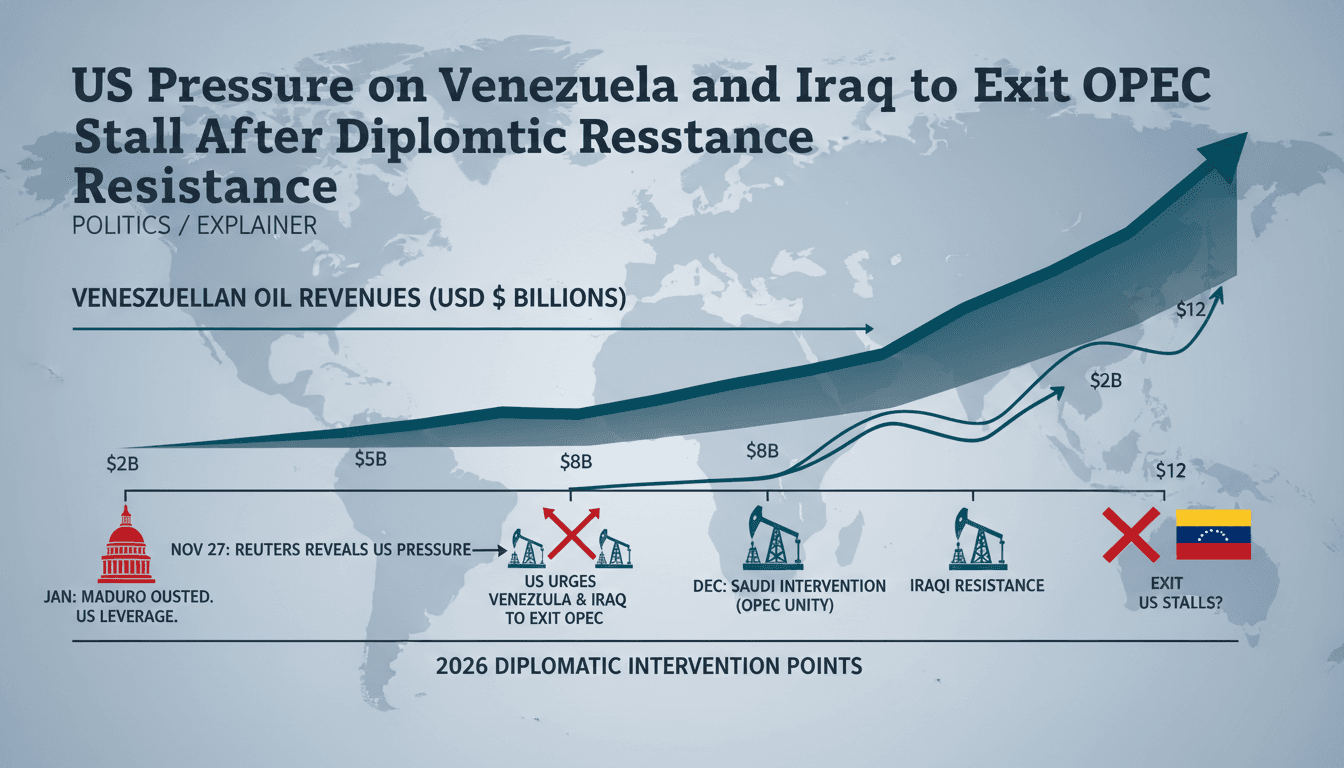
Why it matters
Attempts by external powers to sever founding members from OPEC illustrate a structural shift where bilateral financial control is deployed to override multilateral supply coordination.
What happened (in 30 seconds)
- The diplomatic campaign: In 2026, the Trump administration held direct talks with Venezuela and Iraq, urging both founding members to exit OPEC to lift production ceilings and open pathways for U.S. investment.
- The financial block: Washington leveraged its authority to block Venezuela from paying its annual membership dues of approximately €2.8 million, targeting its formal standing within the organization.
- The resistance: Iraq's oil ministry rejected the departure proposal in favor of negotiating higher internal quotas, while Saudi Crown Prince Mohammed bin Salman intervened during the summer to halt pressure on Caracas, leaving both nations inside the group.
The context you actually need
- Post-transition leverage over Caracas: Following the removal of President Nicolas Maduro in January 2026, the U.S. gained substantial oversight of Venezuelan crude flows, collecting $12 billion in Venezuelan oil revenues between January and September 2026.
- Institutional control of Iraqi receipts: Iraq's oil export revenues have been managed through an account at the Federal Reserve Bank of New York since 2003, providing the U.S. financial architecture structural leverage over Baghdad's state finances.
- Longstanding price tension: President Trump has consistently challenged OPEC since his first presidential term, arguing that collective production quotas artificially elevate global energy costs at the expense of importing economies and corporate operations.
What's really happening
The diplomatic pressure directed at Caracas and Baghdad represents an effort to replace multilateral cartel discipline with bilateral production incentives. For decades, OPEC has operated on a quota mechanism designed to balance global supply against demand, maintaining a floor under international oil benchmarks. By encouraging Venezuela and Iraq—two of the organization's five founding members—to abandon these collective limits, U.S. policymakers aimed to release suppressed output capacity directly into global markets.
The mechanics of this push relied entirely on structural financial architecture. Following political changes in Caracas in January 2026, the U.S. exercised direct authority over Venezuelan oil proceeds, accumulating $12 billion in receipts within nine months. This fiscal oversight allowed Washington to restrict Venezuela's routine foreign transactions, including its approximately €2.8 million annual administrative dues to OPEC. By starving the administrative link, the administration sought to force a de facto operational divorce from the cartel, clearing the path for U.S.-backed commercial entities to secure upstream concessions without facing output caps.
In Iraq, the incentive structure encountered domestic institutional resistance. Although Prime Minister Ali Faleh al-Zaidi brought the prospect of an OPEC departure to a cabinet-level government meeting, the Iraqi oil ministry opposed the move. The ministry calculated that preserving membership while lobbying internally for higher individual output baselines offered superior revenue predictability. Unilateral departure would have exposed Iraq to retaliatory market-share pricing from regional neighbors without guaranteeing sustained capital inflows, particularly given the volatility inherent to fully unhedged crude markets.
The initiative stalled when regional diplomatic interests aligned against the cartel's fragmentation. Saudi Crown Prince Mohammed bin Salman intervened directly during the summer of 2026 to stabilize Venezuela's position and protect the integrity of the producer coalition. For Riyadh and the wider Gulf energy complex, maintaining collective pricing discipline remains a core economic priority. Fragmenting the group would diminish the bloc's ability to orchestrate coordinated supply adjustments, injecting acute pricing volatility into state budgets across the Middle East. While neither Venezuela nor Iraq exited the group, the intervention established that sovereign energy alliances are increasingly subject to bilateral transactional pressure, leaving baseline supply assumptions open to geopolitical leverage.
Who feels it first (and how)
- Energy procurement executives: Industrial operators and corporate treasuries indexing contracts to Brent or WTI face heightened tail-risk volatility as major producers balance bilateral political pressure against cartel quotas.
- Upstream exploration and service firms: U.S.-backed energy companies assessing field concessions in Venezuela and Iraq must navigate the tension between host-nation OPEC obligations and bilateral production targets.
- Gulf energy planners and sovereign funds: Policymakers across the UAE and Saudi Arabia are forced to expend diplomatic capital to preserve collective market coordination against external attempts to unlock idle supply.
- Emerging market sovereign debt analysts: Fixed-income desks tracking Iraqi and Venezuelan paper must evaluate the structural risk of dollar-clearing accounts being used as leverage over core fiscal policy.
What to watch next
- Iraqi quota baseline reviews: Baghdad's upcoming formal requests for expanded production allowances inside OPEC will indicate whether the oil ministry can maintain domestic fiscal stability without breaking cartel ranks.
- Venezuelan concession rollouts: The structural terms of new contracts granted to U.S.-backed energy entities in Caracas will reveal whether production caps are being observed in practice or bypassed through technical reclassifications.
- Federal Reserve account operations: Any procedural changes to how Iraq's crude revenues are routed through the U.S. banking system will signal the degree of continued leverage Washington holds over Baghdad's economic autonomy.
The Trump administration urged Venezuela and Iraq to withdraw from OPEC, blocked Venezuelan dues of €2.8 million, and collected $12 billion in Venezuelan oil revenues between January and September 2026; both nations remained in the organization.
Washington will continue using its regulatory and financial jurisdiction over dollar-denominated crude revenue clearing to influence output decisions in both South America and the Middle East.
Whether OPEC's current compliance mechanisms can withstand sustained bilateral diplomacy if global energy demand shifts and individual members face mounting domestic revenue deficits.
Frequently Asked Questions
- Why it matters?
- Attempts by external powers to sever founding members from OPEC illustrate a structural shift where bilateral financial control is deployed to override multilateral supply coordination.
- What happened (in 30 seconds)?
- The diplomatic campaign: In 2026, the Trump administration held direct talks with Venezuela and Iraq, urging both founding members to exit OPEC to lift production ceilings and open pathways for U.S. investment. The financial block: Washington leveraged its authority to block Venezuela from paying its annual membership dues of approximately €2.8 million, targeting its formal standing within the organization. The resistance: Iraq's oil ministry rejected the departure proposal in favor of negotiati
- What's really happening?
- The diplomatic pressure directed at Caracas and Baghdad represents an effort to replace multilateral cartel discipline with bilateral production incentives. For decades, OPEC has operated on a quota mechanism designed to balance global supply against demand, maintaining a floor under international oil benchmarks. By encouraging Venezuela and Iraq—two of the organization's five founding members—to abandon these collective limits, U.S. policymakers aimed to release suppressed output capacity direc
- Who feels it first (and how)?
- Energy procurement executives: Industrial operators and corporate treasuries indexing contracts to Brent or WTI face heightened tail-risk volatility as major producers balance bilateral political pressure against cartel quotas. Upstream exploration and service firms: U.S.-backed energy companies assessing field concessions in Venezuela and Iraq must navigate the tension between host-nation OPEC obligations and bilateral production targets. Gulf energy planners and sovereign funds: Policymakers a
- What to watch next?
- Iraqi quota baseline reviews: Baghdad's upcoming formal requests for expanded production allowances inside OPEC will indicate whether the oil ministry can maintain domestic fiscal stability without breaking cartel ranks. Venezuelan concession rollouts: The structural terms of new contracts granted to U.S.-backed energy entities in Caracas will reveal whether production caps are being observed in practice or bypassed through technical reclassifications. Federal Reserve account operations: Any pro
Global business headlines with AI angles.
"General business outlet that frequently covers AI."
— A47 Editor
The Trump Administration Encouraged Iran And Venezuela To Leave OPEC: Report
The International Business Times reported that the Trump administration saw the continued membership of Iran, Venezuela, and Iraq (referred to via Baghdad) in OPEC as contrary to Washington's interest in promoting greater oil investment and productio...
Coverage of national news and events from across the United States.
"HuffPost is known for its progressive editorial stance, offering opinionated yet comprehensive coverage on social, political, and cultural topics."
— A47 Editor
U.S. Pushed Venezuela, Iraq To Consider Leaving OPEC, Sources Say
The U.S. reportedly pressed Venezuela and Iraq to consider leaving OPEC, according to sources, in a move described as an unusually direct challenge to the oil cartel that President Donald Trump has long accused of keeping oil prices artificially high...
Market-moving headlines impacting equities, bonds, and related risk assets.
"Real-time catalysts and volatility drivers across indices and sectors."
— A47 Editor
Trump urged Venezuela, Iraq to leave OPEC and blocked dues, Reuters reports
Investing.com, citing Reuters, reports that US President Donald Trump urged Venezuela and Iraq to consider leaving OPEC and blocked membership dues, according to the coverage. The base report is categorized under markets with a neutral tone.
Arabic-language coverage of international news and geopolitics.
"RT Arabic is a Russian state-funded outlet often criticized for promoting Kremlin-aligned narratives."
— A47 Editor
ضغوط أمريكية على عضوين مؤسسين لـ"أوبك" للانسحاب من المنظمة
Ten informed sources reported that the administration of U.S. President Donald Trump encouraged Venezuela and Iraq earlier this year to consider withdrawing from the Organization of the Petroleum Exporting Countries (OPEC), with both countries being ...
Pan-Arab political news and analysis.
"Al-Quds Al-Arabi is a London-based Arabic newspaper known for political coverage."
— A47 Editor
مصادر: أمريكا تحث فنزويلا والعراق على بحث الانسحاب من “أوبك”
Ten informed sources told the Alquds Al-Arabi newspaper, based in London, that the administration of US President Donald Trump earlier this year encouraged Venezuela and Iraq to consider withdrawing from the Organization of the Petroleum Exporting Co...
Regional coverage and analysis focused on politics, diplomacy, and business across the Middle East.
"Al-Monitor is known for analytical reporting on Middle East politics and policy developments."
— A47 Editor
Exclusive-US pushed Venezuela, Iraq to consider leaving OPEC, sources say
Reuters reported, citing ten people familiar with the matter, that the Trump administration encouraged Venezuela and Iraq to consider leaving OPEC earlier this year and prevented Venezuela from paying its annual membership dues to the group. The prev...
Oil, metals, and agriculture: supply/demand headlines, OPEC chatter, inventories, and price action.
"Solid tape for energy and metals traders tracking macro and micro catalysts."
— A47 Editor
Exclusive-US pushed Venezuela, Iraq to consider leaving OPEC, sources say
Investing.com reported in an exclusive, citing unnamed sources, that the United States pressed Venezuela and Iraq to consider leaving OPEC. The report is categorized under markets with a negative tone, and the sources' accounts have not been independ...