
Russian Sabotage Incidents in Europe Rise 16 Percent as IISS Warns of Mass-Casualty Risk
Why it matters
A coordinated hybrid campaign running alongside the war in Ukraine is testing European response thresholds, quietly elevating supply chain vulnerability across central transit jurisdictions without officially triggering collective defense treaties.
What happened (in 30 seconds)
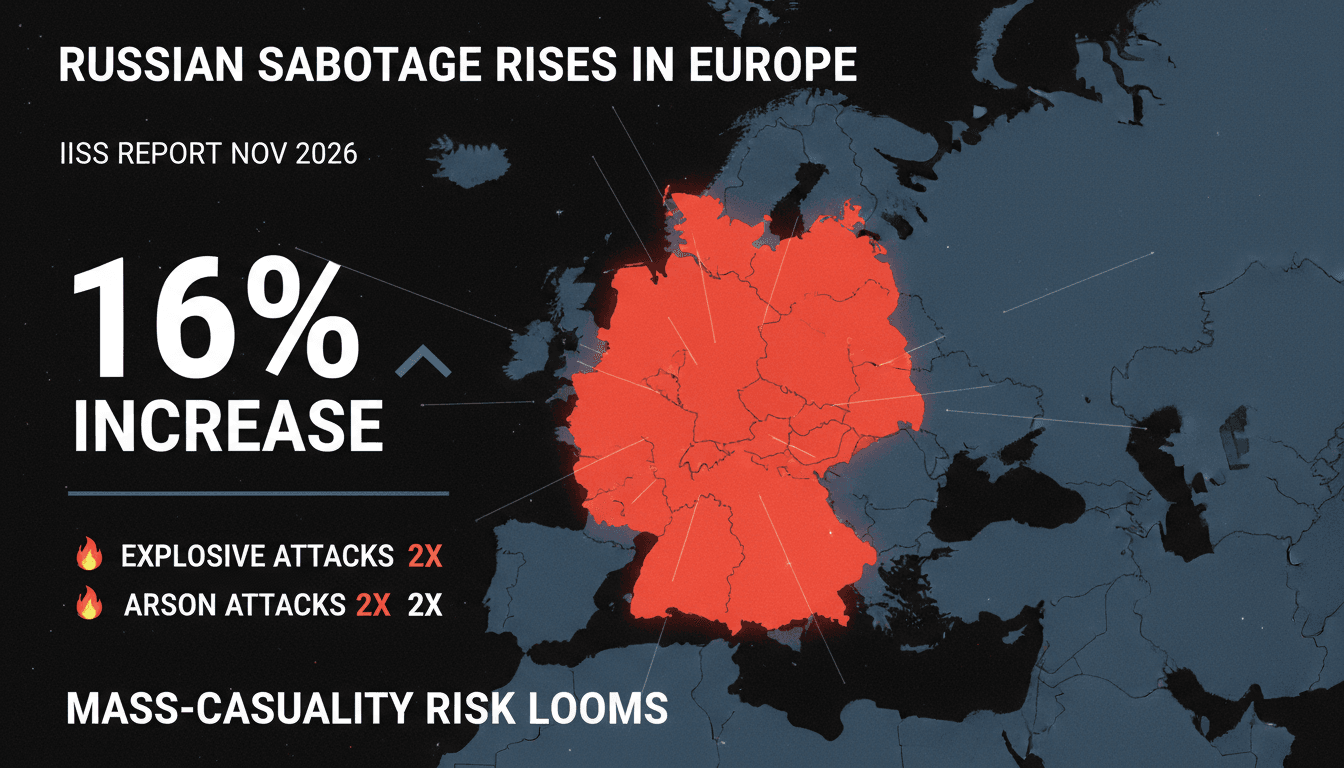
- Sabotage activity increased by 16 percent: The International Institute for Strategic Studies (IISS) documented a 16 percent year-over-year rise in Russian-linked sabotage incidents across Europe during the 12 months ending September 2026.
- Arson and explosive tactics doubled: Operations orchestrated by Russian intelligence services and recruited proxies saw a 100 percent increase in the use of fires and explosive devices, moving away from low-impact disruption.
- Critical nodes took the brunt: Over half of all verified incidents targeted strategic installations, focusing predominantly on transport networks, energy distribution infrastructure, and military-industrial supply chains in Poland and Germany.
The context you actually need
- The conflict reached its fifth year: With the war in Ukraine continuing into 2026, European aggregate defense spending surpassed Russia’s by 9.6 percent in 2025, creating persistent pressure on Moscow to find asymmetric leverage.
- Strategic objectives remain unmet: Despite the physical damage to localized assets—such as a railway explosion in Poland in November 2025 and a drone incident in Leipzig in August 2026—the campaign has not interrupted Western material support for Ukraine.
- Responses remain decentralized: European leadership has engaged in multi-nation intelligence investigations, but governments continue to react on an ad-hoc basis to avoid formal escalation scenarios.
What's really happening
The 16 percent increase in European sabotage incidents highlights an evolving structural reality: when conventional military spending cannot neutralize an opponent's industrial backing, hybrid attrition fills the void. In 2025, European nations collectively outspent Russia on defense by 9.6 percent, sustaining steady shipments of military hardware and budgetary aid to Ukraine. Unable to directly sever these support lines via conventional strikes without activating direct confrontation, Russian intelligence agencies have systematically broadened their physical sabotage playbook.
The operational mechanism relies heavily on low-cost, deniable tactics. Rather than deploying sovereign military assets, intelligence planners contract local proxies to execute arson attacks and detonate explosives at freight yards, energy sites, and manufacturing centers. The doubling of arson and explosive tactics over the past 12 months reflects an operational shift toward higher-friction outcomes. By directing more than 50 percent of actions at critical infrastructure, the campaign seeks to introduce frictional costs into the continental supply network, create localized panic, and erode domestic political resolve regarding ongoing foreign assistance.
Geographically, the targeting reflects pure network topology. Germany and Poland serve as the primary logistical clearinghouses for military hardware, replacement components, and energy rerouting destined for Ukraine. Consequently, these jurisdictions have recorded the heaviest concentration of operations. Incidents like the November 2025 railway blast in Poland and the August 2026 drone incursion near Leipzig demonstrate a willingness to target active logistics corridors.
The core systemic danger identified by analysts is the narrowing margin for operational error. While the hybrid operations have produced zero mass-casualty events to date, the transition to explosive and incendiary methods significantly increases the probability of civilian fatalities or critical infrastructure failure. European policymakers currently respond on an incident-by-incident basis, intentionally avoiding the declaration of rigid red lines to prevent escalatory spirals. However, should an operational miscalculation lead to significant loss of life, that flexible posture will face immediate political strain, forcing decisions on counter-escalation that European capitals have spent years attempting to avoid.
Who feels it first (and how)
- Freight operators and rail logistics firms in Central Europe: Freight forwarders routing cargo through Poland and Eastern Germany encounter localized delivery delays, tighter route security, and increased surveillance audits around key transport hubs.
- Industrial facility risk managers: Corporate security and business continuity managers overseeing energy and defense-adjacent infrastructure must absorb higher operational expenditures to guard physical perimeters against deniable proxy operations.
- European intelligence and border enforcement agencies: Investigative bodies in frontline states—including Poland, Germany, Lithuania, and Bulgaria—face sustained resource reallocation toward counter-sabotage tracking and proxy network disruption.
- Commercial infrastructure insurers: Underwriters assessing European energy and transport networks must recalibrate risk pricing for facilities situated along transit arteries feeding Eastern Europe.
What to watch next
- Joint forensic investigative outputs: Watch for public evidence dossiers released by the multi-state intelligence coalition (Poland, Germany, Lithuania, Bulgaria), which will signal whether coordinated attribution leads to shared diplomatic or economic countermeasures.
- The kinetic collateral threshold: Track whether sabotage tactics migrate toward shared civilian-commercial facilities, as any event producing direct casualties will test the sustainability of Europe's case-by-case response framework.
- Supply line velocity metrics: Monitor transit times along the Polish-German rail corridors for measurable freight diversions or structural slowdowns resulting from enhanced perimeter defense protocols.
Russian-linked sabotage across Europe grew 16 percent between October 2025 and September 2026, with arson and explosive attacks doubling and more than half of all operations hitting critical infrastructure.
Intelligence handlers will continue relying on disposable proxy networks to conduct low-cost physical disruptions, keeping operations beneath the legal threshold of open military aggression.
Whether European governments will define collective red lines if an operational misstep triggers a mass-casualty event or systemic disruption to continental energy flows.
Frequently Asked Questions
- Why it matters?
- A coordinated hybrid campaign running alongside the war in Ukraine is testing European response thresholds, quietly elevating supply chain vulnerability across central transit jurisdictions without officially triggering collective defense treaties.
- What happened (in 30 seconds)?
- Sabotage activity increased by 16 percent: The International Institute for Strategic Studies (IISS) documented a 16 percent year-over-year rise in Russian-linked sabotage incidents across Europe during the 12 months ending September 2026. Arson and explosive tactics doubled: Operations orchestrated by Russian intelligence services and recruited proxies saw a 100 percent increase in the use of fires and explosive devices, moving away from low-impact disruption. Critical nodes took the brunt: Over
- What's really happening?
- The 16 percent increase in European sabotage incidents highlights an evolving structural reality: when conventional military spending cannot neutralize an opponent's industrial backing, hybrid attrition fills the void. In 2025, European nations collectively outspent Russia on defense by 9.6 percent, sustaining steady shipments of military hardware and budgetary aid to Ukraine. Unable to directly sever these support lines via conventional strikes without activating direct confrontation, Russian i
- Who feels it first (and how)?
- Freight operators and rail logistics firms in Central Europe: Freight forwarders routing cargo through Poland and Eastern Germany encounter localized delivery delays, tighter route security, and increased surveillance audits around key transport hubs. Industrial facility risk managers: Corporate security and business continuity managers overseeing energy and defense-adjacent infrastructure must absorb higher operational expenditures to guard physical perimeters against deniable proxy operations.
- What to watch next?
- Joint forensic investigative outputs: Watch for public evidence dossiers released by the multi-state intelligence coalition (Poland, Germany, Lithuania, Bulgaria), which will signal whether coordinated attribution leads to shared diplomatic or economic countermeasures. The kinetic collateral threshold: Track whether sabotage tactics migrate toward shared civilian-commercial facilities, as any event producing direct casualties will test the sustainability of Europe's case-by-case response framewo
Capitol Hill news, legislation, and policy insight.
"The Hill specializes in U.S. politics and policy, with a focus on Capitol Hill developments and a reputation for insider reporting."
— A47 Editor
Russian sabotage spikes in Europe, including 'risk of mass-casualty incident': Analysis
Incidents of sabotage blamed on Russia in Europe rose 16 percent year-over-year in September, according to a report from the International Institute for Strategic Studies (IISS), which describes Moscow's campaign as an "unconventional war" that has i...
Global business headlines with AI angles.
"General business outlet that frequently covers AI."
— A47 Editor
Russia's Hybrid Warfare Campaign Against Europe Has So Far Failed But Could Yet Escalate, New IISS Report Claims
An IISS report argues that Russia's hybrid warfare campaign against Europe has so far failed to achieve its aims but could still escalate, potentially causing a mass-casualty event on European soil. The think tank warns that Poland and Germany would ...
Global political, business, and cultural coverage from WSJ international desks.
"The Wall Street Journal offers extensive international reporting with a reputation for financial insight and a center-right editorial stance."
— A47 Editor
Opinion | Russia Escalates Attacks on Europe
The Wall Street Journal opinion piece "Russia Escalates Attacks on Europe" cites a new report warning that "a mass-casualty incident is increasingly possible" as Russian pressure on the continent intensifies. The commentary frames the escalation as a...