
Trump Administration Withholds Donor Identity Behind $300 Million National Park Service Deposit Funding D.C. Projects
Why it matters
The redirection of philanthropic and corporate capital into state-managed infrastructure accounts creates a precedent for how public works are financed without legislative appropriation.
What happened (in 30 seconds)
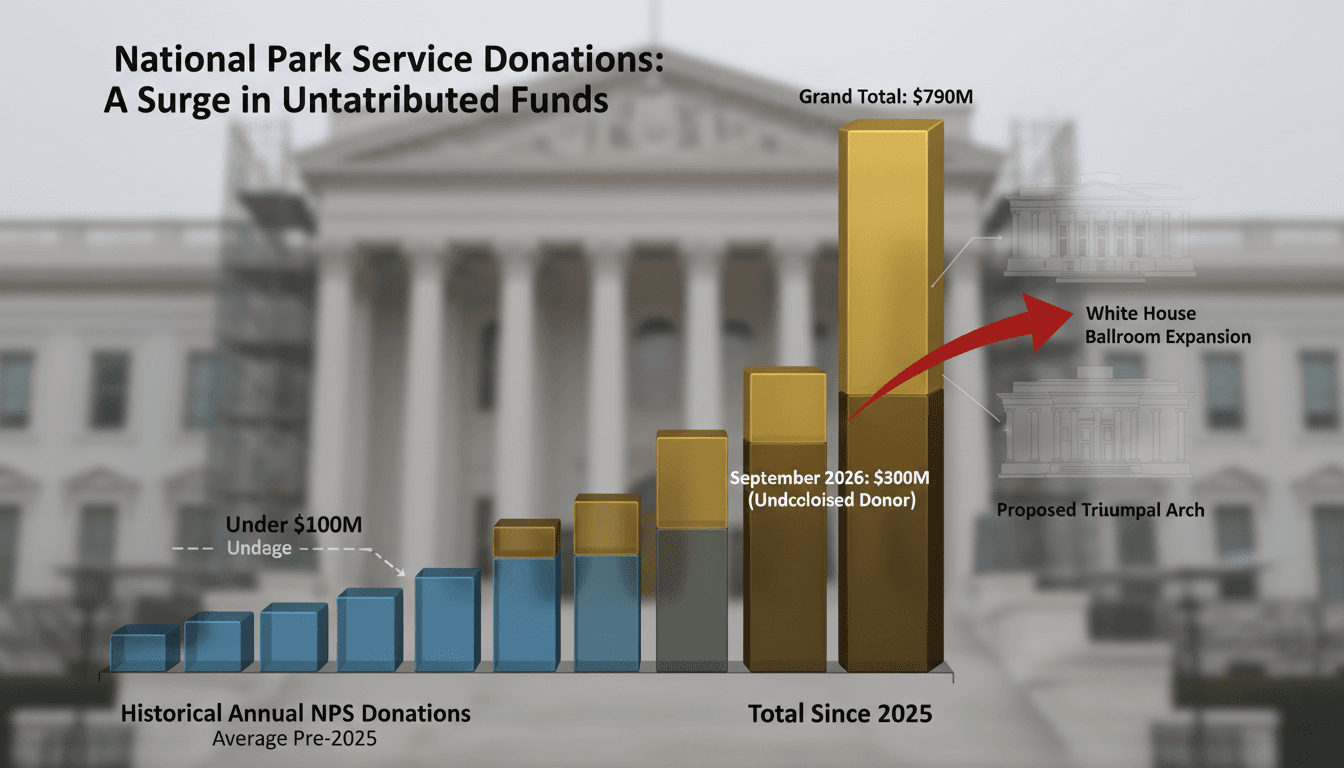
- A major deposit arrived: In September 2026, an approximately $300 million deposit entered a National Park Service donation account, contributing to a $347 million monthly intake against a projected $50 million benchmark.
- The administration withheld donor identities: The Interior Department declined to name the contributors behind the $300 million transfer or detail the exact allocation mechanisms for the capital.
- Capital was routed to capital projects: The funds support infrastructure initiatives across Washington, D.C., including a White House ballroom, Lincoln Memorial Reflecting Pool repairs, and a planned 250-foot triumphal arch.
The context you actually need
- Historical baselines were recalibrated: Prior to January 2025, the National Park Service donation account typically brought in under $100 million annually to support system-wide park operations.
- Total inflows reached $790 million: Cumulative deposits into the account reached approximately $790 million by late 2026 following Donald Trump's return to office.
- Known private donors previously contributed: Reporting earlier in 2026 revealed separate commitments of $25 million each from Nvidia, Apple, and the Adelson family, alongside at least $77 million from undisclosed sources, tied to a broader $333 million White House ballroom fundraising effort.
What's really happening
The operational mechanics of federal procurement and infrastructure funding are shifting toward specialized gift funds. Under standard federal procedures, capital for civic infrastructure requires direct congressional authorization and statutory appropriations. By routing private capital into the National Park Service donation account, capital improvements proceed without drawing on conventional legislative purse strings.
This financial pipeline creates distinct institutional dynamics. For the executive branch, it establishes an off-balance-sheet mechanism capable of deploying hundreds of millions of dollars into high-profile capital projects on accelerated timelines. When the single $300 million deposit landed in September 2026, it elevated monthly receipts to $347 million—nearly seven times the agency's $50 million forecast. Since January 2025, cumulative inflows have hit $790 million.
The structural tension lies in the interface between anonymous giving and regulatory governance. Under existing statutes, gift funds allow federal departments to accept unconditional contributions. However, former Interior Department ethics officials, such as Tony Irish of Public Employees for Environmental Responsibility, point out that non-disclosure leaves open whether private donors anticipate administrative or regulatory accommodations in return.
Because corporate entities like tech firms and private estates participate in these funding programs, enterprise compliance functions face increased scrutiny. When $25 million tranches from commercial entities sit alongside hundreds of millions in anonymous funding, the dividing line between standard civic philanthropy and targeted regulatory alignment becomes central to institutional risk. The administration continues to defend the speed and visual execution of the infrastructure works, while congressional figures like Richard Blumenthal and Adam Schiff have begun issuing document demands to intermediaries to trace whether access or policy considerations were packaged alongside civic contributions.
The operational reality is that public works in Washington, D.C., are operating on a model financed directly by non-appropriated private injections. For entities navigating federal contracts or global compliance frameworks, this alters the baseline assumptions around project clearance, capital pooling, and disclosure exposure.
Who feels it first (and how)
- Corporate compliance officers: Multinational legal teams evaluating donations, partnerships, or sponsorships must reassess anti-corruption and transparency exposure when interacting with public-private accounts.
- Federal contractors and construction consortia: Engineering firms managing D.C. capital works navigate funding streams that operate outside ordinary congressional drawdown schedules.
- Lobbying and government affairs practices: Strategic advisors face direct scrutiny and formal inquiries from lawmakers investigating fundraising intermediaries and potential quid pro quo arrangements.
What to watch next
- Congressional committee inquiries: Demands for records issued by senators like Blumenthal and Schiff will signal whether legislative bodies can compel donor disclosures through subpoena power.
- Litigation on project permits: Court proceedings, particularly preliminary injunctions targeting the proposed 250-foot triumphal arch, will establish the legal viability of projects built via non-appropriated gifts.
- Subsequent Treasury filings: Upcoming monthly reporting from the National Park Service will show whether the $790 million capital flow represents an isolated peak or an enduring funding mechanism.
An undisclosed deposit of approximately $300 million was transferred to the National Park Service in September 2026, pushing cumulative donations past $790 million since January 2025.
Scrutiny will intensify on the intersection between corporate donors and federal regulatory policies handled by executive agencies.
The identity of the specific entities that supplied the $300 million deposit, and whether those contributions were linked to commitments on federal policy outcomes.
Frequently Asked Questions
- Why it matters?
- The redirection of philanthropic and corporate capital into state-managed infrastructure accounts creates a precedent for how public works are financed without legislative appropriation.
- What happened (in 30 seconds)?
- A major deposit arrived: In September 2026, an approximately $300 million deposit entered a National Park Service donation account, contributing to a $347 million monthly intake against a projected $50 million benchmark. The administration withheld donor identities: The Interior Department declined to name the contributors behind the $300 million transfer or detail the exact allocation mechanisms for the capital. Capital was routed to capital projects: The funds support infrastructure initiative
- What's really happening?
- The operational mechanics of federal procurement and infrastructure funding are shifting toward specialized gift funds. Under standard federal procedures, capital for civic infrastructure requires direct congressional authorization and statutory appropriations. By routing private capital into the National Park Service donation account, capital improvements proceed without drawing on conventional legislative purse strings. This financial pipeline creates distinct institutional dynamics. For the
- Who feels it first (and how)?
- Corporate compliance officers: Multinational legal teams evaluating donations, partnerships, or sponsorships must reassess anti-corruption and transparency exposure when interacting with public-private accounts. Federal contractors and construction consortia: Engineering firms managing D.C. capital works navigate funding streams that operate outside ordinary congressional drawdown schedules. Lobbying and government affairs practices: Strategic advisors face direct scrutiny and formal inquiries f
- What to watch next?
- Congressional committee inquiries: Demands for records issued by senators like Blumenthal and Schiff will signal whether legislative bodies can compel donor disclosures through subpoena power. Litigation on project permits: Court proceedings, particularly preliminary injunctions targeting the proposed 250-foot triumphal arch, will establish the legal viability of projects built via non-appropriated gifts. Subsequent Treasury filings: Upcoming monthly reporting from the National Park Service will
Celebrity news, photo galleries, and Hollywood updates.
"Wonderwall covers celebrity gossip, Hollywood rumors, and pop culture photo galleries."
— A47 Editor
Trump administration won’t identify source of $300 million deposit into fund used for president’s D.C. projects, raising conflict-of-interest concerns: ‘Lack of transparency,’ former Interior Department attorney says
The Trump administration has declined to identify the source of roughly $300 million deposited into a National Park Service account used to help fund President Donald Trump's construction projects in Washington, D.C. Government financial records repo...
Breaking news, politics, business, and entertainment from the U.S. and around the world.
"The New York Post is a tabloid-format newspaper known for its sensationalist headlines and conservative-leaning editorial tone."
— A47 Editor
Trump’s DC renovation account gets mysterious $300M infusion
The National Park Service bank account used to finance President Trump's prized renovation projects across Washington, DC received a $300 million infusion from an unknown source in September, according to the New York Post. The origin of the funds ha...
Coverage of national news and events from across the United States.
"HuffPost is known for its progressive editorial stance, offering opinionated yet comprehensive coverage on social, political, and cultural topics."
— A47 Editor
Hundreds Of Millions Are Funding Trump’s D.C. Vanity Projects, But The Donors Remain A Mystery
Financial records reviewed by The New York Times show that donations to the National Park Service in one month were seven times higher than expected, raising questions about who is financing President Donald Trump's renovation projects in Washington,...