
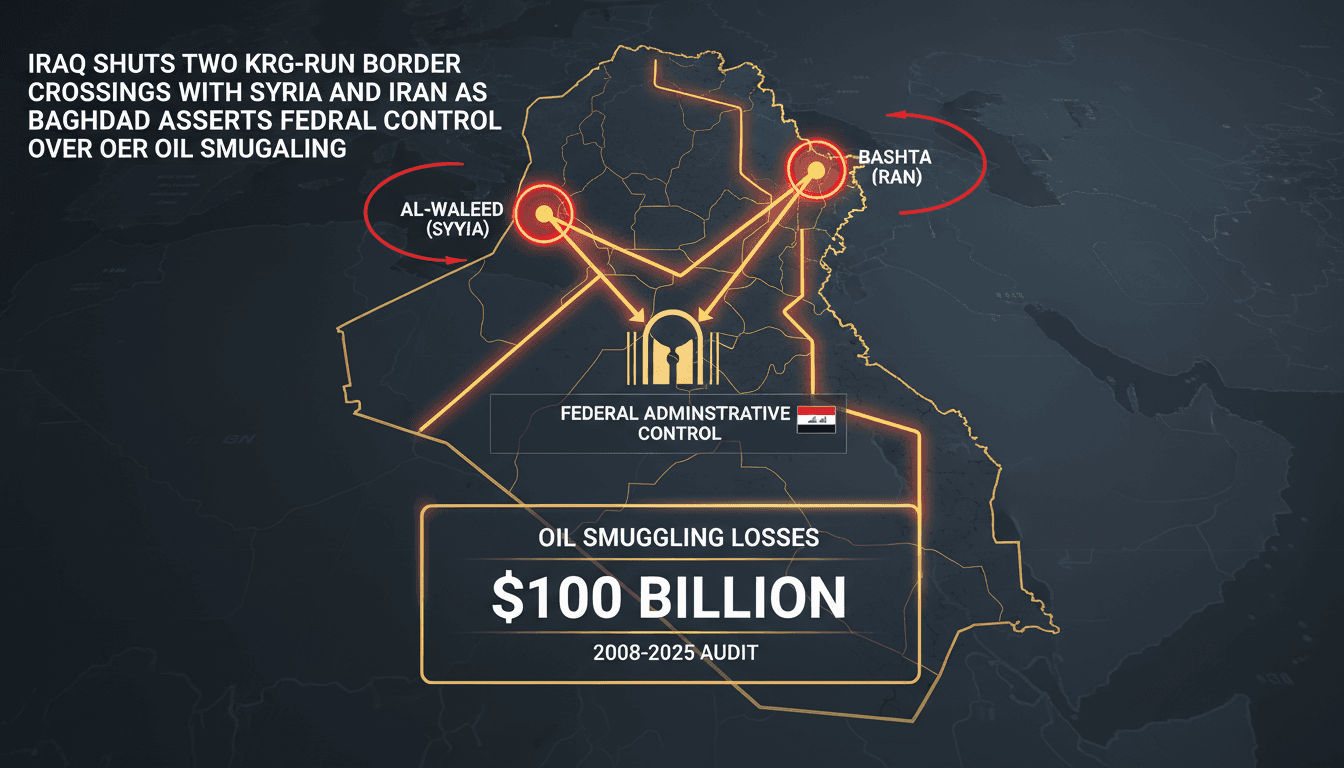
Iraq Shuts Two KRG-Run Border Crossings With Syria and Iran as Baghdad Asserts Federal Control Over Oil Smuggling
Why it matters
Centralized control over external checkpoints directly curbs unofficial hydrocarbon transit, realigning disputed revenue flows back into the federal treasury.
What happened (in 30 seconds)
- Federal border forces shut down key peripheral checkpoints: Iraqi Border Forces, directed by Commander Lt. Gen. Mohammed Abdul Wahab Sakr Al-Saeedi, took direct operational control of and closed the al-Waleed crossing with Syria in Nineveh province and the Bashta crossing with Iran in Halabja province on November 26, 2026.
- The move enforces a decisive supreme court mandate: The action implemented orders from Prime Minister Ali al-Zaidi, following a November 25, 2026 Federal Supreme Court ruling that authorized federal security forces to deploy along all international borders across the country.
- Crackdowns extended to inter-provincial logistics: Federal authorities simultaneously targeted and restricted unofficial transit lines between Nineveh and Erbil provinces, prompting immediate civic protests across Erbil, Duhok, and neighboring Kurdish regional hubs.
The context you actually need
- A 17-year fiscal audit triggered central intervention: Investigations into the North Oil Company, alongside findings from the Federal Board of Supreme Audit, revealed that unauthorized and out-of-channel petroleum exports totaled over $100 billion between 2008 and 2025.
- Jurisdiction over external gates has long remained contested: Border stations along Syria and Iran had operated under the direct administrative framework of the Kurdistan Regional Government (KRG), rather than Baghdad's State Company for Marketing of Oil (SOMO) and federal customs agencies.
- The judicial ruling eliminated prior administrative ambiguities: By asserting that all international access corridors belong strictly to federal purview, the high court provided Baghdad with legal backing to seize physical management of logistics choke points and upstream crude infrastructure.
What's really happening
The physical closure of the al-Waleed and Bashta crossings goes beyond routine border security; it represents an institutional mechanism designed to shut down decentralized arbitrage in the regional petroleum market. For nearly two decades, structural gaps between Erbil's semi-autonomous export operations and Baghdad’s centralized export monopoly created logistical pathways through which petroleum flowed outside the framework of the federal budget. The Federal Board of Supreme Audit's accounting—pinpointing $100 billion in leaked revenue across a 17-year window—provided Baghdad with the fiscal rationale to recalibrate internal revenue distribution.
At its core, this structural maneuver operates through physical interdiction rather than regulatory negotiations. Border transit points that historically handled local cross-border trade and unmonitored overland trucking are now blocked by armed federal border commands. By interdicting cross-border routes into Syria and Iran, the central government disrupts informal distribution networks that relied on route fragmentation to transport crude without federal clearance. The concurrent restriction of transit arteries linking Nineveh to Erbil locks in this encirclement, functionally cutting off northern fields from peripheral offloading hubs.
The fundamental incentive driving Baghdad is the defense of sovereign fiscal receipts. Operating under volatile global energy demand, the federal government cannot afford parallel export systems that dilute federal receipts or risk non-compliance with unified national quotas. Conversely, the KRG’s economic architecture relied heavily on independent border transit to sustain independent fiscal autonomy and fund regional administrative liabilities.
By deploying federal personnel straight to peripheral gates, the central executive eliminates decentralized regulatory oversight. This shift consolidates oil handling under federal instruments like the North Oil Company and central customs offices. The protests unfolding across Erbil and Duhok reflect the friction of this fiscal consolidation. The immediate loss of local customs revenues and cross-border transport profits shifts direct commercial leverage back to the capital, converting contested administrative zones into federally secured corridors.
Who feels it first (and how)
- Kurdish commercial transit operators and logistics firms: Fleets relying on the Bashta and al-Waleed access points face immediate route cancellations, idling transport assets and sharply driving up regional freight costs.
- Cross-border trade intermediaries in Nineveh and Halabja: Wholesalers, clearing agents, and drivers operating within the border zones lose cross-border throughput, cutting daily commercial revenues.
- Regional energy traders and terminal operators: Commercial brokers monitoring overland petroleum routing from northern fields must reroute shipments through federally monitored pipelines or suspend trades completely.
- Public sector administrators within the KRG: Erbil's regional treasury faces an immediate loss of cross-border customs fees and transport levies that historically funded public sector allocations.
What to watch next
- Federal customs installations at northern border hubs: Watch whether Baghdad deploys civilian revenue officials and federal tax infrastructure to permanently replace Kurdish administrative posts at these gates.
- Production adjustments across northern oil fields: Track extraction data from North Oil Company facilities and northern extraction sites to assess whether pipeline delivery balances compensate for halted trucking routes.
- Erbil-Baghdad budget reconciliation negotiations: Observe if Kurdish regional representatives use impending parliamentary fiscal discussions to negotiate alternative revenue-sharing formulas in exchange for recognizing federal border sovereignty.
Iraqi Border Forces shuttered the al-Waleed crossing to Syria and the Bashta crossing to Iran on November 26, 2026, acting on orders from Prime Minister Ali al-Zaidi following a Federal Supreme Court ruling; state audits estimated historic off-grid oil transit losses at over $100 billion.
Informal overland crude transit toward neighboring hubs will see steep short-term declines as federal troops enforce restrictions along secondary roads between Nineveh and Erbil.
Whether the central government and the KRG will establish a unified revenue-sharing protocol to reopen commercial freight lanes, or if federal forces will run permanent border customs operations unilaterally.
Frequently Asked Questions
- Why it matters?
- Centralized control over external checkpoints directly curbs unofficial hydrocarbon transit, realigning disputed revenue flows back into the federal treasury.
- What happened (in 30 seconds)?
- Federal border forces shut down key peripheral checkpoints: Iraqi Border Forces, directed by Commander Lt. Gen. Mohammed Abdul Wahab Sakr Al-Saeedi, took direct operational control of and closed the al-Waleed crossing with Syria in Nineveh province and the Bashta crossing with Iran in Halabja province on November 26, 2026. The move enforces a decisive supreme court mandate: The action implemented orders from Prime Minister Ali al-Zaidi, following a November 25, 2026 Federal Supreme Court ruling
- What's really happening?
- The physical closure of the al-Waleed and Bashta crossings goes beyond routine border security; it represents an institutional mechanism designed to shut down decentralized arbitrage in the regional petroleum market. For nearly two decades, structural gaps between Erbil's semi-autonomous export operations and Baghdad’s centralized export monopoly created logistical pathways through which petroleum flowed outside the framework of the federal budget. The Federal Board of Supreme Audit's accounting
- Who feels it first (and how)?
- Kurdish commercial transit operators and logistics firms: Fleets relying on the Bashta and al-Waleed access points face immediate route cancellations, idling transport assets and sharply driving up regional freight costs. Cross-border trade intermediaries in Nineveh and Halabja: Wholesalers, clearing agents, and drivers operating within the border zones lose cross-border throughput, cutting daily commercial revenues. Regional energy traders and terminal operators: Commercial brokers monitoring o
- What to watch next?
- Federal customs installations at northern border hubs: Watch whether Baghdad deploys civilian revenue officials and federal tax infrastructure to permanently replace Kurdish administrative posts at these gates. Production adjustments across northern oil fields: Track extraction data from North Oil Company facilities and northern extraction sites to assess whether pipeline delivery balances compensate for halted trucking routes. Erbil-Baghdad budget reconciliation negotiations: Observe if Kurdish
Arabic-language coverage of international news and geopolitics.
"RT Arabic is a Russian state-funded outlet often criticized for promoting Kremlin-aligned narratives."
— A47 Editor
العراق.. إغلاق معبرين مع إيران وسوريا في إطار حملة لمكافحة تهريب النفط
Iraq's border forces commander, Lieutenant General Mohammed Abdul Wahab Sakar al-Saadi, announced the closure of two border crossings with Iran and Syria as part of a campaign to combat oil smuggling, according to the report published by RT Arabic.
UAE-based English-language newspaper covering regional politics, economics, and global affairs.
"The National reflects Emirati policy perspectives while maintaining international editorial standards."
— A47 Editor
Iraq estimates $100bn lost to Kurdistan oil smuggling
Iraq has estimated that roughly $100 billion has been lost to oil smuggling from the Kurdistan region, according to a report published by The National. The development follows an inquiry into illicit oil trade, after which Prime Minister Ali al-Zaidi...
English-language reporting on Saudi politics, policy, and society.
"Saudi Gazette reflects mainstream Saudi institutional perspectives."
— A47 Editor
Iraq closes unofficial border crossings with Syria and Iran in Kurdish region
Iraq has closed two border crossings with Syria and Iran that had been administered by the Kurdistan Regional Government, state media reported, the Al-Waleed crossing with Syria and the Bashta crossing with Iran, according to Lt. Gen. Mohammed Abdul ...