
Baghdad Moves to Centralize Control of Kurdistan Border Crossings and Oil Fields as Federal Court Backs Federal Authority
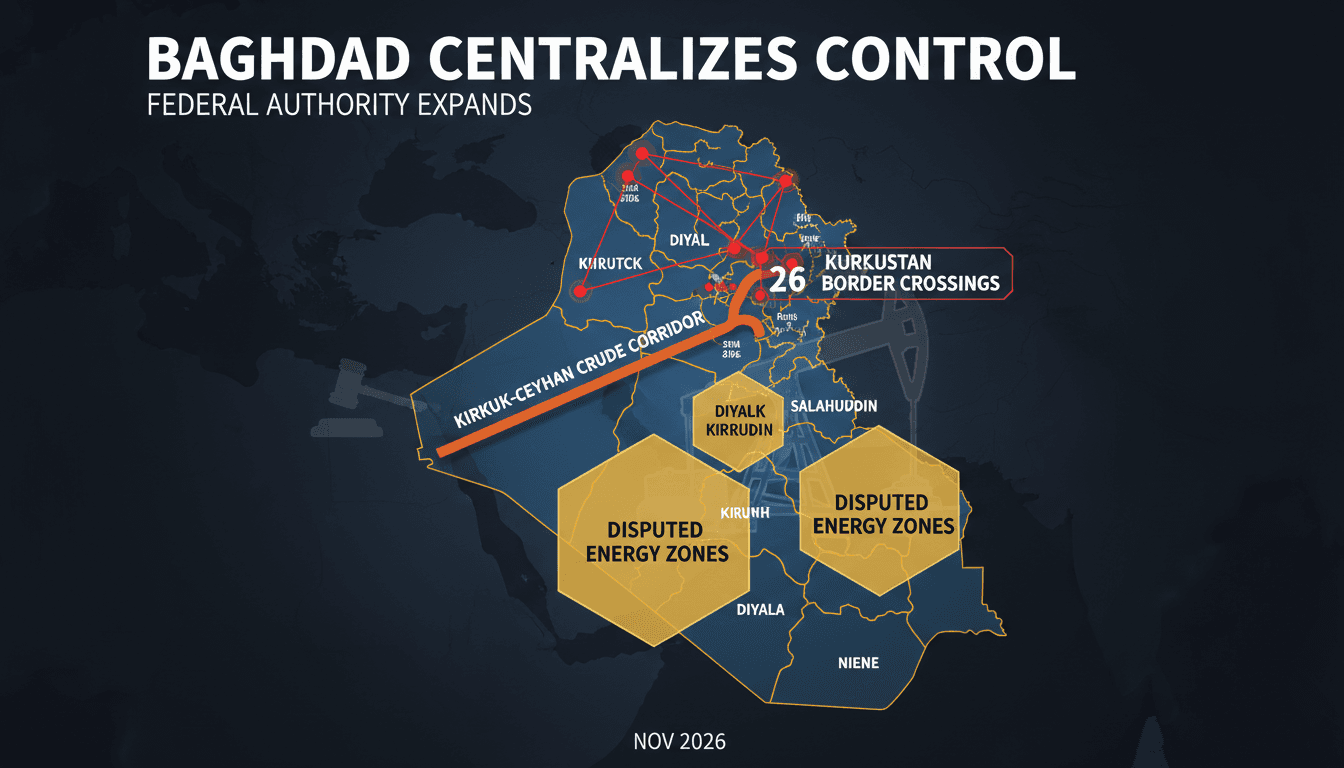
If you manage energy portfolios, logistics, or regional risk out of Dubai or global trading desks, federal enforcement over northern Iraqi routes introduces immediate jurisdictional shifts and a repricing of political risk across Middle Eastern crude supply lines.
Why it matters
Federal consolidation of disputed energy assets and transport corridors recalibrates fiscal leverage across Iraq, altering export security and pipeline predictability through regional trading hubs.
What happened (in 30 seconds)
* Federal orders targeted northern transit: On November 24, 2026, Iraqi Prime Minister Ali al-Zaidi ordered federal security forces to take control of 26 unofficial border crossings and close seasonal smuggling routes in the Kurdistan Region. * Oil ministry oversight expanded: The executive directive placed disputed fields across Diyala, Kirkuk, Salahuddin, and Nineveh provinces under direct oversight of the federal oil ministry. * Judicial backing followed rapidly: On November 25, 2026, the Federal Supreme Court affirmed Baghdad’s exclusive constitutional authority over international borders and hydrocarbon oversight, while the Kurdistan Regional Government (KRG) rejected the actions as unconstitutional.
The context you actually need
* Post-withdrawal authority vacuums: Following the October 2026 exit of the US-led coalition, the federal government initiated domestic security campaigns, including a November 20 operation in Jarf al-Sakhar to curtail militia-linked fuel diversion before turning north. * Historical pipeline friction: Tensions over resource sovereignty and revenue allocation intensified after the 2017 Kurdish independence referendum and the federal repossession of Kirkuk, preceding the September 2025 resumption of crude flows via the Kirkuk-Ceyhan pipeline. * The structural friction point: Disagreements center on four northern provinces where regional security forces maintain local presence while federal authorities claim exclusive constitutional jurisdiction over extraction rights and international trade terminals.
What's really happening
The dispute between Baghdad and Erbil is an institutional contest over economic centralization following the departure of foreign coalition forces. When Prime Minister Ali al-Zaidi directed federal authorities to secure 26 unofficial crossings alongside four official border stations, the federal apparatus moved to eliminate parallel revenue generation that bypasses the central treasury.
This move follows structural logic. On November 20, 2026, federal units secured Jarf al-Sakhar to suppress smuggling operations managed by Kataib Hezbollah and allied groups. Applying that same enforcement posture to northern trade routes frames the northern border initiative as part of an institutional campaign to assert standard customs authority across all frontiers, rather than an isolated political dispute with Kurdish authorities.
The financial stakes involve the hydrocarbon fields spread across Diyala, Kirkuk, Salahuddin, and Nineveh provinces. While the KRG manages regional infrastructure, the Federal Supreme Court’s November 25 decision established that exclusive legal authority over international boundaries and strategic energy management belongs to the federal government. For federal authorities, direct oversight of these fields guarantees uniform export contracts, protects pipeline infrastructure, and ensures all crude output integrates into state fiscal reporting.
For the KRG, administrative control over border terminals and surrounding energy acreage provides the direct revenue necessary to service regional public payrolls and sustain political autonomy. Removing non-standard transit points directly reduces regional revenue collection. While Erbil characterized the deployments as an overreach, Kurdish leadership has kept communication channels open, recognizing that physical pipeline operations toward Ceyhan require technical and security coordination between regional Peshmerga lines and federal operators.
Incentive structures drive both sides toward structured bargaining. Baghdad seeks unified control over hydrocarbon pricing and tariff collection to stabilize central budgets, while Erbil aims to retain local economic management without jeopardizing the flow of export allocations through federal accounts. The outcome tests whether federal ministries can enforce institutional authority over peripheral resource hubs without destabilizing the operating environments of international energy firms operating across northern Iraq.
Who feels it first (and how)
* Commodity Traders and Desk Analysts in Dubai: Must monitor pipeline volume continuity at the Kirkuk-Ceyhan terminal, factoring northern Iraqi supply risks directly into regional crude price differentials. * International Energy Operators in Northern Iraq: Face dual administrative reporting requirements, operational reviews from the federal oil ministry, and potential contract adjustments across fields in disputed provinces. * Cross-Border Logistics and Freight Carriers: Experience operational delays and cargo rerouting as federal security teams shut down 26 informal transit routes between the Kurdistan Region and neighboring markets. * KRG and Federal Public Finance Authorities: Face immediate shifts in tariff distribution and customs clearance receipts as border control transitions toward central state collection points.
What to watch next
* Operational integration at border terminals: Watch whether federal customs officers physically replace regional staff at major Kurdish transit hubs, which will indicate Erbil's willingness to accept administrative revenue sharing. * Federal Oil Ministry directives on Diyala and Kirkuk fields: Monitoring whether federal technical teams alter existing field operating agreements will reveal the speed of upstream centralization. * Pipeline pumping stability along Kirkuk-Ceyhan: Daily throughput figures will signal whether security deployments generate field-level operational friction or maintain steady crude deliveries.
Prime Minister Ali al-Zaidi issued federal orders to seize 26 unofficial border crossings and placed oil fields in Diyala, Kirkuk, Salahuddin, and Nineveh under federal oversight, backed by a Federal Supreme Court ruling.
Baghdad and Erbil will engage in formal revenue-allocation negotiations to prevent field shutdowns, utilizing the 2025 pipeline reopening framework to sustain export volumes.
Whether local security forces within the four disputed provinces will fully withdraw from transport checkpoints without armed pushback or administrative stalemates.
Frequently Asked Questions
- Why it matters?
- Federal consolidation of disputed energy assets and transport corridors recalibrates fiscal leverage across Iraq, altering export security and pipeline predictability through regional trading hubs.
- What happened (in 30 seconds)?
- Federal orders targeted northern transit: On November 24, 2026, Iraqi Prime Minister Ali al-Zaidi ordered federal security forces to take control of 26 unofficial border crossings and close seasonal smuggling routes in the Kurdistan Region. Oil ministry oversight expanded: The executive directive placed disputed fields across Diyala, Kirkuk, Salahuddin, and Nineveh provinces under direct oversight of the federal oil ministry. Judicial backing followed rapidly: On November 25, 2026, the Federal S
- What's really happening?
- The dispute between Baghdad and Erbil is an institutional contest over economic centralization following the departure of foreign coalition forces. When Prime Minister Ali al-Zaidi directed federal authorities to secure 26 unofficial crossings alongside four official border stations, the federal apparatus moved to eliminate parallel revenue generation that bypasses the central treasury. This move follows structural logic. On November 20, 2026, federal units secured Jarf al-Sakhar to suppress s
- Who feels it first (and how)?
- Commodity Traders and Desk Analysts in Dubai: Must monitor pipeline volume continuity at the Kirkuk-Ceyhan terminal, factoring northern Iraqi supply risks directly into regional crude price differentials. International Energy Operators in Northern Iraq: Face dual administrative reporting requirements, operational reviews from the federal oil ministry, and potential contract adjustments across fields in disputed provinces. Cross-Border Logistics and Freight Carriers: Experience operational delays
- What to watch next?
- Operational integration at border terminals: Watch whether federal customs officers physically replace regional staff at major Kurdish transit hubs, which will indicate Erbil's willingness to accept administrative revenue sharing. Federal Oil Ministry directives on Diyala and Kirkuk fields: Monitoring whether federal technical teams alter existing field operating agreements will reveal the speed of upstream centralization. Pipeline pumping stability along Kirkuk-Ceyhan: Daily throughput figures
Pan-Arab political news and analysis.
"Al-Quds Al-Arabi is a London-based Arabic newspaper known for political coverage."
— A47 Editor
العراق وكردستان: معركة السيادة أم إعادة توزيع مراكز النفوذ؟
U.S. President Donald Trump on Friday expressed support for Iraqi Prime Minister Ali al-Zaidi's efforts to extend the state's authority across Iraq, combat corruption and oil smuggling, and confine weapons to state control. The statement came amid a ...
Conservative-leaning political and national coverage.
"The Washington Times is a conservative-leaning newspaper known for its political coverage and advocacy of right-of-center viewpoints."
— A47 Editor
Trump backs Iraqi leader's power plays
President Trump is backing Iraqi Prime Minister Ali al-Zaidi's efforts to expand state control, according to a report from The Washington Times. The coverage frames the U.S. president's support as aligned with al-Zaidi's push to consolidate governmen...
Arabic-language coverage of international news and geopolitics.
"RT Arabic is a Russian state-funded outlet often criticized for promoting Kremlin-aligned narratives."
— A47 Editor
ترامب يدعم مساعي الزيدي لفرض سيطرة الدولة العراقية على النفط والسلاح
U.S. President Donald Trump announced on Friday his full support for the efforts of Iraqi Prime Minister Ali al-Zaidi to extend the authority of the Iraqi state across the entire country, according to RT Arabic. The statement centers on Iraq's contro...
UAE-based English-language newspaper covering regional politics, economics, and global affairs.
"The National reflects Emirati policy perspectives while maintaining international editorial standards."
— A47 Editor
Trump backs Iraq's Al Zaidi as tensions rise with Kurds
The National reports that US President Donald Trump has backed Iraqi Prime Minister Ali al-Zaidi as tensions rise between Baghdad and Iraq's Kurdish leadership, with the base report lacking a detailed summary of the specific dispute.
Key macro releases (CPI, jobs, PMIs), surprise indexes, and market implications.
"Great for data-print awareness and instant read-through to rates and risk assets."
— A47 Editor
Trump backs Iraqi leader’s efforts to assert more state authority
The base report from Investing.com says US President Donald Trump has backed Iraq's leader in efforts to assert greater state authority, with the coverage categorized under markets and carrying a neutral tone.
Regional coverage and analysis focused on politics, diplomacy, and business across the Middle East.
"Al-Monitor is known for analytical reporting on Middle East politics and policy developments."
— A47 Editor
Trump backs Iraqi leader's efforts to assert more state authority
On Friday, US President Donald Trump publicly backed Iraqi Prime Minister Ali al-Zaidi's drive to assert state authority across Iraq, including halting the smuggling of Iraqi oil, ending corruption, and placing all weapons under exclusive state contr...