
Poland Signs $300 Million Palantir AI Military Decision-Support Contract With Data Sovereignty Controls
Why it matters
The five-year procurement signals that allied defense establishments will bypass domestic technological development gaps by acquiring proven battle-management AI, provided foreign vendors accept absolute structural exclusion from operational data and encryption keys.
What happened (in 30 seconds)
- The procurement agreement: On November 27, 2026, the Polish Ministry of National Defense finalized an estimated $300 million, five-year contract with Palantir Technologies in Warsaw to deploy decision-support software across all branches of the Polish Armed Forces.
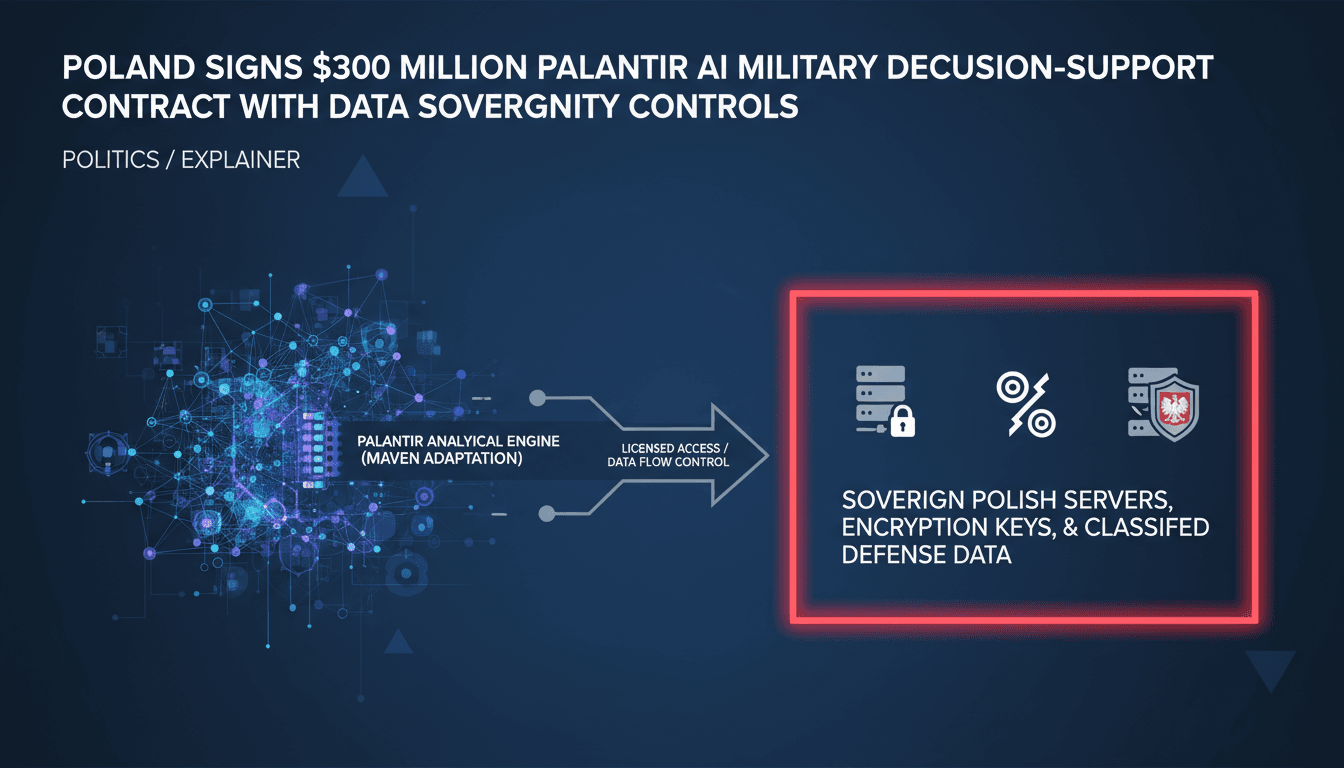
- The platform deployment: Poland is procuring an adaptation of Palantir’s Maven Smart System, locally designated as Saturn, to integrate multi-source battlefield data, accelerate threat identification, and assist command staff with real-time course-of-action modeling.
- The operational boundary: The formal agreement establishes that all servers, cryptographic keys, and military datasets remain under the exclusive physical and administrative control of the Polish Armed Forces, with zero vendor access permitted to confidential feeds.
The context you actually need
- Precursor collaboration: The commercial contract builds directly upon a bilateral memorandum of understanding executed between Poland and Palantir in 2025, which framed joint alignment around artificial intelligence, IT infrastructure, and cyber defense capabilities.
- Combat-tested software heritage: The software foundation originated inside the U.S. Department of Defense's Project Maven in 2017 and is actively deployed by the U.S. military, NATO command structures, and Ukrainian defense units to process multi-domain sensor feeds.
- The European sovereignty debate: European defense ministries and technology policy leaders have consistently raised operational risk concerns regarding dependence on proprietary American platforms that remain subject to external regulatory, legal, or export controls.
What's really happening
The $300 million transaction resolves a fundamental strategic tension facing European defense establishments: the urgent need to field operational military artificial intelligence against regional threats versus the institutional mandate to maintain national sovereignty over defense infrastructure.
Poland’s eastern border sits under direct security pressure from Russia. Creating a domestic battlefield data-fusion engine from scratch requires years of specialized software engineering, extensive sensor integration, and iterative live-fire optimization. Palantir's platform offers immediate operational capability because its algorithms have already absorbed multi-domain operational data across U.S., NATO, and Ukrainian combat theaters.
To overcome the institutional resistance surrounding reliance on non-European defense vendors, Poland negotiated an uncompromised data architecture. The Polish Ministry of National Defense structured the deal to draw a hard technological boundary between the operational platform algorithms and the operational data plane.
Palantir licenses the analytical engine and provides continuous enterprise support, but it operates under total operational blindness. The Polish Armed Forces retain complete, segregated control over the physical server hardware, the ingestion pipelines, and the cryptographic keys. Palantir personnel cannot view military inputs, examine operational telemetry, or query output recommendations.
This contract structure dismantles the traditional commercial SaaS engagement model, where vendors leverage client interaction data to refine, retrain, and optimize proprietary baseline models. Instead, Poland treats the software as an isolated on-premises analytical appliance.
Defense Minister Władysław Kosiniak-Kamysz framed the operational logic directly, arguing that refusing to adopt battle-tested software would degrade defense readiness. However, domestic street protests in Warsaw demonstrate that technology dependence remains politically contentious, regardless of contractual isolation.
For Palantir, the deal proves that tier-one defense contractors can secure major international software revenue without demanding operational data access. For allied defense ministries, it demonstrates an executable framework: procure external algorithmic processing power to counter near-term border risks while ring-fencing sovereign intelligence inside impenetrable national perimeters.
Who feels it first (and how)
- Polish Armed Forces commanders: Joint force operational planners gain automated, real-time aggregation of multi-source intelligence, transforming tactical analysis timelines while navigating an entirely new command-and-control interface.
- European defense software developers: Regional enterprise defense startups face a raised operational bar, as national defense ministries opt for fielded American platforms rather than waiting for early-stage European sovereign alternatives.
- Enterprise IT and compliance executives: Chief information officers managing dual-use software, defense procurement, or sensitive industrial data gain a visible legal-architectural precedent for deploying proprietary foreign algorithms alongside zero-trust, ring-fenced data partitions.
- Polish defense procurement officials: Civilian acquisition teams must execute a complex five-year technical oversight regime to verify that Palantir technicians never interact with isolated hosting environments or cryptographic boundaries.
What to watch next
- Interoperability milestones across NATO borders: Watch how Saturn interfaces with existing NATO command frameworks, showing whether localized data isolation creates technical friction during multi-nation exercises.
- Replication across other European defense budgets: Monitor whether eastern European and Nordic states draft comparable procurement bids that demand identical data isolation covenants from non-EU tech providers.
- Verification audits and operational friction: Track Polish military statements regarding software deployment speed, monitoring whether air-gapped hosting arrangements complicate routine software updates, system patches, and technical support.
Poland committed approximately $300 million over five years to deploy Palantir's Maven Smart System (Saturn); the Polish Armed Forces retain absolute ownership of all servers, data pipelines, and cryptographic keys.
Other NATO member states will use the Polish contractual template to bypass domestic software development delays without ceding national intelligence data to American corporations.
Whether total vendor exclusion from system servers will reduce the software’s performance efficiency or slow down required zero-day algorithmic updates during fast-evolving tactical scenarios.
Frequently Asked Questions
- Why it matters?
- The five-year procurement signals that allied defense establishments will bypass domestic technological development gaps by acquiring proven battle-management AI, provided foreign vendors accept absolute structural exclusion from operational data and encryption keys.
- What happened (in 30 seconds)?
- The procurement agreement: On November 27, 2026, the Polish Ministry of National Defense finalized an estimated $300 million, five-year contract with Palantir Technologies in Warsaw to deploy decision-support software across all branches of the Polish Armed Forces. The platform deployment: Poland is procuring an adaptation of Palantir’s Maven Smart System, locally designated as Saturn, to integrate multi-source battlefield data, accelerate threat identification, and assist command staff with rea
- What's really happening?
- The $300 million transaction resolves a fundamental strategic tension facing European defense establishments: the urgent need to field operational military artificial intelligence against regional threats versus the institutional mandate to maintain national sovereignty over defense infrastructure. Poland’s eastern border sits under direct security pressure from Russia. Creating a domestic battlefield data-fusion engine from scratch requires years of specialized software engineering, extensive
- Who feels it first (and how)?
- Polish Armed Forces commanders: Joint force operational planners gain automated, real-time aggregation of multi-source intelligence, transforming tactical analysis timelines while navigating an entirely new command-and-control interface. European defense software developers: Regional enterprise defense startups face a raised operational bar, as national defense ministries opt for fielded American platforms rather than waiting for early-stage European sovereign alternatives. Enterprise IT and com
- What to watch next?
- Interoperability milestones across NATO borders: Watch how Saturn interfaces with existing NATO command frameworks, showing whether localized data isolation creates technical friction during multi-nation exercises. Replication across other European defense budgets: Monitor whether eastern European and Nordic states draft comparable procurement bids that demand identical data isolation covenants from non-EU tech providers. Verification audits and operational friction: Track Polish military statem
Stock market news, investing ideas, and trading analysis.
"TheStreet provides market news and retail-investor-focused analysis."
— A47 Editor
Palantir's new military AI deal has a surprising catch
Poland has signed a $300 million military AI deal with Palantir, according to TheStreet, though a key restriction attached to the agreement remains a notable catch in the base story's coverage of the markets category.
RT is a Russian state-funded network covering global events from a Russian perspective.
"RT is widely criticized for promoting pro-Kremlin narratives and is considered by many to be a state propaganda outlet."
— A47 Editor
Poland bets on US battlefield AI
Poland has signed a deal to buy Palantir's battlefield AI, according to RT (Russia Today), while several European governments are seeking alternatives out of concern over dependence on US technology. The base report is brief and does not specify the ...
Technology business and AI-related headlines.
"Data-driven tech newsroom with global scope."
— A47 Editor
Poland Signs $300 Million Palantir Deal to Use AI in Defense
Poland will use artificial intelligence-based software from Palantir Technologies Inc. to analyze battlefield data, in a deal reported at $300 million, even as some European allies push to reduce their reliance on US technology for critical defense c...
Technology business news, market impacts, and innovation trends.
"Bloomberg is a premier financial and tech news provider, respected for its in-depth reporting and analytical rigor."
— A47 Editor
Poland Signs $300 Million Palantir Deal to Use AI in Defense
Poland will use artificial intelligence-based software from Palantir Technologies Inc. to analyze battlefield data, in a deal reported at $300 million, even as some European allies push to reduce their reliance on US technology for critical defense c...