
Baghdad Denies Army Deployment Toward Kurdistan Region as Federal Oil and Border Control Dispute Escalates
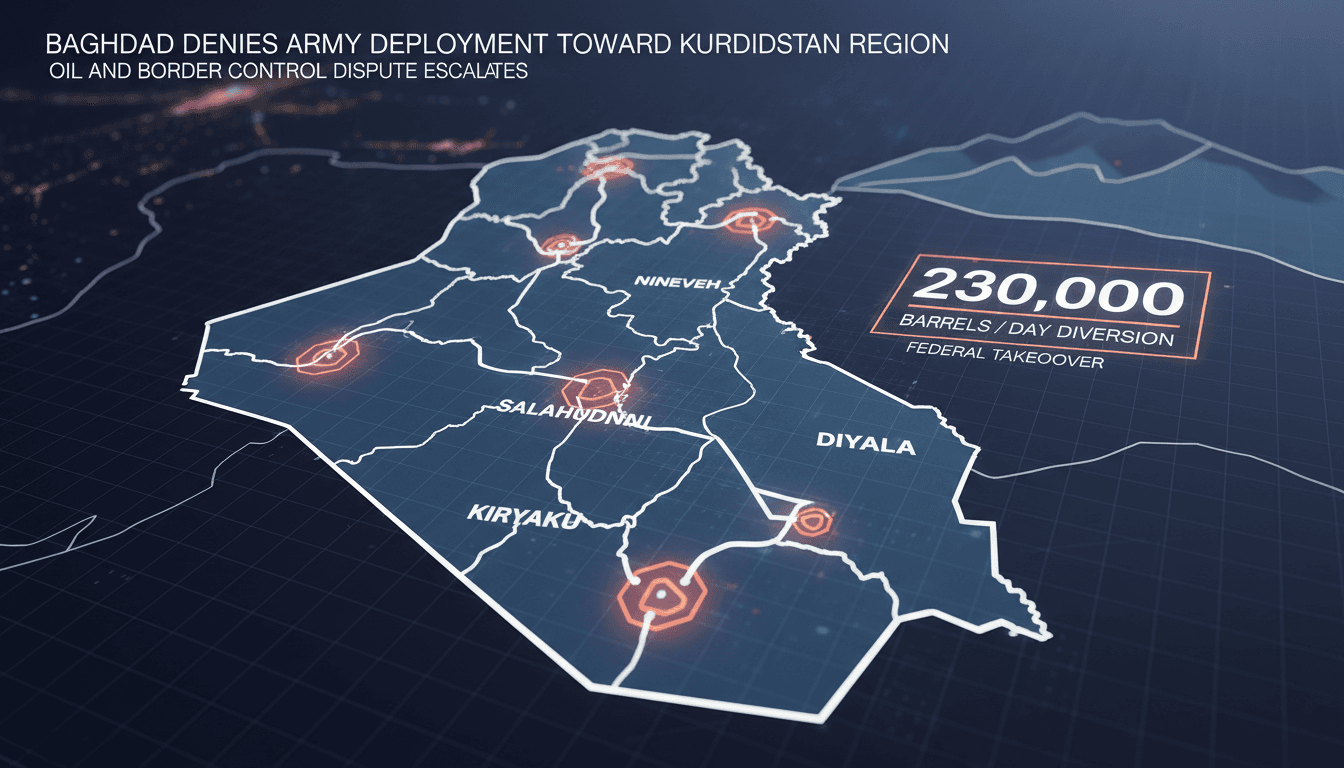
For global operators tracking Middle East supply stability, Iraq’s move to centralize regional crude logistics and clamp down on unauthorized flows signals a tighter enforcement of federal fiscal boundaries without an immediate cross-border supply disruption.
Why it matters
The confrontation over border posts and oil fields tests whether Iraq can structurally integrate regional hydrocarbon revenues into its centralized treasury without triggering operational standstills across northern export infrastructure.
What happened (in 30 seconds)
- Federal denial issued: On November 26, 2026, Iraqi government spokesperson Haidar al-Aboudi denied reports that federal army units were advancing toward the Kurdistan Region, clarifying that state forces aim to protect residents rather than threaten regional security.
- Enforcement orders enacted: Prime Minister Ali al-Zaidi ordered the Border Ports Authority to secure legitimate crossings, shutter unofficial trade paths, and assume direct federal management of key oil fields across Kirkuk, Nineveh, Salahuddin, and Diyala.
- Diplomatic window opened: Following protests in Erbil against centralized administrative maneuvers, the country’s four presidential offices scheduled a formal national dialogue for December 1, 2026, to resolve jurisdiction over revenue and border control.
The context you actually need
- The baseline revenue leak: The enforcement push follows a formal probe into diverted crude at the North Oil Company, targeting an estimated volume of 200,000 to 230,000 barrels per day moving via unofficial channels, representing roughly $200 million in uncollected monthly revenue.
- The constitutional mandate: Iraq’s Federal Supreme Court issued a binding ruling confirming Baghdad’s exclusive authority over international boundary posts, military deployments, oil and gas production facilities, and national energy receipts.
- The regional administrative pushback: The Kurdistan Regional Government rejected attempts at unilateral central administration and military rhetoric, while thousands of residents gathered in Erbil to challenge federal interventions as an infringement on regional constitutional autonomy.
What's really happening
The friction between Baghdad and Erbil is an administrative dispute over fiscal leakage and jurisdictional boundaries rather than an active military mobilization. When Prime Minister Ali al-Zaidi directed federal entities to assume operational oversight of oil fields across Kirkuk, Nineveh, Salahuddin, and Diyala, the action was targeted at plugging structural revenue gaps. Independent estimates indicate that 200,000 to 230,000 barrels of oil per day bypass official pipelines through unauthorized transport routes, diverting an estimated $200 million every month away from the federal budget.
By tasking the Border Ports Authority with closing unofficial transit corridors, the federal government is exercising the mandate established by the Federal Supreme Court. That judicial verdict granted Baghdad clear legal oversight over all external border institutions, armed forces positioning, energy extraction assets, and aggregate hydrocarbon revenues. Consequently, when reports surfaced alleging that conventional army divisions were deploying toward the Kurdistan Region's internal perimeter, spokesperson Haidar al-Aboudi moved quickly on state television to state there was no truth to claims of offensive maneuvers.
The underlying economic incentive centers on federal budget stability. Baghdad has tied its fiscal enforcement directly to public commitments, explicitly affirming that public sector salaries for regional Kurdish employees remain secured in the 2027 federal budget framework. In exchange, the central government expects unified accounting for crude produced within national borders. For Erbil, the sudden takeover of regional infrastructure threatens administrative self-financing mechanisms and local authority, prompting formal rejections from Prime Minister Masrour Barzani and President Nechirvan Barzani alongside public demonstrations in Erbil.
Because neither party benefits from an armed confrontation that would freeze regional infrastructure, institutional mechanisms are being prioritized. The deployment of regulatory bodies—such as port authorities and field managers—backed by formal talks scheduled for December 1, 2026, reflects a strategy of economic consolidation. Baghdad is testing how far legal authority can reshape energy management on the ground while offering sustained salary guarantees to offset administrative friction.
Who feels it first (and how)
- Crude transport and logistics operators: Intermediaries moving unmonitored crude across northern provinces face immediate route closures as the Border Ports Authority establishes checkpoints along internal boundary lines.
- Kurdish public sector employees: Regional civil servants face administrative dependency on the 2027 federal budget allocation as Baghdad conditions financial disbursements on standardized oil accounting.
- North Oil Company management: State asset supervisors in Kirkuk, Nineveh, Salahuddin, and Diyala operate under tightened federal monitoring following high-level dismissals and structural operational audits.
- Regional energy risk analysts: Commercial operators monitoring Gulf supply chains must price in regulatory friction around northern pipeline jurisdictions without pricing in direct kinetic disruption.
What to watch next
- The December 1 dialogue outcomes: The meeting between Iraq's top state authorities will indicate whether Erbil accepts joint administrative monitoring over borders or initiates formal legal challenges against federal field takeovers.
- Border Ports Authority implementation metrics: Evidence of physical closures at unofficial bypass points will confirm whether federal teams can curtail unauthorized crude transit without triggering local security friction.
- Federal salary disbursements for 2027: The formal codification of Kurdish public payroll transfers within the upcoming federal budget will demonstrate whether Baghdad’s financial commitments hold firm amid restructuring.
The Iraqi federal government officially denied army deployments toward the Kurdistan Region; Prime Minister al-Zaidi ordered federal takeovers of specific oil fields and border points; unauthorized trade diverts an estimated 200,000 to 230,000 barrels per day valued at $200 million monthly.
The December 1 national dialogue will center on revenue-sharing mechanisms and joint customs protocols rather than structural changes to the Federal Supreme Court's underlying legal decree.
Whether federal administrative teams can secure long-term operational control over designated fields in Kirkuk, Nineveh, Salahuddin, and Diyala without ongoing friction from local regional authorities.
Frequently Asked Questions
- Why it matters?
- The confrontation over border posts and oil fields tests whether Iraq can structurally integrate regional hydrocarbon revenues into its centralized treasury without triggering operational standstills across northern export infrastructure.
- What happened (in 30 seconds)?
- Federal denial issued: On November 26, 2026, Iraqi government spokesperson Haidar al-Aboudi denied reports that federal army units were advancing toward the Kurdistan Region, clarifying that state forces aim to protect residents rather than threaten regional security. Enforcement orders enacted: Prime Minister Ali al-Zaidi ordered the Border Ports Authority to secure legitimate crossings, shutter unofficial trade paths, and assume direct federal management of key oil fields across Kirkuk, Nineve
- What's really happening?
- The friction between Baghdad and Erbil is an administrative dispute over fiscal leakage and jurisdictional boundaries rather than an active military mobilization. When Prime Minister Ali al-Zaidi directed federal entities to assume operational oversight of oil fields across Kirkuk, Nineveh, Salahuddin, and Diyala, the action was targeted at plugging structural revenue gaps. Independent estimates indicate that 200,000 to 230,000 barrels of oil per day bypass official pipelines through unauthorize
- Who feels it first (and how)?
- Crude transport and logistics operators: Intermediaries moving unmonitored crude across northern provinces face immediate route closures as the Border Ports Authority establishes checkpoints along internal boundary lines. Kurdish public sector employees: Regional civil servants face administrative dependency on the 2027 federal budget allocation as Baghdad conditions financial disbursements on standardized oil accounting. North Oil Company management: State asset supervisors in Kirkuk, Nineveh,
- What to watch next?
- The December 1 dialogue outcomes: The meeting between Iraq's top state authorities will indicate whether Erbil accepts joint administrative monitoring over borders or initiates formal legal challenges against federal field takeovers. Border Ports Authority implementation metrics: Evidence of physical closures at unofficial bypass points will confirm whether federal teams can curtail unauthorized crude transit without triggering local security friction. Federal salary disbursements for 2027: The
Global news coverage with extensive reporting on Middle Eastern conflicts and geopolitics.
"Al Jazeera is a Qatar-based broadcaster known for wide regional coverage and alternative perspectives."
— A47 Editor
Iraq denies reports of troop movements towards Kurdish region
The Iraqi government has rejected media reports claiming that Iraqi army units were moving towards the Kurdistan region, stating there is "no truth" to the claims, as reported by Al Jazeera on November 26, 2026.
Comprehensive coverage of Middle Eastern and global issues.
"Al Jazeera is a prominent voice from the Global South, especially the Middle East, with an emphasis on underreported stories."
— A47 Editor
Iraq denies reports of troop movements towards Kurdish region
The Iraqi government has rejected media reports claiming that Iraqi army units were moving towards the Kurdistan region, stating there is "no truth" to the claims, as reported by Al Jazeera on November 26, 2026.
UAE-based English-language newspaper covering regional politics, economics, and global affairs.
"The National reflects Emirati policy perspectives while maintaining international editorial standards."
— A47 Editor
Iraq denies sending troops to Kurdistan as crisis talks begin
Iraq has denied reports that it sent troops toward the Kurdistan region as crisis talks began, according to The National. The base report centres on Baghdad's rejection of claims that military units were moving into the Kurdish area, a denial reporte...
Arabic-language coverage of international news and geopolitics.
"RT Arabic is a Russian state-funded outlet often criticized for promoting Kremlin-aligned narratives."
— A47 Editor
الحكومة العراقية تنفي تحرك الجيش نحو كردستان
The Iraqi government has denied reports that army units were moving toward the Kurdistan Region, amid rising tensions with Erbil over oil and border crossings, according to RT Arabic.