
Euclid Telescope Discovers Ancient Quasars Transforming Understanding of Early Universe
Here's what it means for you.
The recent discoveries made by the ESA's Euclid space telescope have profound implications for our understanding of the early universe. By identifying ancient quasars, astronomers are shedding light on the formation of supermassive black holes and the conditions that existed shortly after the Big Bang. This research not only enhances our cosmic history but also opens avenues for future exploration of dark matter and dark energy. As we delve deeper into the universe's formative years, these findings could reshape our understanding of cosmic structure formation. The implications extend beyond astronomy, potentially influencing various scientific fields and public interest in space exploration.
What happened
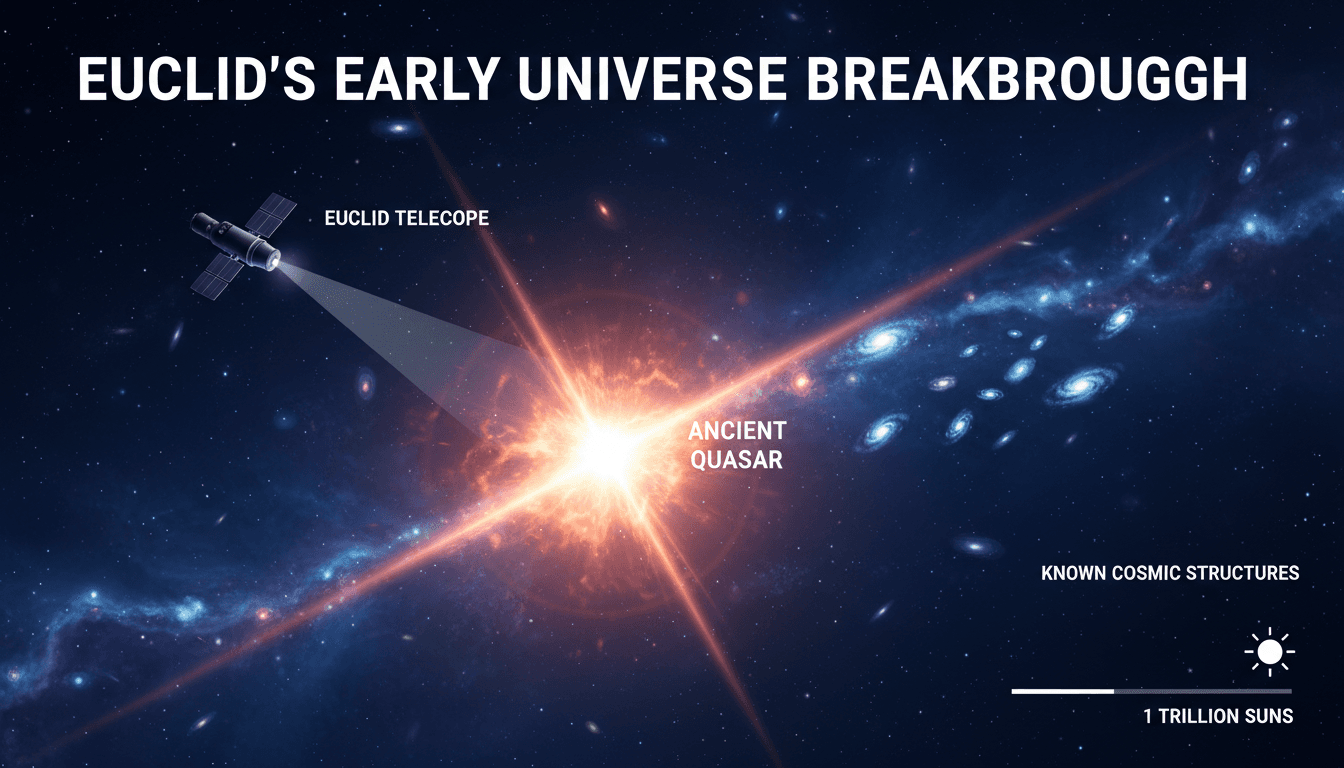
Astronomers utilizing the ESA's Euclid space telescope have made groundbreaking discoveries by identifying some of the oldest and most luminous quasars ever observed. Among these findings are two ancient black holes that shine brighter than a trillion suns. This remarkable brightness signifies their immense energy output and the scale of black hole activity in the early universe.
The discoveries have more than doubled the known population of quasars from the universe's first billion years. This significant expansion provides new insights into the conditions of the early universe and the formation of cosmic structures. The findings were announced in July 2026, marking a pivotal moment in astronomical research.
The Context
The Euclid telescope, a mission by the European Space Agency (ESA), is designed to explore distant cosmic phenomena. The recent discoveries highlight its capabilities in unveiling the mysteries of the early universe. Understanding these ancient quasars is crucial for comprehending the formation of supermassive black holes and the first galaxies.
These findings come at a time when the scientific community is increasingly focused on the origins of the universe and the nature of dark matter and dark energy. The discoveries not only enrich our cosmic narrative but also emphasize the importance of continued investment in space exploration technologies.
Takeaway
As astronomers continue to analyze data from the Euclid telescope, we can anticipate further groundbreaking discoveries that will deepen our understanding of the universe's origins. Future observations may reveal more about the early universe and the implications of these quasars for understanding dark matter and dark energy. The ongoing research will likely pave the way for new theories and models regarding cosmic structure formation.
The excitement surrounding these findings underscores the importance of the Euclid mission in expanding our knowledge of the cosmos. As we look ahead, the potential for new insights into the early universe remains vast and promising.
Space science news, astronomy updates, and spaceflight developments.
"Space.com delivers space science news, astronomy updates, and spaceflight developments with engaging coverage."
— A47 Editor
Scientists have discovered the oldest quasar ever seen, and it shines with the light of a trillion suns
Astronomers using the European Space Agency's Euclid space telescope have discovered the oldest quasar ever observed, shining with the brightness of a trillion suns. This remarkable find sheds light on the early universe, revealing black hole-powered...
Scientific discoveries, health, technology, and natural phenomena.
"Live Science reports on scientific discoveries, health, technology, and natural phenomena with a popular science tone."
— A47 Editor
Euclid telescope discovers the 2 most ancient monster black holes in the universe — each brighter than a trillion suns
The Euclid telescope has made a groundbreaking discovery by identifying two of the most ancient monster black holes in the universe, each exhibiting brightness greater than a trillion suns. This finding significantly expands the catalog of known quas...
Science and technology stories including AI.
"Longstanding science magazine with thoughtful AI coverage."
— A47 Editor
Astronomers discover some of the most extreme primordial quasars in the universe
Astronomers have made a significant discovery by identifying some of the most extreme primordial quasars in the universe, which are crucial for understanding the formation of the first galaxies and supermassive black holes. This research sheds light ...
Scientific research, technology, environment, and society.
"Scientific American is one of the oldest and most authoritative science magazines, known for deep dives into science, technology, and society."
— A47 Editor
Astronomers discover some of the most extreme primordial quasars in the universe
Astronomers have made a significant discovery by identifying some of the most extreme primordial quasars in the universe, which are crucial for understanding the formation of the first galaxies and supermassive black holes. This research sheds light ...