
China's Tianwen-2 spacecraft transmits first images of quasi-moon Kamo'oalewa
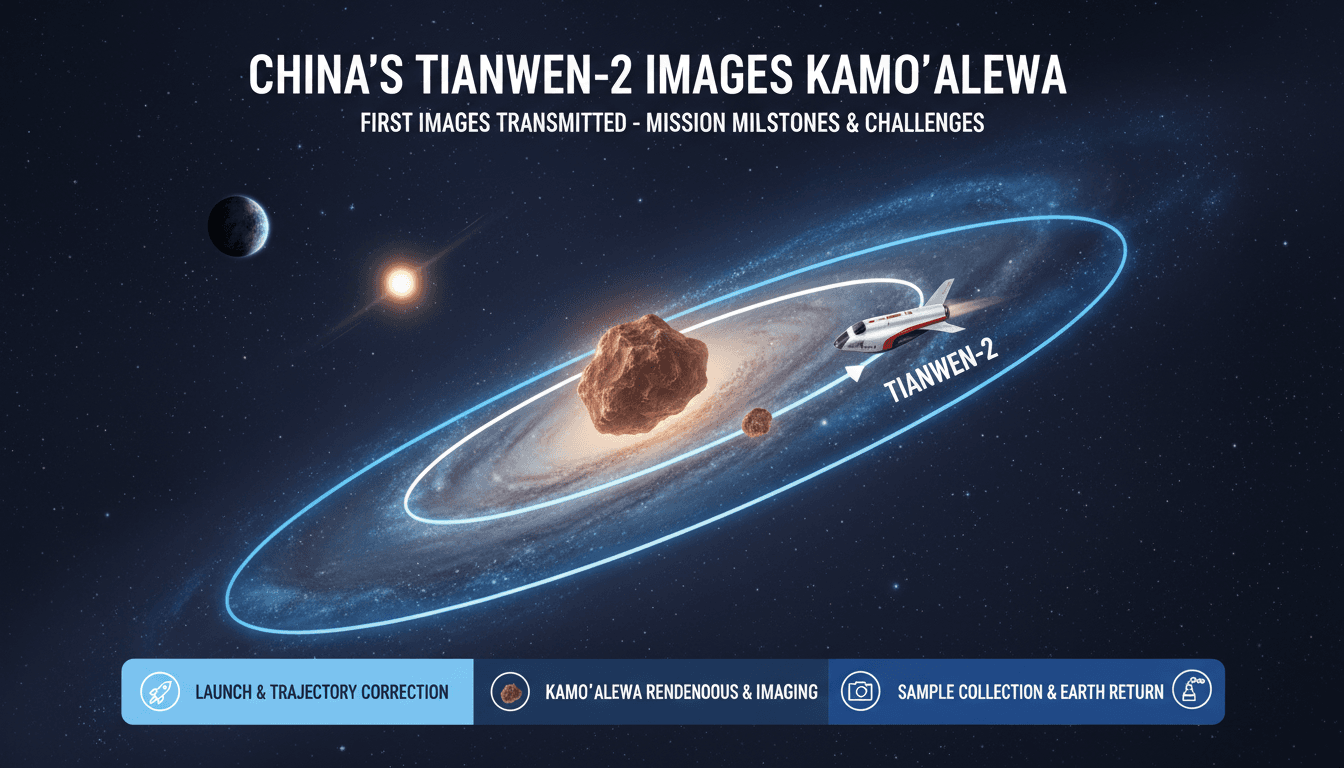
Here's what it means for you.
The successful transmission of images from China's Tianwen-2 spacecraft marks a significant advancement in space exploration, particularly in the study of asteroids. This mission not only highlights China's growing capabilities in space technology but also sets the stage for future international collaborations in asteroid research. The challenges anticipated in sample collection could influence global strategies for similar missions, emphasizing the need for innovative solutions in space exploration. As the mission unfolds, stakeholders in the aerospace sector will closely monitor developments, which may impact investment and policy decisions related to space exploration initiatives. The implications of Tianwen-2's findings could resonate beyond China's borders, shaping the future of asteroid exploration worldwide.
What happened
China's Tianwen-2 spacecraft has successfully captured and transmitted its first images of the quasi-moon Kamo'oalewa. This milestone was achieved on July 6, 2026, marking a significant step in the mission aimed at collecting samples from the asteroid. The initial images provide valuable insights into Kamo'oalewa, designated as asteroid 2016HO3, which orbits Earth in a unique trajectory.
However, the analysis following the image transmission suggests potential difficulties in the sample collection process. These challenges could impact the overall success of the mission, raising questions about the feasibility of obtaining samples from this celestial body.
The Context
Kamo'oalewa is classified as a quasi-moon, a designation that highlights its unusual orbit around Earth. The Tianwen-2 mission is part of China's broader efforts in space exploration and asteroid research, reflecting the nation's commitment to advancing its capabilities in this field. The timing of the image release coincides with ongoing discussions about the future of asteroid exploration and the importance of sample return missions.
As the mission progresses, the international space community will be watching closely, given the potential implications for future missions targeting other asteroids and celestial bodies. The challenges identified in the initial analysis could serve as a learning opportunity for other nations engaged in similar endeavors.
Takeaway
As the Tianwen-2 mission continues, further analysis will be crucial in determining the feasibility of successful sample collection from Kamo'oalewa. The outcomes of this mission could influence future asteroid exploration strategies and sample return missions globally. Stakeholders will be keenly interested in updates regarding the spacecraft's sample collection efforts and any advancements made in overcoming the identified challenges.
Future missions targeting other asteroids may also benefit from the insights gained through Tianwen-2's experiences. The ongoing developments will be pivotal in shaping the landscape of space exploration in the coming years.
Scientific discoveries, health, technology, and natural phenomena.
"Live Science reports on scientific discoveries, health, technology, and natural phenomena with a popular science tone."
— A47 Editor
Secretive Chinese probe snaps first photo of Earth's mysterious 'quasi-moon' — and it may pose a big problem
China's Tianwen-2 spacecraft has successfully captured the first close-up image of Kamo'oalewa, a near-Earth asteroid often referred to as a 'quasi-moon.' This milestone marks a significant step in its mission to collect and return samples from this ...
Space science news, astronomy updates, and spaceflight developments.
"Space.com delivers space science news, astronomy updates, and spaceflight developments with engaging coverage."
— A47 Editor
China releases 1st photo of Earth's elusive 'quasi-moon' Kamo'oalewa
China's Tianwen-2 probe has successfully transmitted its first image of the near-Earth asteroid Kamo'oalewa, also known as quasi-moon 2016HO3. This milestone marks a significant step in the mission aimed at collecting and returning samples from this ...
Science and technology stories including AI.
"Longstanding science magazine with thoughtful AI coverage."
— A47 Editor
Chinese spacecraft Tianwen-2 beams back first image of Earth’s “mini moon”
China's Tianwen-2 spacecraft has successfully transmitted its first image of Kamoʻoalewa, a near-Earth asteroid often referred to as Earth's 'mini moon.' This marks a significant milestone in its mission to collect samples from the asteroid and retur...
Scientific research, technology, environment, and society.
"Scientific American is one of the oldest and most authoritative science magazines, known for deep dives into science, technology, and society."
— A47 Editor
Chinese spacecraft Tianwen-2 beams back first image of Earth’s “mini moon”
China's Tianwen-2 spacecraft has successfully transmitted its first image of Kamoʻoalewa, a near-Earth asteroid often referred to as Earth's 'mini moon.' This marks a significant milestone in its mission to collect samples from the asteroid and retur...