
NASA's Perseverance rover detects complex carbon molecules on Mars indicating potential ancient life
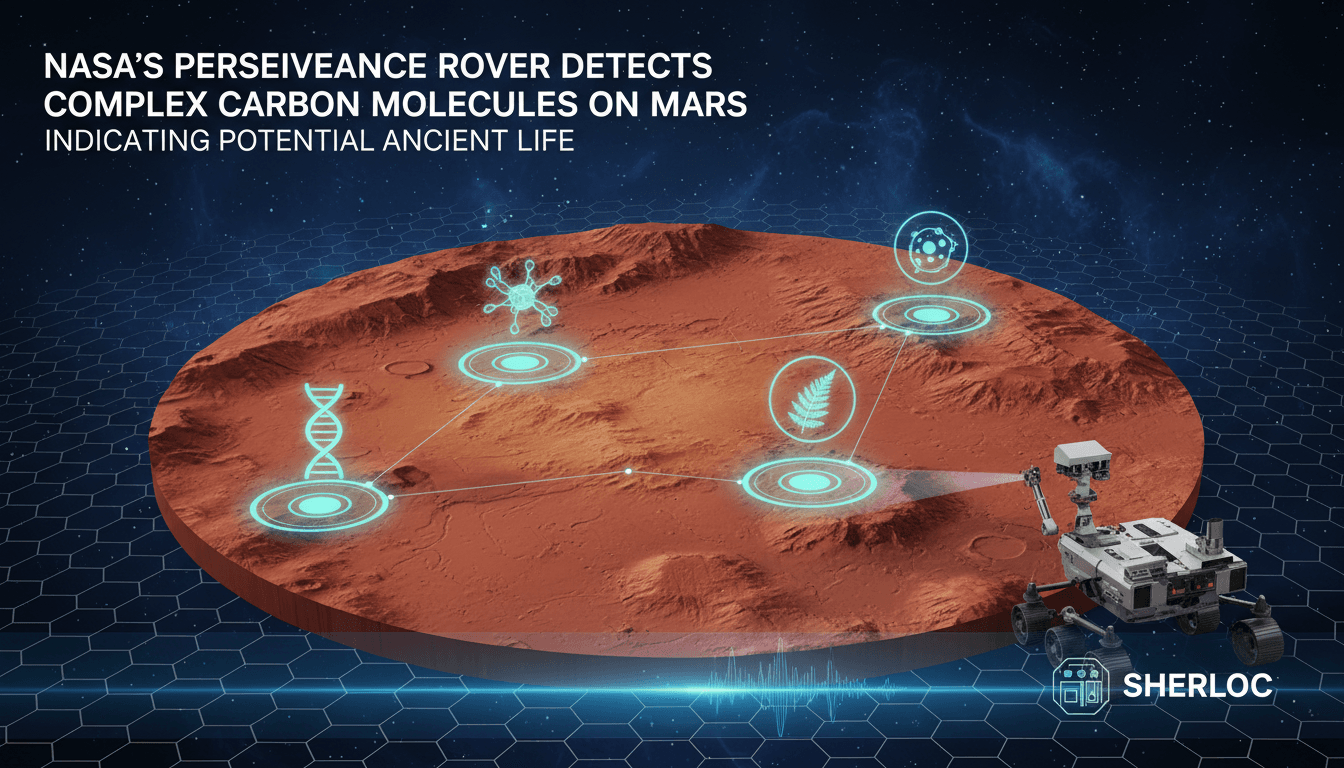
Here's what it means for you.
The recent discovery by NASA's Perseverance rover has significant implications for our understanding of Mars and the potential for ancient life. As scientists analyze the organic carbon detected in the Jezero crater, this could lead to a paradigm shift in how we view the planet's history and its capacity to support life. The findings may also influence future exploration missions, guiding where and how we search for signs of life beyond Earth. This discovery not only enhances our knowledge of Mars but also fuels public interest and investment in space exploration. As we uncover more about our neighboring planet, the implications for astrobiology and planetary science become increasingly profound.
What happened
NASA's Perseverance rover has made a groundbreaking discovery on Mars by identifying complex carbon molecules in mudstones located in the Jezero crater. This area is significant as it was once a river delta, suggesting it may have provided a suitable environment for life billions of years ago. The rover's advanced Sherloc instrument played a crucial role in detecting these organic compounds, marking the most robust organic detection in the Jezero crater to date.
The findings were reported on June 24, 2026, and indicate that the rover has detected hundreds of organic carbon molecules. This extensive detection highlights the potential for ancient microbial life on Mars, raising questions about the planet's past and its ability to support life.
The Context
The Jezero crater is a focal point for Mars exploration due to its history as a river delta, which could have created conditions conducive to life. The Sherloc instrument on the Perseverance rover is specifically designed to identify organic compounds and signs of past life, making this discovery particularly significant. As scientists continue to study the data collected, the implications of these findings could reshape our understanding of Mars' geological and biological history.
The timing of this discovery is critical as it aligns with ongoing efforts to explore Mars more thoroughly. Future missions may be influenced by these findings, directing attention to other regions of the planet that could harbor similar signs of life. The collaboration between various space agencies and research institutions underscores the importance of this research in the broader context of planetary exploration.
Takeaway
As further analysis of the detected organic compounds is conducted, scientists hope to gain deeper insights into the history of water on Mars and the potential for past life. This discovery opens new avenues for exploration, with upcoming missions likely to focus on other regions of Mars that may yield additional evidence of ancient life. The findings from the Perseverance rover could significantly impact our understanding of the planet's past environments and the conditions that may have supported life.
The ongoing research will not only enhance our knowledge of Mars but also inform future exploration strategies. As we continue to uncover the mysteries of the Red Planet, the potential for discovering life beyond Earth remains an exciting frontier.
Discoveries, research, environment, and health innovations.
"New Scientist is a well-respected publication offering accessible science news, commentary, and expert analysis."
— A47 Editor
Possible signs of ancient life on Mars are rich in complex carbon
NASA's Perseverance rover has identified large, complex carbon compounds on the surface of Martian rocks, alongside unusual patterns that may indicate traces of microbial activity, suggesting potential signs of ancient life on Mars. This discovery wa...
Space science news, astronomy updates, and spaceflight developments.
"Space.com delivers space science news, astronomy updates, and spaceflight developments with engaging coverage."
— A47 Editor
Did NASA just find evidence of ancient life on Mars? Perseverance rover spots complex carbon in Red Planet rocks
NASA's Perseverance rover has made a significant discovery on Mars, detecting complex organic carbon molecules in rocks within Jezero crater, which is considered the most robust organic detection in the area to date. This finding suggests the potenti...
Reports on science policy, discoveries, and public debate in the scientific realm.
"The Guardian’s science section is known for thoughtful and critical reporting on global research, ethics, and public understanding of science."
— A47 Editor
Nasa rover detects potential signatures of ancient microbial life on Mars
NASA's Perseverance rover has detected complex organic carbon molecules in rocks located in the Bright Angel outcrop of Neretva Vallis, a dried riverbed that once carried water into Mars' Jezero crater billions of years ago, indicating potential sign...
Top international stories selected by The Guardian editors.
"The Guardian is known for its progressive editorial stance and in-depth analysis."
— A47 Editor
Nasa rover detects potential signatures of ancient microbial life on Mars
NASA's Perseverance rover has detected complex organic carbon molecules in rocks located in the Bright Angel outcrop of Neretva Vallis, a dried riverbed that once carried water into Mars' Jezero crater billions of years ago, indicating potential sign...