
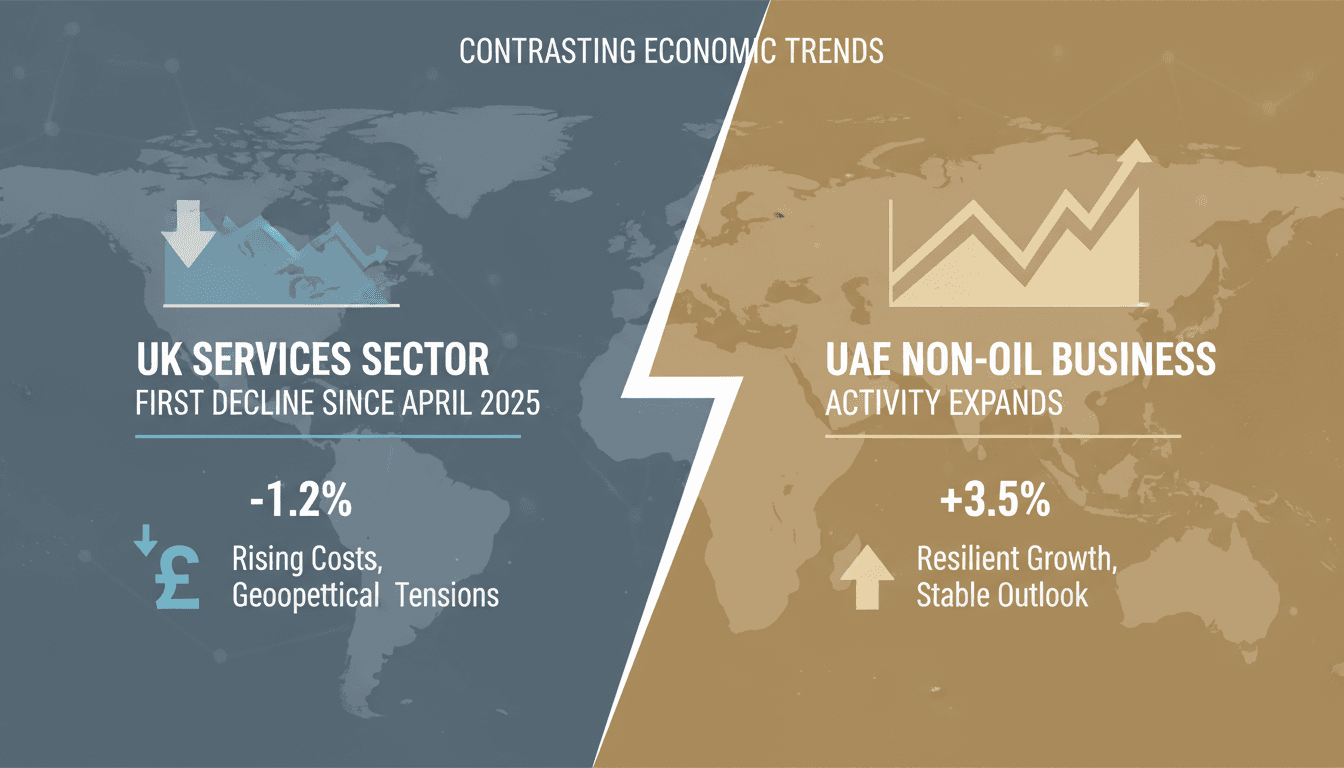
UK services sector experiences first decline since April 2025 while UAE non-oil business activity expands
Here's what it means for you.
The recent decline in the UK services sector signals potential economic challenges ahead, particularly as rising costs and geopolitical tensions weigh on business sentiment. For professionals and investors, this shift may prompt a reevaluation of strategies in the UK market. Conversely, the UAE's non-oil sector's growth suggests a more favorable environment, indicating opportunities for investment and expansion in that region. As the UK grapples with these economic pressures, stakeholders should closely monitor developments that could influence recovery or further decline. The contrasting performances of these two economies highlight the importance of regional stability in shaping market dynamics.
What happened
In May 2026, UK services firms reported their first decline in activity since April 2025, a significant shift attributed to rising costs and reduced optimism. This downturn reflects the ongoing pressures stemming from geopolitical tensions, particularly related to the Iran war. Meanwhile, the UAE's non-oil business activity expanded during the same month, showcasing resilience despite similar regional uncertainties.
The divergence in performance between the UK and UAE underscores the varying impacts of external factors on different economies. While the UK faces challenges, the UAE's growth in its non-oil sector suggests a more robust economic environment.
The Context
The decline in UK services activity is closely linked to increased operational costs and a general sense of pessimism among businesses. Geopolitical tensions, particularly those arising from the Iran war, have contributed to this economic strain. In contrast, the UAE's non-oil sector has demonstrated resilience, continuing to expand even amid the same regional instability.
This situation highlights the differing economic landscapes in the UK and UAE, where external factors can have contrasting effects. The ability of the UAE to maintain growth in its non-oil sectors may provide a buffer against the challenges faced by the UK.
Takeaway
Looking ahead, it will be crucial to monitor further economic indicators from both the UK and UAE to gauge signs of recovery or continued decline. Stakeholders should pay attention to developments in the Iran war, as these could significantly impact regional economies. The contrasting economic performances suggest that while the UK may struggle, the UAE could continue to thrive if external conditions remain favorable.
As geopolitical tensions persist, the outlook for the UK may remain uncertain, while the UAE's non-oil sector could sustain its growth trajectory. This divergence emphasizes the need for strategic planning in response to evolving economic conditions.
Key macro releases (CPI, jobs, PMIs), surprise indexes, and market implications.
"Great for data-print awareness and instant read-through to rates and risk assets."
— A47 Editor
UK services firms post first drop in activity since April 2025 as Iran war price pressure persists
UK services firms have reported their first decline in activity since April 2025, attributed to ongoing price pressures stemming from the conflict in Iran. This downturn reflects the broader economic impact of geopolitical tensions that have been esc...
Pan-Arab news coverage spanning politics, business, sports, and regional affairs.
"Asharq Al-Awsat reflects a broad Arab editorial perspective with strong attention to regional geopolitics."
— A47 Editor
تراجع نشاط قطاع الخدمات البريطاني في مايو مع استمرار تداعيات الحرب الإيرانية
A recent survey revealed that service sector activity in the UK declined in May, attributed to rising costs and a decrease in optimism amid the ongoing repercussions of the Iranian war.
UAE-based English-language newspaper covering regional politics, economics, and global affairs.
"The National reflects Emirati policy perspectives while maintaining international editorial standards."
— A47 Editor
UAE non-oil business activity expands in May despite Iran war uncertainty
Non-oil business activity in the UAE expanded in May 2026, despite ongoing uncertainties stemming from the regional conflict involving Iran. This growth indicates resilience in the UAE's economy amid geopolitical tensions.