
Microsoft's Majorana 1 quantum chip claims challenged by Nature critique
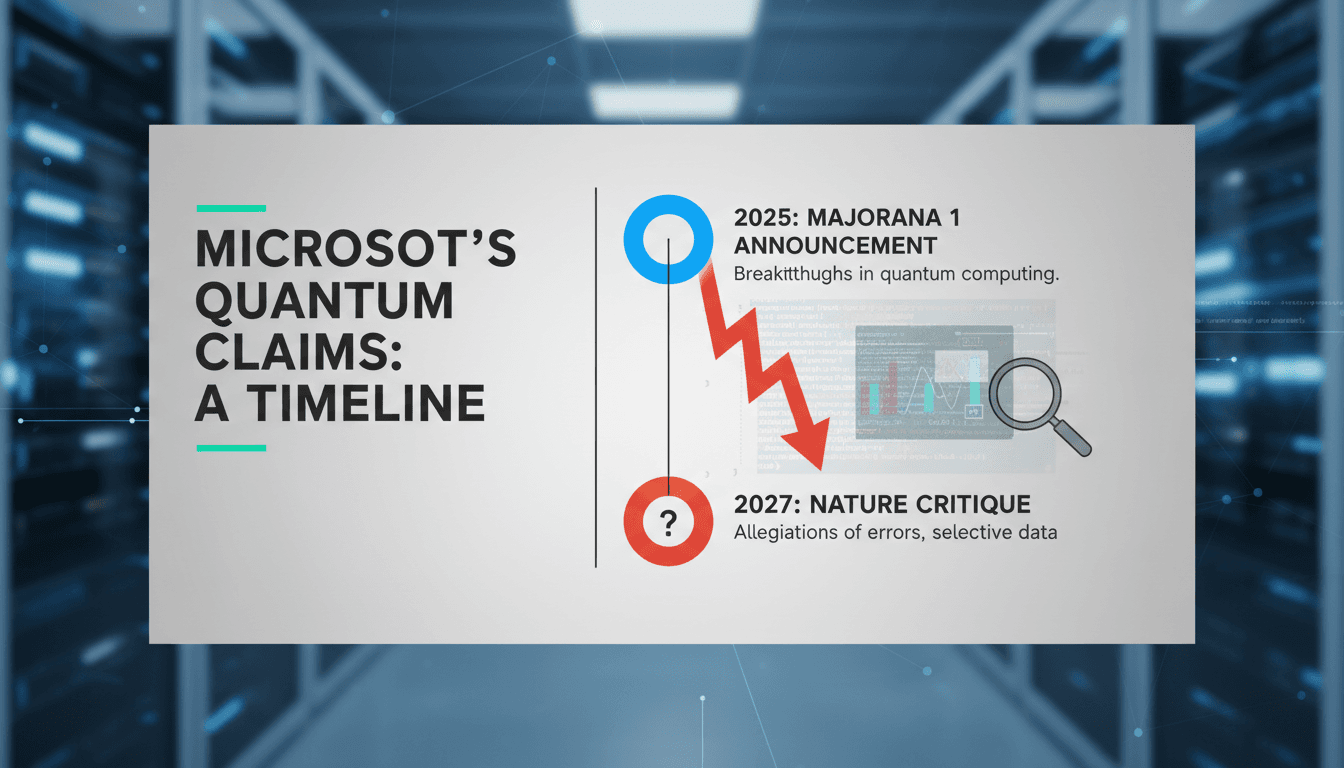
Here's what it means for you.
The recent critique of Microsoft's Majorana 1 quantum chip raises significant questions about the integrity of its quantum computing claims. As the technology sector increasingly relies on transparency and accuracy, this scrutiny could impact Microsoft's credibility and future innovations. Stakeholders in the quantum computing field will be watching closely to see how Microsoft responds to these allegations.
What happened
A peer-reviewed paper published in Nature has cast doubt on Microsoft's claims regarding its Majorana 1 quantum computing chip. The critique suggests that the technology may be based on flawed data and analysis, particularly highlighting basic errors in Python programming and selective data presentation. This has led experts to question the validity of Microsoft's assertions about its topological qubits, which were previously touted as revolutionary.
The Nature paper was published on June 24, 2026, following Microsoft's announcement of the Majorana 1 chip in February 2025. The timing of this critique is crucial, as it challenges the foundation of Microsoft's advancements in quantum technology. As scrutiny intensifies, the implications for Microsoft's reputation in the tech industry are significant.
The Context
Microsoft introduced the Majorana 1 chip with claims of utilizing topological qubits, a technology that was expected to revolutionize quantum computing. However, the recent Nature paper alleges that the research supporting these claims is flawed, raising concerns among experts in the field. The critique points to issues such as data cherry-picking and programming errors, which could undermine the credibility of Microsoft's technological advancements.
This situation places Microsoft at a crossroads, as it must navigate the fallout from these allegations while maintaining trust in its quantum computing initiatives. The scrutiny from the scientific community may prompt a reevaluation of the company's approach to transparency and data integrity. As the quantum computing landscape evolves, the stakes for Microsoft and its competitors are higher than ever.
Takeaway
The scrutiny of Microsoft's quantum claims could have lasting implications for its credibility and future developments in quantum computing. As investigations into the validity of such claims continue, the tech giant may need to respond transparently to restore confidence among stakeholders. Observers will be keen to see how Microsoft addresses these allegations and whether it can reaffirm its position in the competitive quantum landscape.
Looking ahead, further investigations into quantum computing claims by major tech companies are likely. The outcome of this situation may set a precedent for how similar allegations are handled in the industry, influencing public perception and policy regarding quantum technology.
Consumer tech and culture with frequent AI coverage.
"Influential tech outlet covering AI products and policy."
— A47 Editor
A new paper argues Microsoft exaggerated its quantum claims a year ago
A recent critique published in Nature questions Microsoft's claims regarding its Majorana 1 quantum computing chip, which was introduced in February 2025 as a revolutionary topological qubit technology. The paper suggests that the foundational techno...
Tech news, reviews, and analysis of consumer electronics, science, art, and culture.
"The Verge is a technology-focused media outlet known for in-depth reporting, product reviews, and coverage of the intersection between technology and culture."
— A47 Editor
A new paper argues Microsoft exaggerated its quantum claims a year ago
A recent critique published in Nature questions Microsoft's claims regarding its Majorana 1 quantum computing chip, which was introduced in February 2025 as a revolutionary topological qubit technology. The paper suggests that the foundational techno...
Curated tech headlines including AI stories.
"Influential aggregator surfacing the day’s top tech/AI links."
— A47 Editor
Nature publishes a peer-reviewed paper alleging that Microsoft's 2025 quantum breakthrough claims were based on "basic Python errors" and data cherry-picking (Thomas Claburn/The Register)
A peer-reviewed paper published in Nature has raised serious allegations against Microsoft's claims of a quantum computing breakthrough, asserting that these claims were based on fundamental Python errors and selective data usage. The critique highli...
Science and technology stories including AI.
"Longstanding science magazine with thoughtful AI coverage."
— A47 Editor
Top quantum computer expert claims Microsoft’s ‘topological qubit’ doesn’t hold up
A leading quantum computer expert has criticized Microsoft's claims regarding its topological qubit technology, suggesting that the company's assertions do not hold up under scrutiny. This skepticism comes amid Microsoft's ongoing promotion of its qu...
Scientific research, technology, environment, and society.
"Scientific American is one of the oldest and most authoritative science magazines, known for deep dives into science, technology, and society."
— A47 Editor
Top quantum computer expert claims Microsoft’s ‘topological qubit’ doesn’t hold up
A leading quantum computer expert has criticized Microsoft's claims regarding its topological qubit technology, suggesting that the company's assertions do not hold up under scrutiny. This skepticism comes amid Microsoft's ongoing promotion of its qu...