
NASA declares MAVEN spacecraft mission concluded after contact loss
Here's what it means for you.
The conclusion of the MAVEN mission marks a significant moment in the realm of space exploration, particularly regarding long-term missions to Mars. As NASA reflects on the challenges faced, this event may influence future mission designs and technology advancements aimed at enhancing spacecraft reliability. The loss of MAVEN serves as a reminder of the complexities involved in studying distant planets and the need for robust systems to mitigate potential failures. The MAVEN mission's end also highlights the importance of the data collected over its operational lifespan, which will continue to inform scientific understanding of Mars. This knowledge is crucial for planning future missions and ensuring that they are equipped to handle similar challenges.
What happened
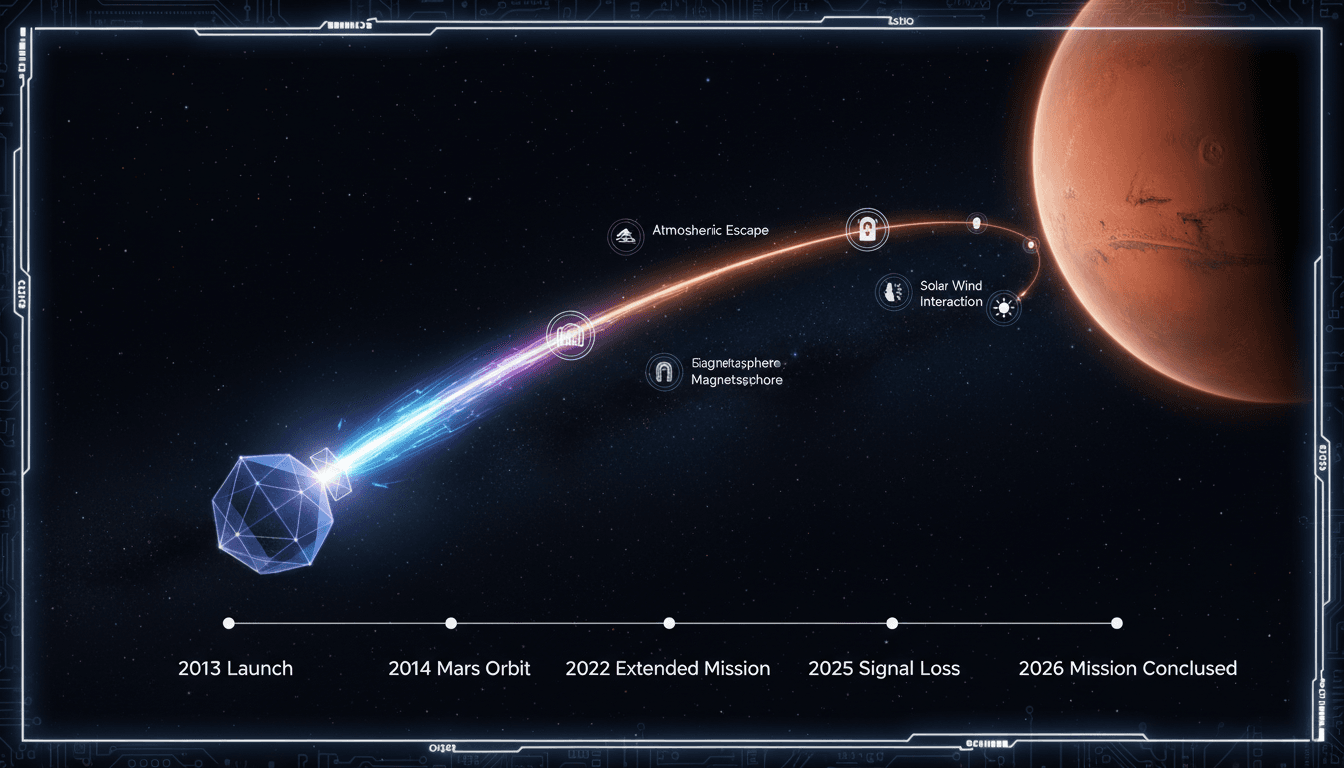
NASA has officially declared the MAVEN spacecraft dead after losing contact in December 2025. The spacecraft, which was launched in 2013, dedicated over a decade to studying Mars' atmosphere and climate. An anomaly affecting its rotation speed led to an unexpected loss of power, rendering the spacecraft unrecoverable.
The mission was concluded after extensive efforts to re-establish communication with MAVEN proved unsuccessful. NASA confirmed the spacecraft's status on June 3, 2026, marking the end of a significant chapter in Martian exploration.
The Context
MAVEN, which stands for Mars Atmosphere and Volatile Evolution, was launched to enhance our understanding of the Martian atmosphere. Over its 11 years of operation, the spacecraft provided invaluable data that has shaped current knowledge about Mars' climate and atmospheric conditions. The loss of contact underscores the inherent risks associated with long-duration space missions.
As NASA and other space agencies plan future Mars missions, the lessons learned from MAVEN's operational challenges will be critical. This incident serves as a pivotal moment for stakeholders involved in space exploration, emphasizing the need for advancements in spacecraft technology to prevent similar issues in the future.
Takeaway
The end of the MAVEN mission highlights the ongoing challenges of long-term space exploration. As NASA reflects on the mission's contributions, it will continue to build on the knowledge gained to inform future Mars exploration efforts. Upcoming missions will likely incorporate lessons learned from MAVEN to enhance the reliability and longevity of spacecraft.
Future Mars missions planned by NASA and other agencies will be closely watched, as they aim to push the boundaries of our understanding of the Red Planet. The advancements in spacecraft technology that emerge from this experience will be crucial in ensuring the success of these endeavors.
Business, investment, entrepreneurship, leadership, and innovation.
"Forbes is known for its coverage of business leaders, market trends, and entrepreneurial ventures with a pro-business editorial stance."
— A47 Editor
NASA Declares Mars Spacecraft Dead After It Spins Out Of Control
NASA has officially declared the MAVEN spacecraft dead after losing contact during its mission, which lasted 11 years and focused on exploring Mars' atmosphere and climate. This marks the end of a significant chapter in Mars exploration, as MAVEN con...
Conservative-leaning political and national coverage.
"The Washington Times is a conservative-leaning newspaper known for its political coverage and advocacy of right-of-center viewpoints."
— A47 Editor
MAVEN mission ends after more than a decade studying Martian atmosphere
NASA has announced that its MAVEN spacecraft, which launched in 2013 to study the Martian atmosphere, is now considered unrecoverable after more than a decade of operations. This decision follows a prolonged period of silence from the spacecraft, whi...
Scientific discoveries, health, technology, and natural phenomena.
"Live Science reports on scientific discoveries, health, technology, and natural phenomena with a popular science tone."
— A47 Editor
'In an unrecoverable state': NASA confirms MAVEN spacecraft is officially dead after loss of signal behind Mars
NASA has confirmed that its MAVEN spacecraft is officially dead after losing contact in December 2025. The loss of signal was attributed to an anomaly in the probe's rotation speed, which resulted in an unexpected power failure, although the precise ...