
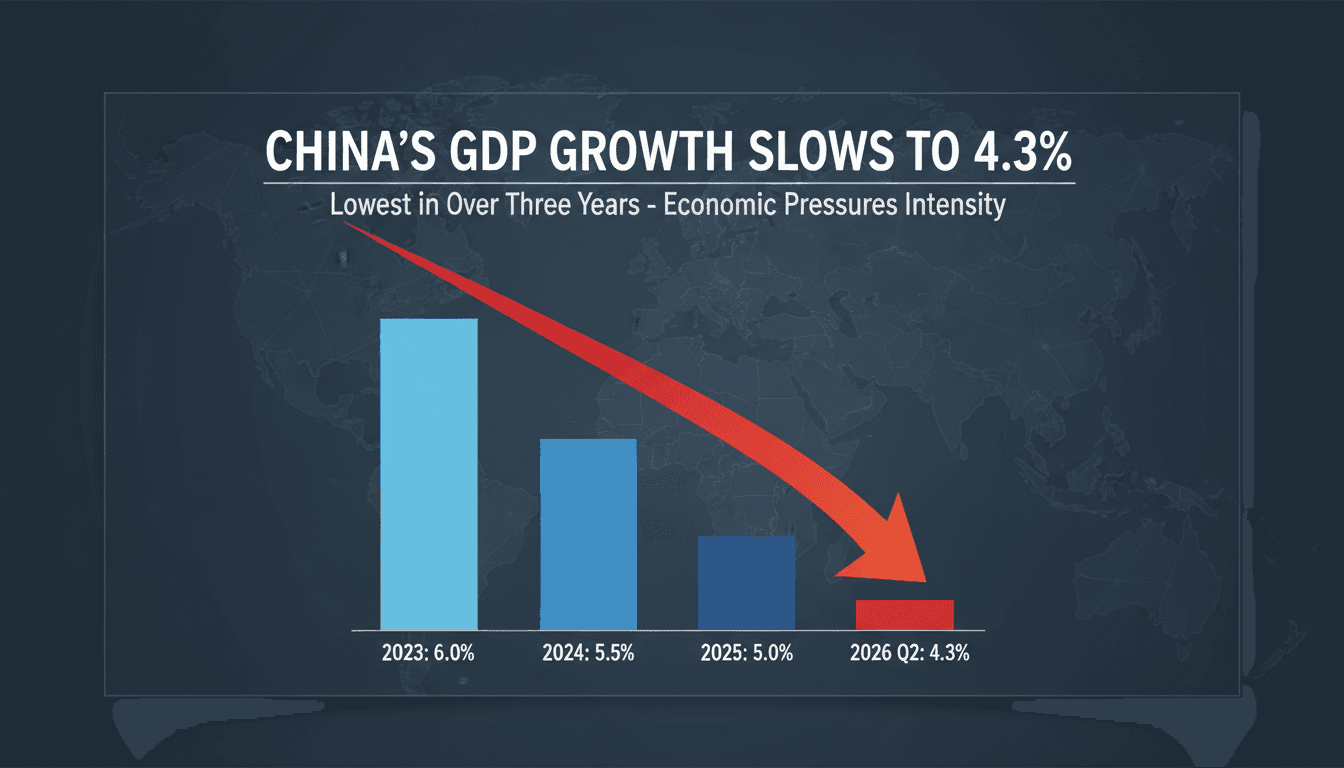
China's GDP growth slows to 4.3%, lowest in over three years
Here's what it means for you.
The recent decline in China's GDP growth to 4.3% signals significant economic challenges that could impact global markets. Investors and policymakers should closely monitor the situation as it may lead to shifts in economic strategies and trade dynamics. The slowdown raises concerns about domestic demand and structural imbalances, which could affect international trade relations and investment flows. As the Chinese government contemplates more aggressive policies to stimulate growth, the ripple effects could be felt across various sectors, particularly in export-driven economies. Stakeholders must remain vigilant as these developments unfold.
What happened
China's GDP growth for the second quarter of 2026 has been reported at 4.3%, a notable decrease from 5.0% in the previous quarter. This figure marks the lowest growth rate in over three years, reflecting a concerning trend in the country's economic performance. The decline is attributed to ongoing structural imbalances and weak domestic demand, despite some support from exports.
The economic indicators suggest increasing pressures on the economy, prompting discussions about the effectiveness of current policies. As the government evaluates its response, the implications of this slowdown could have far-reaching consequences.
The Context
The latest GDP figures highlight significant challenges facing China's economy, particularly as the growth rate falls to the low end of the government's annual target range. Structural imbalances complicate the policy responses needed to address these issues, making it difficult for the government to stimulate growth effectively.
Weak domestic demand has emerged as a critical factor contributing to the economic slowdown, raising questions about consumer confidence and spending patterns. As the world's second-largest economy, China's performance is closely watched by global markets, making these developments particularly relevant for international stakeholders.
Takeaway
Looking ahead, the Chinese government may need to implement more aggressive policies to stimulate growth amid these economic challenges. Potential policy changes could focus on addressing the structural imbalances and enhancing domestic demand to foster a more resilient economy.
Additionally, the impact of global economic conditions on China's export performance will be crucial to monitor, as it could influence the overall recovery trajectory. Stakeholders should remain attentive to forthcoming announcements and economic indicators that may signal shifts in China's economic strategy.
Macro commentary, policy analysis, growth/inflation themes, and global outlooks.
"Contextual macro coverage that complements day-to-day market headlines."
— A47 Editor
China’s Q2 GDP growth cools to 3-1/2-year low, structural imbalances complicate policy
China's GDP growth for the second quarter has fallen to its lowest level in three and a half years, reflecting significant structural imbalances within the economy. This downturn is attributed to weak domestic demand, declining retail sales, and fall...
Social/economic commentary and analysis relevant to business and markets.
"WSJ blends data-driven economic insight with commentary on policy and society."
— A47 Editor
China’s economic growth cooled more than expected in the second quarter of the year despite robust exports, as local governments and households pulled back spending
China's economy expanded by 4.3% in the second quarter of 2026, a decline from 5.0% in the previous quarter, indicating a cooling growth rate that was more significant than anticipated. This slowdown raises concerns about the sustainability of China'...
Global political, business, and cultural coverage from WSJ international desks.
"The Wall Street Journal offers extensive international reporting with a reputation for financial insight and a center-right editorial stance."
— A47 Editor
China’s Growth Cools More Than Expected in Second Quarter
China's economy expanded by 4.3% in the second quarter of 2026, a decline from 5.0% in the previous quarter, indicating a cooling growth rate that was more significant than anticipated. This slowdown raises concerns about the sustainability of China'...
Editor-curated FT homepage stories spanning markets, business, world, and opinion.
"The Financial Times is a globally respected business publication with a centrist/center-left tone and strong markets focus."
— A47 Editor
China reports lowest GDP growth in more than 3 years
China has reported its lowest GDP growth in over three years, with the second-quarter figure falling at the low end of its annual target range. This decline is attributed to ongoing economic pressures, including weak domestic demand and declining ret...
Macro commentary, policy analysis, growth/inflation themes, and global outlooks.
"Contextual macro coverage that complements day-to-day market headlines."
— A47 Editor
China’s second-quarter economic growth misses market forecast
China's economic growth for the second quarter of 2026 has fallen short of market expectations, reflecting ongoing challenges in the domestic economy. The growth rate was lower than anticipated, indicating a potential slowdown in economic activity.
Key macro releases (CPI, jobs, PMIs), surprise indexes, and market implications.
"Great for data-print awareness and instant read-through to rates and risk assets."
— A47 Editor
China Q2 GDP disappoints as sluggish domestic demand offsets exports boost
China's GDP growth for the second quarter of 2026 has disappointed, falling to its lowest level in over three years, primarily due to sluggish domestic demand that offset a boost from exports. The growth rate was lower than market expectations, highl...