
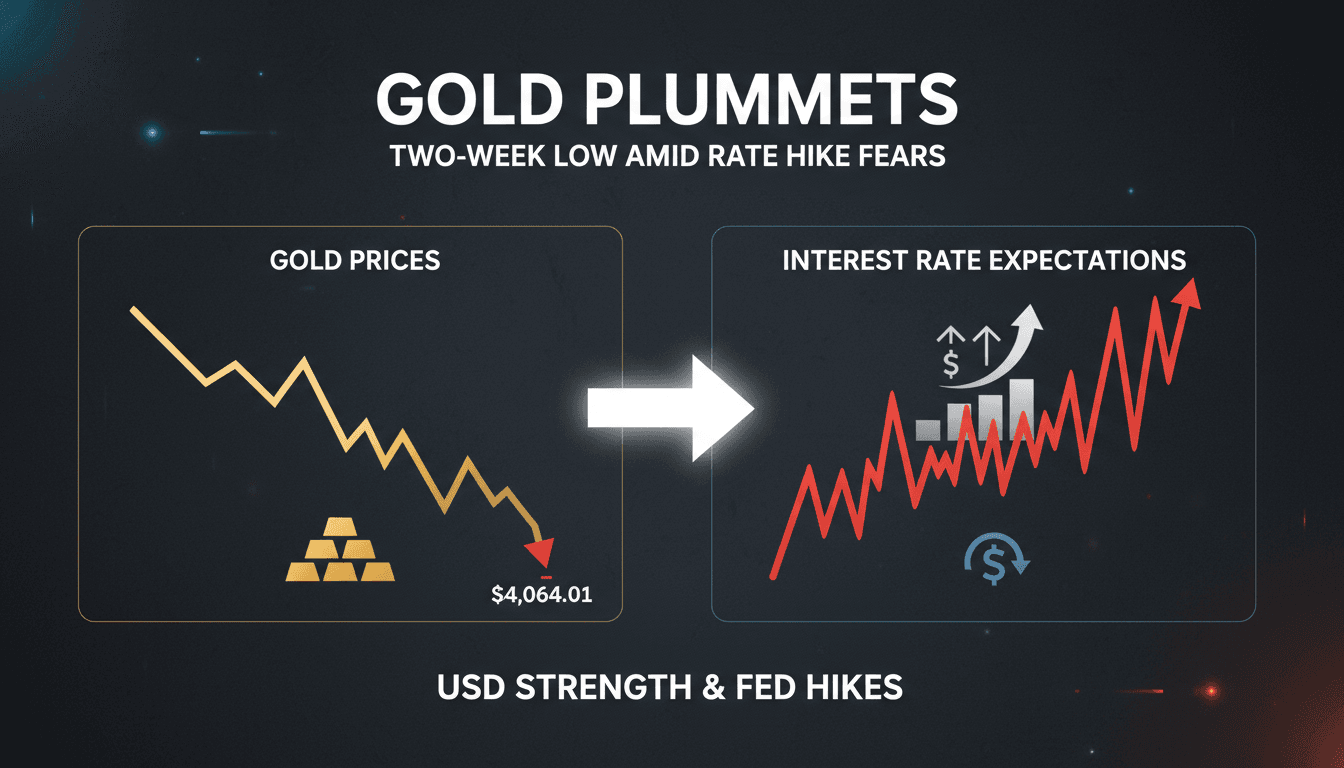
Gold prices hit two-week low amid rising interest rate expectations
Here's what it means for you.
The recent decline in gold prices signals a shift in market dynamics, primarily influenced by a stronger dollar and anticipated interest rate hikes by the U.S. Federal Reserve. Investors may need to reassess their strategies as gold's traditional role as a safe haven is challenged. With inflation concerns lingering, the outlook for gold remains uncertain, potentially impacting portfolios reliant on precious metals.
What happened
Gold prices have fallen significantly, reaching a two-week low with spot gold dropping to $4,064.01 per ounce. This decline is attributed to a strengthening dollar, which has made gold less appealing as a non-yielding asset. Additionally, traders are now anticipating three interest rate hikes from the U.S. Federal Reserve this year, further pressuring gold prices.
The current spot price reflects a notable market reaction to economic signals, with gold having fallen approximately 23% since the onset of the U.S.-Israeli war on Iran in late February. U.S. gold futures for August delivery also declined, falling 1.7% to $4,080.80, while spot silver dropped 1.6% to $61 per ounce.
The Context
The dollar has reached a more than one-year high, impacting gold's attractiveness to investors. As the Federal Reserve signals potential interest rate hikes, market participants are closely monitoring these developments. The ongoing geopolitical tensions, particularly regarding U.S.-Iran relations, add another layer of complexity to the situation.
Gold has historically served as a hedge against inflation and economic uncertainty, but rising interest rates challenge this role. The interplay between these factors is crucial for understanding the current volatility in gold prices and the broader market implications.
Takeaway
Looking ahead, the outlook for gold remains uncertain as inflation concerns persist and economic indicators are closely watched. The upcoming U.S. Personal Consumption Expenditures data release will provide insights into inflation trends, which could further influence gold prices. Additionally, developments in U.S.-Iran negotiations may impact market stability and investor sentiment.
If gold prices continue to drop below key levels, further declines could be anticipated. Market participants should remain vigilant as these dynamics unfold.
Oil, metals, and agriculture: supply/demand headlines, OPEC chatter, inventories, and price action.
"Solid tape for energy and metals traders tracking macro and micro catalysts."
— A47 Editor
Gold slides, with spot prices under $4,000/oz for the first time since November
Gold prices have fallen below $4,000 per ounce for the first time since November, reflecting a significant decline in the precious metals market. This drop is attributed to a stronger U.S. dollar and the Federal Reserve's hawkish signals regarding po...
Business, markets, economy, and corporate news with strong UAE and regional relevance.
"Emirates 24|7 business coverage tends to center UAE markets, property, regulation, and regional economic developments."
— A47 Editor
Gold slips to two-week low as Fed rate-hike bets buoy dollar
Gold prices have fallen to a two-week low, with spot gold dropping 1.1% to $4,064.01 per ounce as the U.S. dollar strengthens amid rising expectations of interest rate hikes by the Federal Reserve. This decline follows conflicting reports regarding U...
Regional and international reporting focused on Middle Eastern politics, diplomacy, and economics.
"Asharq Al-Awsat is a Saudi-owned international newspaper reflecting mainstream Gulf political perspectives."
— A47 Editor
Gold Slips Over 2% as Dollar Holds Firm on Fed Rate-hike Expectations
Gold prices have slipped over 2% as the U.S. dollar remains strong amid rising expectations for interest rate hikes by the Federal Reserve. This decline reflects ongoing pressures on gold, which has seen significant fluctuations in recent weeks.