
EU AI Act's Transparency Rules Now Enforceable Across Member States
What happened
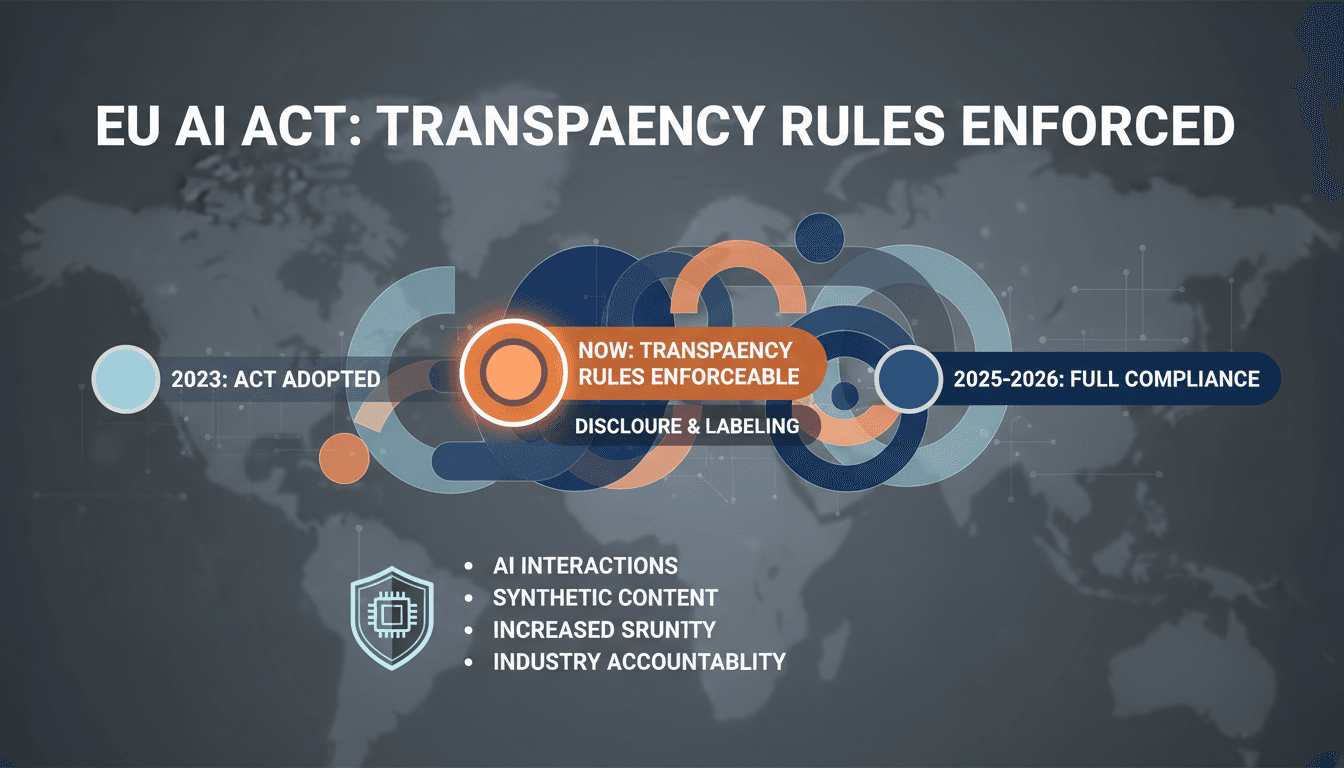
The European Union has officially begun enforcing new AI transparency rules as part of the AI Act, which took effect on August 2, 2026. These regulations require companies to disclose when users are interacting with AI systems and to label synthetic content accordingly. This enforcement is a significant step in the phased rollout of the AI Act, which aims to enhance transparency and accountability in AI technologies.
With the recent implementation of these rules, companies across the bloc must navigate a complex landscape of compliance requirements. The urgency for organizations to align their practices with regulatory expectations has never been greater, as failure to comply could lead to penalties and enforcement actions.
The Context
The EU AI Act represents a comprehensive effort to regulate artificial intelligence, focusing on transparency and accountability. The Act's phased implementation began with initial rules taking effect on February 2, 2025, and obligations for general-purpose AI models starting on August 2, 2025. The recent enforcement of transparency rules signifies a critical juncture for stakeholders, including AI vendors and users alike.
As the landscape of AI technologies continues to evolve, the importance of these regulations cannot be overstated. Companies must now prioritize ethical practices and transparency in their AI deployments to maintain user trust and comply with the new legal framework.
Takeaway
Looking ahead, companies must closely monitor their compliance strategies as high-risk obligations are set to approach in the coming years. The ongoing implementation of the EU AI Act is likely to lead to increased scrutiny of AI technologies, pushing organizations to adapt swiftly to regulatory changes.
As enforcement actions and penalties for non-compliance become more prevalent, businesses that proactively embrace transparency will be better positioned to thrive in this new regulatory environment.
Community posts including AI/ML tutorials and news.
"Open platform where developers share AI learnings."
— A47 Editor
EU AI Act Timeline: What AI Vendors and Developers Must Track Through 2026
The European Union's AI Act is being implemented in stages, with the first rules taking effect on February 2, 2025, and significant governance provisions for general-purpose AI models commencing on August 2, 2025. The next major milestone is set for ...
Arabic tech reporting on products, startups, and digital trends.
"Unlimit-Tech is an Arabic tech site covering gadgets and digital news."
— A47 Editor
المفوضية الأوروبية تبدأ تطبيق قواعد الشفافية الجديدة على أنظمة الذكاء الاصطناعي
The European Commission has begun implementing new transparency rules for artificial intelligence systems, as mandated by the European AI Act established in 2024, which includes significant penalties for non-compliance. These regulations require comp...
Community posts including AI/ML tutorials and news.
"Open platform where developers share AI learnings."
— A47 Editor
The EU AI Act started applying to your chatbot two days ago
The EU AI Act officially came into effect on August 2, 2026, imposing immediate transparency obligations on chatbots and other AI-generated content targeting EU users. This regulation mandates compliance with Article 50, which outlines specific dutie...
Consumer tech and culture with frequent AI coverage.
"Influential tech outlet covering AI products and policy."
— A47 Editor
Europe’s AI labeling and transparency rules are now in effect
The European Union has implemented new rules under its AI Act, effective August 2nd, aimed at enhancing transparency regarding AI interactions, including chatbots and deepfakes. Companies are now required to disclose when users are engaging with AI t...
Tech news, reviews, and analysis of consumer electronics, science, art, and culture.
"The Verge is a technology-focused media outlet known for in-depth reporting, product reviews, and coverage of the intersection between technology and culture."
— A47 Editor
Europe’s AI labeling and transparency rules are now in effect
The European Union has implemented new rules under its AI Act, effective August 2nd, aimed at enhancing transparency regarding AI interactions, including chatbots and deepfakes. Companies are now required to disclose when users are engaging with AI t...
Consumer technology news with AI coverage.
"Gadget and tech site reporting on AI in products."
— A47 Editor
EU announces new rules on AI transparency
The European Union has announced the enforcement of new artificial intelligence (AI) rules across its member states, aiming to enhance transparency and accountability in AI technologies. This initiative reflects the EU's commitment to regulating AI i...
Covers consumer technology, electronics, gadgets, and product reviews.
"Engadget is a trusted source for gadget reviews and consumer tech news, known for its hands-on analysis and industry coverage."
— A47 Editor
EU announces new rules on AI transparency
The European Union has announced the enforcement of new artificial intelligence (AI) rules across its member states, aiming to enhance transparency and accountability in AI technologies. This initiative reflects the EU's commitment to regulating AI i...
Policy and strategy for digital leaders, including AI.
"Analyzes AI in the context of enterprise strategy."
— A47 Editor
EC begins enforcement of AI Act transparency rules
The European Commission's AI Office has initiated the enforcement of transparency rules under the AI Act, marking a significant step in regulating artificial intelligence within the EU. This enforcement allows for greater oversight and accountability...